
Penny Dreadfuls, 1867 · page 155 of 196
The Skeleton Crew; Or, Wildfire Ned — page 155: what you’re looking at
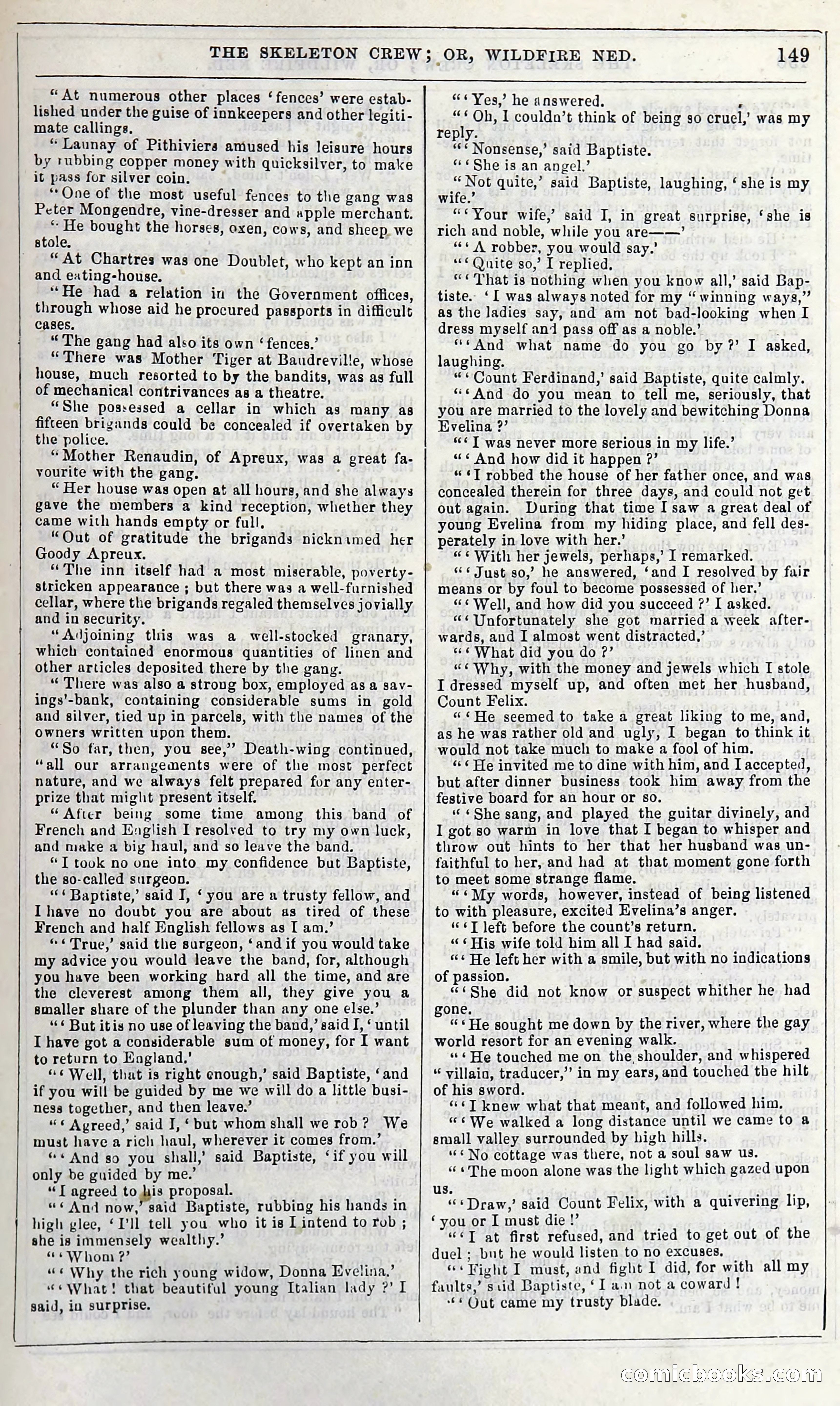
A restored page from Penny Dreadfuls, 1867. Page through the whole issue in the reader above.
📄 Transcribed text from this page (OCR, searchable)
Machine-transcribed from the original scan — historical spelling and the odd misread are preserved.
SS ES Se a ee THE SKELETON CREW; OR, WILDFIRE NED. 149 ee ee “At numerous other places ‘fences’ were estab- lished under the guise of innkeepers and other legiti- mate callings, “Launay of Pithiviers amused his leisure hours by rubbing copper money with quicksilver, to make it pass for silver coin. “One of the most useful fences to the gang was Peter Mongendre, vine-dresser and apple merchant. rs He bought the horses, oxen, cows, and sheep we stole, “At Chartres was one Doublet, who kept an inn and eating-house. “He had a relation in the Government offices, through whose aid he procured passports in difficult cases. “The gang had also its own ‘ fences.’ “There was Mother Tiger at Baudreville, whose house, much resorted to by the bandits, was as full of mechanical contrivances as a theatre. “She possessed a cellar in which as many as fifteen brigands could be concealed if overtaken by the police. “Mother Renaudin, of Apreux, was a great fa- vourite with the gang, “ Her house was open at all hours, and she always gave the members a kind reception, whether they came with hands empty or full, “Out of gratitude the brigands nicknimed her Goody Apreux. “The inn itself had a most miserable, poverty- stricken appearance ; but there was a well-furnished cellar, where the brigands regaled themselves jovially and in security. “Adjoining this was a well-stocked granary, which contained enormous quantities of linen and other articles deposited there by the gang. “There was also a stroug box, employed asa sav- ings’-bank, containing considerable sums in gold and silver, tied up in parcels, with the names of the Owners written upon them. “So far, then, you see,” Death-wing continued, “all our arrangements were of the most perfect nature, and we always felt prepared for any enter- prize that might present itself. “After being some time among this band of French and English I resolved to try my own luck, and make a big haul, and so leave the band. “T took no one into my confidence but Baptiste, the so-called surgeon. “¢ Baptiste,’ said I, ‘ you are a trusty fellow, and Ihave no doubt you are about as tired of these French and half English fellows as I am.’ “<« True,’ said the surgeon, ‘and if you would take my advice you would leave the band, for, although you have been working hard all the time, and are the cleverest among them all, they give you a smaller share of the plunder than any one else.’ ‘“‘¢ But itis no use of leaving the band,’ said I, ‘ until I have got a considerable sum of money, for I want to return to England.’ “¢ Well, that is right enough,’ said Baptiste, ‘and if you will be guided by me we will do a little busi- ness together, and then leave.’ “¢ Avreed,’ said J, ‘but whom shall we rob? We must have a rich haul, wherever it comes from.’ “« And so you shall,’ said Baptiste, ‘if you will only be guided by me.’ “T agreed to his proposal. “¢ And now,’ said Baptiste, rubbing his hands in high glee, ‘Ill tell you who it is I intend to rob ; she is immensely wealthy.’ “6 Whom ?’ ““¢ Why the rich young widow, Donna Evelina,’ “What! that beautiful young Italian lady ?’ I said, in surprise. “¢ Yes,’ he answered. F “¢ Oh, I couldn’t think of being so cruel,’ was my reply. ““* Nonsense,’ said Baptiste. **« She is an angel.’ ie Not quite,’ said Baptiste, laughing, ‘ she is my wife.’ “¢Your wife,’ said I, in great surprise, ‘she is rich and noble, while you are——’ ‘“** A robber, you would say.’ “Quite so,’ I replied, “«That is nothing when you know all,’ said Bap- tiste. ‘I was always noted for my “winning ways,” as the ladies say, and am not bad-looking when I dress myself and pass off as a noble.’ “*And what name do you go by?’ I asked, laughing. “* Count Ferdinand,’ said Baptiste, quite calmly. *¢ And do you mean to tell me, seriously, that you are married to the lovely and bewitching Donna Evelina ?’ “‘¢ T wag never more Serious in my life.’ ““¢ And how did it happen ?’ “¢T robbed the house of her father once, and was concealed therein for three days, and could not get out again. During that time I saw a great deal of young Evelina from my hiding place, and fell des- perately in love with her.’ «¢ With her jewels, perhaps,’ I remarked. “¢ Just so,’ he answered, ‘and I resolved by fair means or by foul to become possessed of her.’ ““¢ Well, and how did you succeed ?’ I asked. “¢ Unfortunately she got married a week after- wards, aud I almost went distracted,’ ‘¢¢ What did you do ?’ “¢ Why, with the money and jewels which [I stole I dressed myself up, and often met her husband, Count Felix. “¢He seemed to take a great liking to me, and, as he was rather old and ugly, I began to think it would not take much to make a fool of him. «‘¢ He invited me to dine with him, and I accepted, but after dinner business took him away from the festive board for an hour or so. « ¢She sang, and played the guitar divinely, and I got so warm in love that I began to whisper and throw out hints to her that her husband was un- faithful to her, and had at that moment gone forth to meet some strange flame. ““<My words, however, instead of being listened to with pleasure, excited Evelina’s anger. ““¢T left before the count’s return. ““¢ His wife told him all I had said. “+ He left her with a smile, but with no indications of passion. “‘She did not know or suspect whither he had one. a ‘He sought me down by the river, where the gay world resort for an evening walk. ‘““* He touched me on the shoulder, and whispered “ villain, traducer,” in my ears, and touched the hilt of his sword. “¢]T knew what that meant, and followed him. «“¢ We walked a long distance until we came to a small valley surrounded by high hills. “¢ No cottage was there, not a soul saw us. “The moon alone was the light which gazed upon us. “*Draw,’ said Count Felix, with a quivering lip, ‘you or I must die !’ “¢T at first refused, and tried to get out of the duel ; but he would listen to no excuses, «Wight I must, and fight I did, for with all my faults,’ s.id Baptiste, ‘I a. not a coward ! ‘* Out came my trusty blade. -ONnnicloooks. conn