
Penny Dreadfuls, 1867 · page 161 of 196
The Skeleton Crew; Or, Wildfire Ned — page 161: what you’re looking at
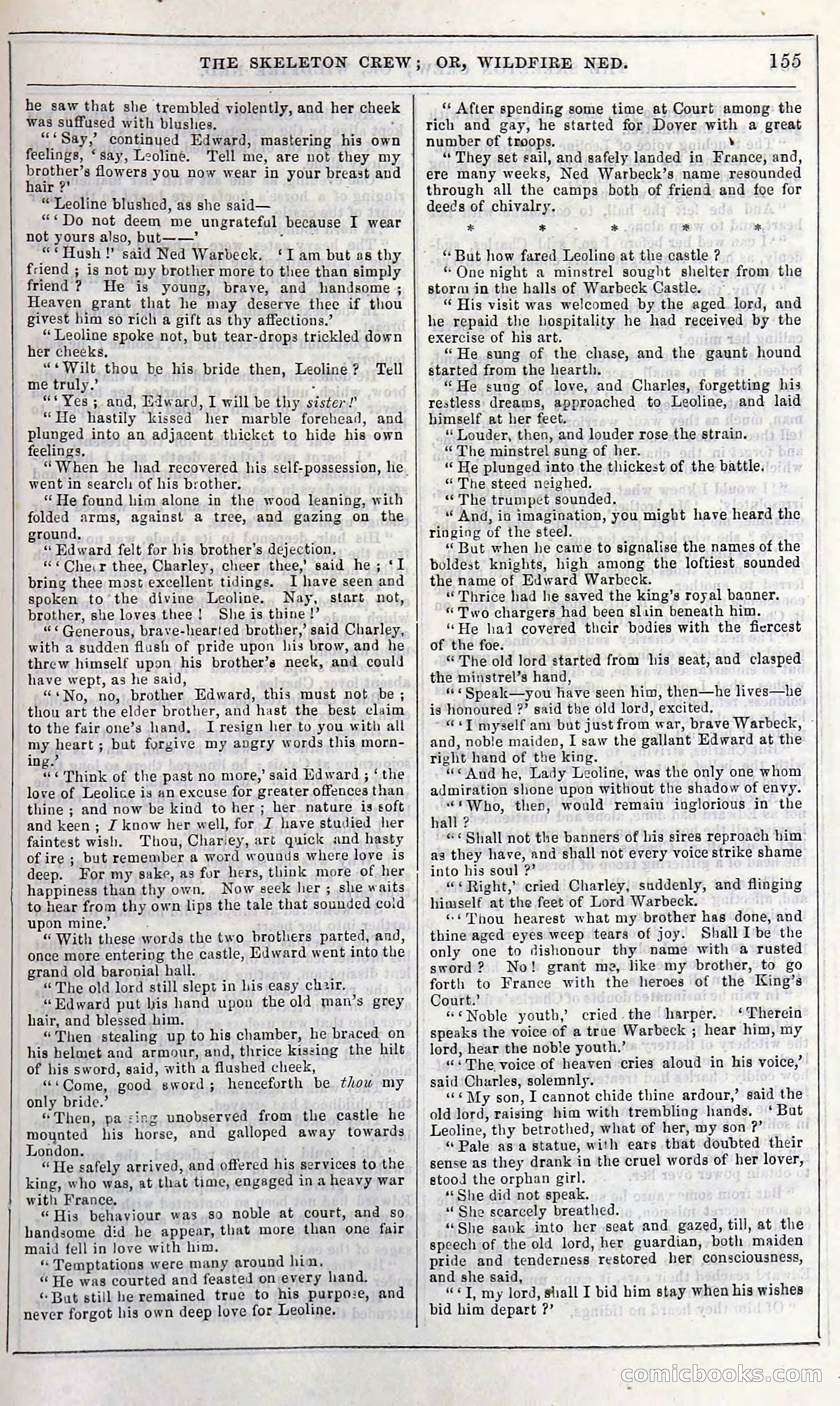
A restored page from Penny Dreadfuls, 1867. Page through the whole issue in the reader above.
📄 Transcribed text from this page (OCR, searchable)
Machine-transcribed from the original scan — historical spelling and the odd misread are preserved.
THE SKELETON CREW; OR, WILDFIRE NED. Sia eee ass ss... rt 155 he saw that she trembled alent and her cheek was suffused with blushes. “*Say,’ continued Edward, mastering his own feelings, ‘say, Leoline. Tell me, are not they my ies s flowers you now wear in your breast and air ?’ “Leoline blushed, as she said— “<Do not deem me ungrateful because I wear not yours also, but——’ ¢ Hush ! said Ned Warbeck. ‘Iam but as thy friend ; is not my brother more to thee than simply friend? He is young, brave, and handsome ; Heaven grant that he may deserve thee if thou givest him so rich a gift as thy affections.’ “ Leoline spoke not, but tear-drops trickled down her cheeks. “«Wilt thou be his. bride then, Leoline? Tell me truly.’ “* Yes ; and, Edward, I will be thy fxg) P “He hastily kissed ‘her marble forehead, and plunged into an adjacent thicket to hide his own feelings, “When he had recovered his self-possession, he. went in search: of his brother. “He found him alone in the wood leaning, with folded arms, against a tree, and gazing on the ground, “ Edward felt for his brother’s dejection. «“« Che:r thee, Charley, cheer thee,’ said he; ‘I bring thee most excellent tidings. I ‘have seen and spoken to the divine Leoline. Nay, start not, brother, she loves thee! She is thine!’ wee Generous, brave-hearted brother,’ said Charley, with a sudden flush of pride upon his brow, and he threw himself upon his brother’s neck, and could have wept, as he said, 5 No, ..00; brother Edward, this must not. be ; thou art the elder brother, and hast the best claim to the fair one’s hand, I resign her to you with all my heart ; but forgive my avgry words this morn- ing.’ “¢ Think of the past no more,’ said Edward ; ‘ the love of Leolice is an excuse for greater offences than thine ; and now be kind to her ; her nature is soft and keen; 7 know her well, for Z have studied her faintest wish. Thou, Chariey, art quick and hasty of ire ; but remember a word wounds where love is deep. For my sake, as for hers, think more of her happiness than thy own. Now seek her ; she waits to hear from thy own lips the tale that sounded cold upon mine,’ “ With these words the two brothers parted, and, once more entering the castle, Edward went into the grand old baronial hall. “The old lord still slept in his easy chzir. “Edward put bis hand upon the old man’s grey hair, and blessed him. “Then stealing up to his chamber, he braced on his helmet and armour, and, thrice kissing the hilt of his sword, said, with a flushed cheek, seat Come, good sword; henceforth be thow my only bride.’ “Then, pa sing unobserved from the castle he mounted his horse, and galloped away towards London. “He safely arrived, and offered his services to the king, who was, at that time, engaged ina heavy war with France, “His behaviour was so noble at court, and so handsome did be appear, that more than one fair maid fell in Jove with him. “ Temptations were many around hin, “ He was courted and feasted on every hand, “ But still he remained true to his purpo:e, and never forgot his own deep love for Leoline. ‘‘ After spending some time at Court among: the rich and gay, he started for Dover with a great number of troops. ’ “They set sail, and safely landed in France, and, ere many weeks, Ned Warbeck’s name resounded through all the camps both of friend and foe for deeds of chivalry, * * . * *% * ‘But how fared Leoline at the castle ? “One night a minstrel sought shelter from the storm in the halls of Warbeck Castle. “ His visit was welcomed by the aged lord, and he repaid the hospitality he had received by the exercise of his art. “ He sung of the chase, and the gaunt hound started from the hearth. “He sung of love, and Charles, forgetting his restless dreams, approached to Leoline, and laid himself at her feet. ‘“ Louder, then, and louder rose the strain. “ The minstrel sung of her. “He plunged into the thickest of the battle. “The steed neighed. “The trumpet sounded. “ And, in imagination, you might have heard the ringing of the steel. ‘But when he came to signalise the names of the boldest knights, high among the loftiest sounded the name of Edward Warbceck. “Thrice had he saved the king’s royal banner. “Two chargers had been slain beneath him. “He had covered their bodies with the fiercest of the foe. “The old lord started from his seat, and clasped the minstrel’s hand, * « Speak—you have seen him, then—he lives—he is honoured ?’ said the old lord, excited. “*T myself am but just from. war, brave Warbeck, and, noble maiden, I saw the gallant Edward at the right hand of the king. «And he, Lady Leoline, was the only one whom admiration shone upon without the shadow of envy. “*Who, then, would remain inglorious in the hall ? «“¢ Shall not the banners of his sires reproach him as they have, and shall not every voice strike shame into his soul ?’ “¢ Right,’ cried Charley, suddenly, and flinging himself at the feet of Lord Warbeck. ‘Thou hearest what my brother has done, and thine aged eyes weep tears of joy. Shall I be the only one to dishonour thy name with a rusted sword? No! grant me, like my brother, to go forth to France with the heroes of the King’s Court.’ **¢ Noble youth,’ speaks the voice of a true Warbeck ; lord, hear the noble youth.’ “<The voice of heaven cries aloud in his voice,’ said Charles, solemnly. ““¢ My son, I cannot chide thine ardour,’ said the old lord, raising him with trembling hands. ‘ But Leoline, thy betrothed, what of her, my son ?’ “Pale as a statue, with ears that doubted their sense as they drank in the cruel words of her lover, stood the orphan girl. ‘«She did not speak. “She scarcely breathed. ‘‘She sank into her seat and gazed, till, at the speech of the old lord, her guardian, both ‘maiden pride and tenderness restored her consciousness, and she said, cOSH omy lord, shall I bid him stay when his wishes bid him depart ?’ cried the harper. ‘Therein hear him, my En oles comm