
Penny Dreadfuls, 1867 · page 187 of 196
The Skeleton Crew; Or, Wildfire Ned — page 187: what you’re looking at
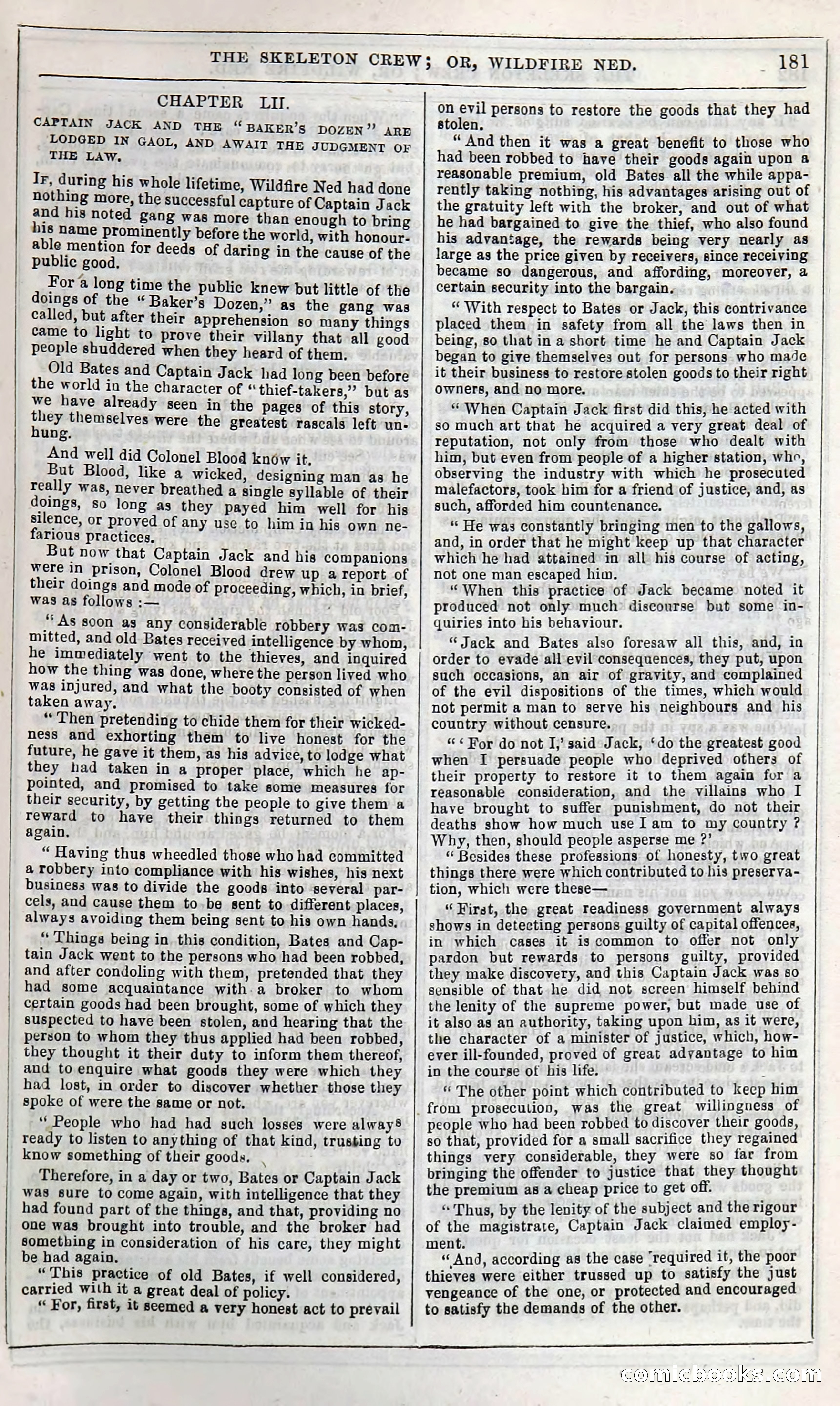
A restored page from Penny Dreadfuls, 1867. Page through the whole issue in the reader above.
📄 Transcribed text from this page (OCR, searchable)
Machine-transcribed from the original scan — historical spelling and the odd misread are preserved.
Fe THE SKELETON CREW; OR, WILDFIRE NED. 181 a CHAPTER LII. CAPTAIN JACK AND THE “ BAKER’s DOZEN”? ARB 3 Ir, during his whole lifetime Wildfi » dl , re Ned hadd pes more, the successful capture of Captain J idk = his noted gang was more than enough to bring ae Menor pee before the world, with honour- ion for dee ing i psibdee cas s of daring in the cause of the For a long time the public knew but li doings of the « Bakery Dozen,” as eek patios, called, but after their apprehension so many things came to light to prove their villany that all good people shuddered when they heard of them. Old Bates and Captain Jack lad lon the world in the character of « hig pia: we have already seen in the pages of this story they themselves were the greatest rascals left un- hung. And well did Colonel Blood know it, But Blood, like a wicked, designing man as he really was, never breathed a single syllable of their doings, so long as they payed him well for his silence, or proved of any use to him in his own ne- Pe practices. ut now that Captain Jack and his compani were In prison, Colonel Blood drew up a any of their doings and mode of proceedi _& report was as follows :— Proceerne, much in brief, ‘As soon as any considerable robbery was com- mitted, and old Bates received inteliio@ice by whom, he immediately went to the thieves, and inquired how the thing was done, where the person lived who was 1pjured, and what the booty consisted of when taken away, “Then pretending to chide them for their wicked- ness and exhorting them to live honest for the future, he gave it them, as his advice, to lodge what they had taken in a proper place, which he ap- pointed, and promised to take some measures for their security, by getting the people to give them a reward to haye their things returned to them again, “ Having thus wheedled those who had committed a robbery into compliance with his wishes, his next business was to divide the goods into several par- cels, and cause them to be sent to different places, always avoiding them being sent to his own hands, “ Things being in this condition, Bates and Cap- tain Jack went to the persons who had been robbed, and after condoling with them, pretended that they had some acquaintance with. a broker to whom certain goods had been brought, some of which they suspected to have been stolen, and hearing that the person to whom they thus applied had been robbed, they thought it their duty to inform them thereof, and to enquire what goods they were which they had lost, in order to discover whether those they spoke of were the same or not. ‘‘ People who had had such losses were alway§ ready to listen to anything of that kind, trusting to know something of their goods. | Therefore, in a day or two, Bates or Captain Jack was sure to come again, with intelligence that they had found part of the things, and that, providing no one was brought into trouble, and the broker had something in consideration of his care, they might be had again. “This practice of old Bates, if well considered, carried with it a great deal of policy. “For, first, it seemed a very honest act to prevail on evil persons to restore the goods that they had stolen. “And then it was a great benefit to those who had been robbed to have their goods again upon 4 reasonable premium, old Bates all the while appa- rently taking nothing, his advantages arising out of the gratuity left with the broker, and out of what he had bargained to give the thief, who also found his advantage, the rewards being very nearly as large as the price given by receivers, since receiving became so dangerous, and affording, moreover, a certain security into the bargain. “ With respect to Bates or Jack, this contrivance placed them in safety from all the laws then in being, so that in a short time he and Captain Jack began to give themselves out for persons who made it their business to restore stolen goods to their right owners, and no more. “ When Captain Jack first did this, he acted with so much art that he acquired a very great deal of reputation, not only from those who dealt with him, but even from people of a higher station, who, observing the industry with which he prosecuted malefactors, took him for a friend of justice, and, as such, afforded him countenance. “ He was constantly bringing men to the gallows, and, in order that he might keep up that character which he had attained in all his course of acting, not one man escaped him. “When this practice of Jack became noted it produced not only much’ discourse but some in- quiries into his behaviour. “Jack and Bates also foresaw all this, and, in order to evade all evil consequences, they put, upon such occasions, an air of gravity, and complained of the evil dispositions of the times, which would not permit a man to serve his neighbours and his country without censure. “<< Wor do not I,’ said Jack, ‘do the greatest good when I persuade people who deprived others of their property to restore it to them again for a reasonable consideration, and the villains who I have brought to suffer punishment, do not their deaths show how much use lam to my country ? Why, then, should people asperse me ?’ “ Besides these professions of honesty, two great things there were which contributed to his preserva- tion, which were these— “First, the great readiness government always shows in detecting persons guilty of capital offences, in which cases it is common to offer not only pardon but rewards to persons guilty, provided they make discovery, and this Captain Jack was 80 sensible of that he did not screen himself behind the lenity of the supreme power, but made use of it also as an authority, taking upon him, as it were, the character of a minister of justice, which, how- ever ill-founded, proved of great adyantage to him in the course of his life. “ The other point which contributed to keep him _from prosecution, was the great willingness of people who had been robbed to discover their goods, so that, provided for a small sacrifice they regained things very considerable, they were so far from bringing the offender to justice that they thought the premium as a cheap price to get off. “ Thus, by the lenity of the subject and the rigour of the magistrate, Captain Jack claimed employ- ment. « And, according as the case ‘required it, the poor thieves were either trussed up to satisfy the just vengeance of the one, or protected and encouraged to satisfy the demands of the other. ———— CconnicldOokkS.C©