
Penny Dreadfuls, 1867 · page 97 of 196
The Skeleton Crew; Or, Wildfire Ned — page 97: what you’re looking at
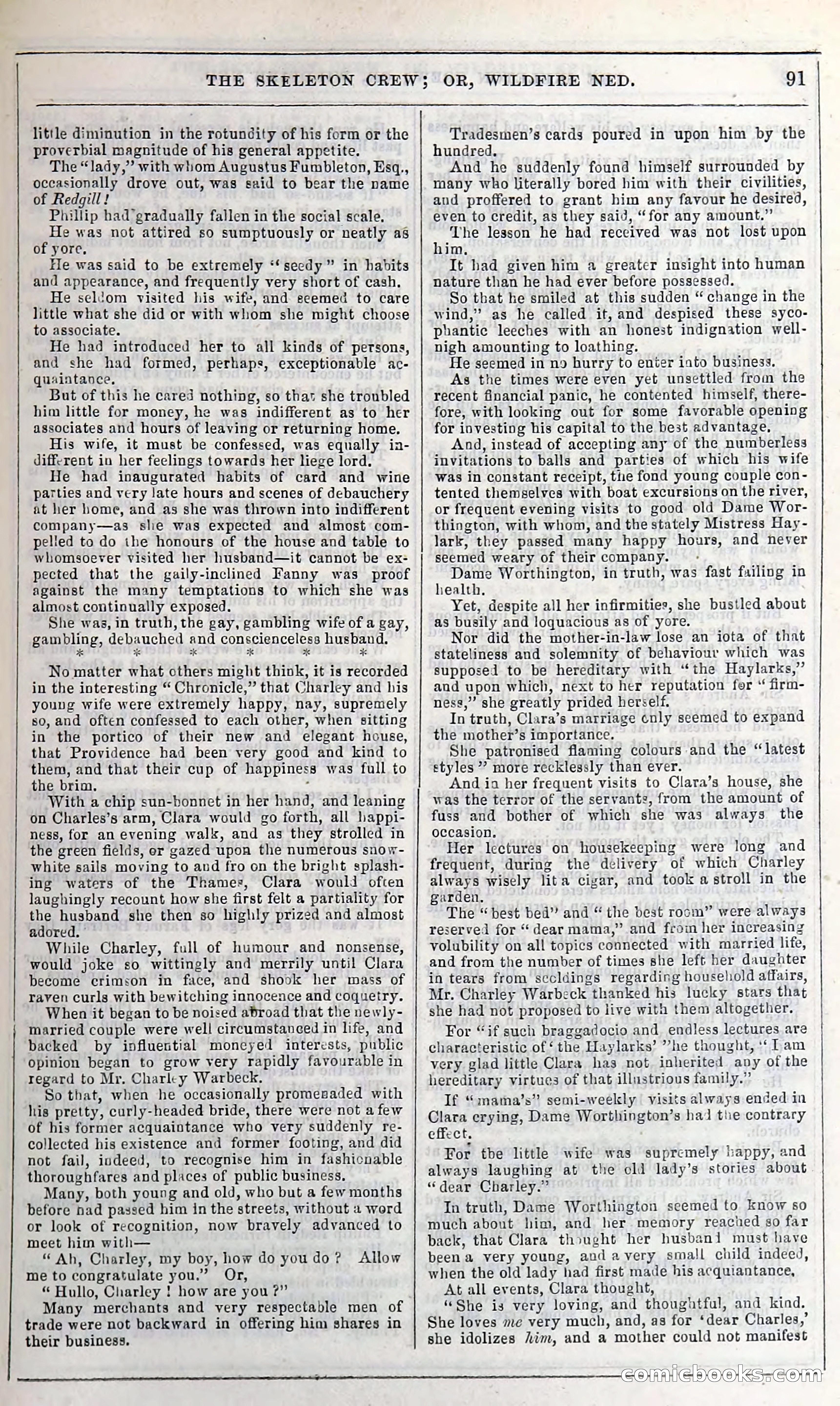
A restored page from Penny Dreadfuls, 1867. Page through the whole issue in the reader above.
📄 Transcribed text from this page (OCR, searchable)
Machine-transcribed from the original scan — historical spelling and the odd misread are preserved.
THE SKELETON CREW; OR, WILDFIRE NED. 91 little diminution in the rotundity of his form or the proverbial magnitude of his general appetite. The “lady,” with whom Augustus Fumbleton, Esq., occasionally drove out, was said to bear the name of Redgill! Phillip had’gradually fallen in the social scale. He was not attired so sumptuously or neatly as of yore, He was said to be extremely ‘*‘ seedy” in habits and appearance, and frequently very short of cash. He selv’om visited his wife, and seemed to care little what she did or with whom she might choose to associate. He had introduced her to all kinds of persons, and she had formed, perhaps, exceptionable ac- quaintance, But of this he cared nothing, so that she troubled him little for money, he was indifferent as to her associates and hours of leaving or returning home. His wife, it must be confessed, was equally in- different in her feelings towards her liege lord. He had inaugurated habits of card and wine parties and very late hours and scenes of debauchery at her home, and as she was thrown into indifferent company—as slie was expected and almost com- pelled to do the honours of the house and table to whomsoever visited her husband—it cannot be ex- pected that the gaily-inclined Fanny was proof against the many temptations to which she was almost continually exposed. She was, in truth, the gay, gambling wife of a gay, gambling, debauched and conscienceless husband. No matter what others might think, it is recorded in the interesting “ Chronicle,” that Charley and his youvg wife were extremely happy, nay, supremely so, and often confessed to each other, when sitting in the portico of their new and elegant house, that Providence had been very good and kind to them, and that their cup of happiness was full to the brim, 3 With a chip sun-bonnet in her hand, and leaning on Charles’s arm, Clara would go forth, all happi- ness, for an evening walk, and as they strolled in the green fields, er gazed upon the numerous snow- white sails moving to and fro on the bright splash- ing waters of the Thames, Clara would often laughingly recount how she first felt a partiality for the husband she then so highly prized and almost adored. © While Charley, full of humour and nonsense, would joke so wittingly and merrily until Clara become crimson in face, and shook her mass of raven curls with bewitching innocence and coquetry. When it began to be noised abroad that the newly- married couple were well circumstaneed in life, and backed by influential moneyed interests, public Opinion began to grow very rapidly favourable in regard to Mr. Charley Warbeck. So that, when he occasionally promesaded with his pretty, curly-headed bride, there were not a few of his former acquaintance who very suddenly re- collected his existence and former footing, and did not fail, indeed, to recognise him in fashicnable thoroughfares and places of public business, Many, both young and old, who but a few months before nad passed him in the streets, without a word or look of recognition, now bravely advanced to meet him with— “ Ah, Charley, my boy, how do youdo? Allow me to congratulate you.” Or, “ Hullo, Charley ! how are you ?” Many merchants and very respectable men of trade were not backward in offering him shares in their business. oe EET TTC HOOKS COLI Tradesmen’s cards poured in upon him by the hundred. And he suddenly found himself surrounded by many who literally bored him with their civilities, aud proffered to grant him any favour he desired, even to credit, as they said, “for any amount.” The lesson he had received was not lost upon lim, It had given him a greater insight into human nature than he had ever before possessed. So that he smiled at this sudden “ change in the wind,” as he called it, and despised these syco- phantic leeches with an honest indignation well- nigh amounting to loathing. He seemed in no hurry to enter into business. As the times were even yet unsettled from the recent financial panic, he contented himself, there- fore, with looking out for some favorable opening for investing his capital to the best advantage, And, instead of accepting any of the numberless invitations to balls and parties of which his wife was in constant receipt, tiie fond young couple con- tented themselves with boat excursions on the river, or frequent evening visits to good old Dame Wor- thington, with whom, and the stately Mistress Hay - lark, they passed many happy hours, and never seemed weary of theircompany. - Dame Worthington, in truth, was fast failing in health. Yet, despite all her infirmities, she bustled about as busily and loquacious as of yore. Nor did the mother-in-law lose an iota of that stateliness and solemnity of behaviour which was supposed to be hereditary with “the Haylarks,” and upon which, next to her reputation fer “ firm- ness,” she greatly prided herself. In truth, Clara’s marriage cnly seemed to expand the mother’s importance. She patronised flaming colours and the “latest styles ’’ more recklessly than ever. And io her frequent visits to Clara’s house, she was the terror of the servantz, from the amount of fuss and bother of which she was always the occasion. Her lectures on housekeeping were long and frequent, during the delivery of which Charley always wisely lita cigar, and took a stroll in the garden. The “best bed” and “ the best room” were always reserved for “dear mama,” and from her increasing volubility on all topics connected with married life, and from the number of times she left her daughter in tears from sccldings regarding household affairs, Mr. Charley Warbeck thanked his lucky stars that she had not proposed to live with them altogether. For “if such braggadocio and endless lectures are characteristic of ‘ the Haylarks’ ”he thought, *‘ [am very glad little Clara has not inherited avy of the hereditary virtues of that illustrious family.” If “mama’s” semi-weekly visits always ended in Clara erying, Dame Worthington’s had the contrary effect. For the little wife was supremely happy, and always laughing at the old lady’s stories about “dear Charley.” In truth, Dame Worthington seemed to know so much about him, and her memory reached so far back, that Clara thought her husbani must have been a very young, and avery small child indeed, when the old lady had first made his acquiantance, At all events, Clara thought, ‘She is very loving, and thoughtful, and kind. She loves me very much, and, as for ‘dear Charles,’ she idolizes fim, and a mother could not manifest