
Penny Dreadfuls, 1877 · page 1 of 10
Beadle's Half Dime Library: Seth Jones; or, The Captives of the Frontier — page 1: what you’re looking at
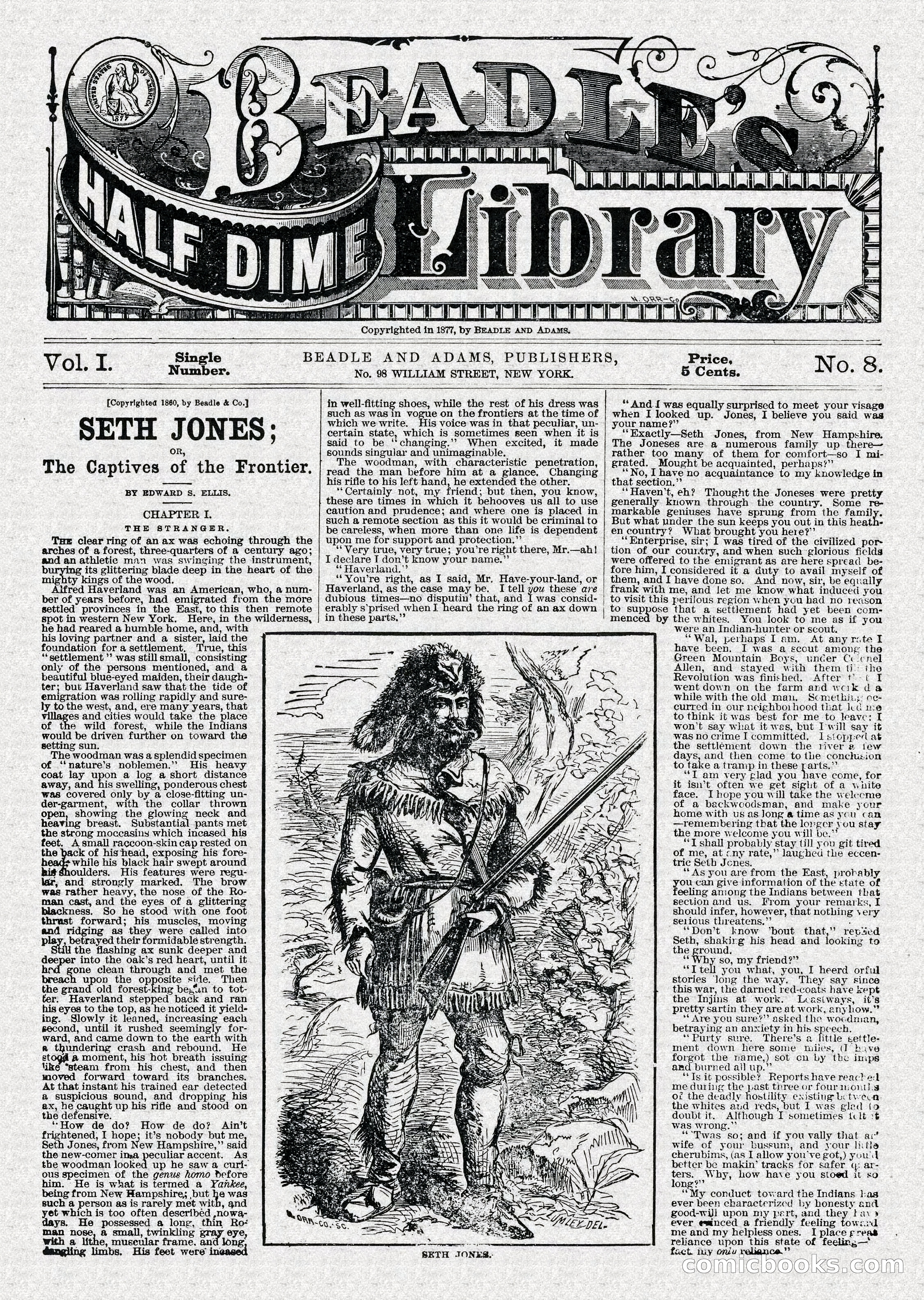
A restored page from Penny Dreadfuls, 1877. Page through the whole issue in the reader above.
📄 Transcribed text from this page (OCR, searchable)
Machine-transcribed from the original scan — historical spelling and the odd misread are preserved.
f eee fh ae 1 i : : ‘| fi = y Single Number. Vol. I. [Copyrighted 1860, by Beadle & Co.] SETH JONES; The Captives of the Frontier. BY EDWARD S. ELLIS. CHAPTER I. THE STRANGER. THe clear ring of an ax was echoing through the arches of a forest, three-quarters of a century ago; and an athletic man was swinging the instrument, b its glittering blade deep in the heart of the mighty kings of the wood, Alfred Haverland was an American, who, @ num- ber of years before, had emigrated from the more settled provinces in the East, to this then remote spot in western New York. Here, in the wilderness, he had reared a humble home, and, with his loving partner and a sister, laid the foundation for a settlement. True, this ‘settlement ’’ was still small, consisting only of the persons mentioned, and a beautiful blue-eyed maiden, their daugh- ter; but Haverland saw that the tide of emigration was rolling rapidly and sure- ly to the west, and, ere many years, that es and cities would take the place of the wild forest, while the Indians would be driven further on toward the setting sun. The woodman was a splendid specimen of ‘‘nature’s noblemen.’’ His heavy coat lay upon a log a short distance away, and his sweiling, ponderous chest was covered only by a close-fitting un- der-garment, with the collar thrown open, showing the glowing neck and heaving breast. Substantial pants met the strong moccasins which incased his feet. A small raccoon-skin cap rested on the back of histhead, exposing his fore- h while his black hair swept around hit Shoulders. His features were regu- lar, and strongly marked. The brow was rather heavy, the nose of the Ro- man cast, and the eyes of a glittering blackness. So he stood with one foot thrust forward; his muscles, moving and ridging as they were called into play, betrayed their formidable strength. id the flashing ax sunk deeper and deeper into the oak’s red heart, until it h one clean through and met the breach upon the opposite side, Then the grand old forest-king be;“in to tot- ter. Haverland stepped back and ran his eyes to the top, as he noticed it yield- ing. Slowly it leaned, increasing each second, until it rushed seemingly for- ward, and came down to the earth with a thundering crash and rebound. He stogd a moment, his hot breath issuing like “steam from his chest, and then moved forward toward its branches. At that instant his trained ear detected a suspicious sound, and dropping his ax, he caught up his rifle and stood on the defensive. **How de do? How de do? Ain’t qahvened, I hope; it’s nobody but me Seth Jones, from New Hampshire,”’ sai the new-comer insa peculiar accent. As the woodman looked up he saw a curt- ous specimen of the genus homo Ddefore him. He is what is termed a Yankee, being from New Hampshire; but he was such a person as is rarely met with, qand yet which is too often described ,nowa- days. He possessed a long, thin Ro- man nose, a small, twinkling eye, a lithe, museular frame. an long limbs. His feet were ineased jy ill syle SN si bi Vi Vili lS KV il Hl STC W a ww LA VL \ Copyrighted in 1877, by BEADLE AND ADAMS, BEADLE AND ADAMS, PUBLISHERS, No. 98 WILLIAM STREET, NEW YORK. in well-fitting shoes, while the rest of his dress was such as was in vogue on the frontiers at the time of which we write. is voice was in that peculiar, un- certain state, which is sometimes seen when it is said to be ‘‘changing.’’ When excited, it made sounds singular and unimaginable. The woodman, with characteristic penetration, read the man before him at a glance, Changing his rifle to his left hand, he extended the other. “Certainly not, my friend; but then, you know, these are times in which it behooves us all to use caution and prudence; and where one is placed in such a remote section as this it would be criminal to be careless, when more than one life is dependent upon me for support and protection.” ‘*Very true, very true; you’re right there, Mr.—ah! I declare I don’t know your name,” ** Haverland."’ ‘*You’re right, as I said, Mr. Have-your-land, or Haverland, as the case may be. I tell you these ave dubious times—no disputin’ that, and erably s’prised when 1 in these parts,”’ — SETH JONES.- +. 5 oy, ceri » HS JN No. 8. Price, 5 Cents. ** And. [ was equally surprised to meet your visa when I looked up. Jones, I believe you said wae your name?”’ ““Exactly—Seth Jones, from New Hampshire. The Joneses are a numerous family up there— rather too many of them for comfort—so I mi- grated. Mought be acquainted, perhaps?” “No, [have no acquaintance to my knowledge in that section.”’ ‘Haven't, eh? Thought the Joneses were pretty generally known through the country. Some re- markable geniuses have sprung from the family. But what under the sun keeps you out in this heathe en country? What brought you here?”’ _ ‘Enterprise, sir; I was tired of the civilized por- tion of our country, and when such ‘glorious ficlds were offered to the emigrant as are here spread be- fore him, I considered it a duty to avail myself of them, and I have done so. And now, sir, be equally frank with me, and let me know what induced you i was consid- | to visit this perilous region when you had no reason eard the ring of an ax down | to el that a settlement had yet been com- menced by the whites. You look to me as if you were an Indian-hunter or scout. ‘Wal, perhaps I am. At any rate I have teen. I was a sccut among the Green Mountain Boys, uncer Cc ‘cnel Allen, and stayed with them ti: the Revolution was finished. After t’-¢ I went down on the farm and woik da while with the old man, Scmethiz;: oe- curred in our neighborhood that led me to think it was best for me-to leave: I won't say what it wes, but Iwill say it was no crime I committed. I stopy-erd at the settlement down the river a itew days, and then come tothe conchision to take a tramip in these parts.” “*T am very glad you have come, for it isn’t often we get sight of a white face. I hope you will take the welccme of a backwoodsman, and make jour home with us as Jong a time as yeu can —remembering that the longer you stay the more welcome you will be.”’ “I shall probably stay till you git tired of me, at cny rate,’ laughed the eccen- tric Seth Jcnes. **As you are from the East, probably you can give information of the state of eeling among the Indians between that section and us. From your remarks, I should infer, however, that nothing very selious threatens,”’ . ‘Don’t know ‘bout that,” revaed Seth, shakirg his head and looking to the ground. $8 Mi so, my friend?” ‘IT tell you what, you, I heerd orful stories Jong the way. They say since this war, the darned red-coats have kept the Injins at work. Lceasiways, it’s pretty sartin they are at work, enyhow.” ** Are you sure?” asked the wocdman, betraying an anxiety in his speech. ‘“Purty sure. There’s a little settle- ment down here some miles, (I hive forgot the name,) sot cn by the imps and burned all up.”’ ‘*TIs it possible? Reports have reach el me dutiug the past three or four morith.g or the deadly hostility existing Letweca- the whites aud reds, but I was gled (o doubt it. Although I sometimes tclt >t was wrong.” ““Twas so; and if you vally that ac’ wife of your bussum, and your li:fte cherubims, (as I allow you've got,) you'd better be makin’ tracks for safer «: ar- Laces Why, how have you stoed it so ong?”’ ‘*“My conduct toward the Indians las ever been characterized by honesty and good-will upon my pert, and they Tay 3 ever esinced a friendly feeling towerd me and my helpless ones. I place rreas reliance upon this state of feelin, — ca. fact nhiy oniu x COMMUGC MOOK 5G)