
Penny Dreadfuls, 1877 · page 5 of 16
Beadle's Half Dime Library — page 5: what you’re looking at
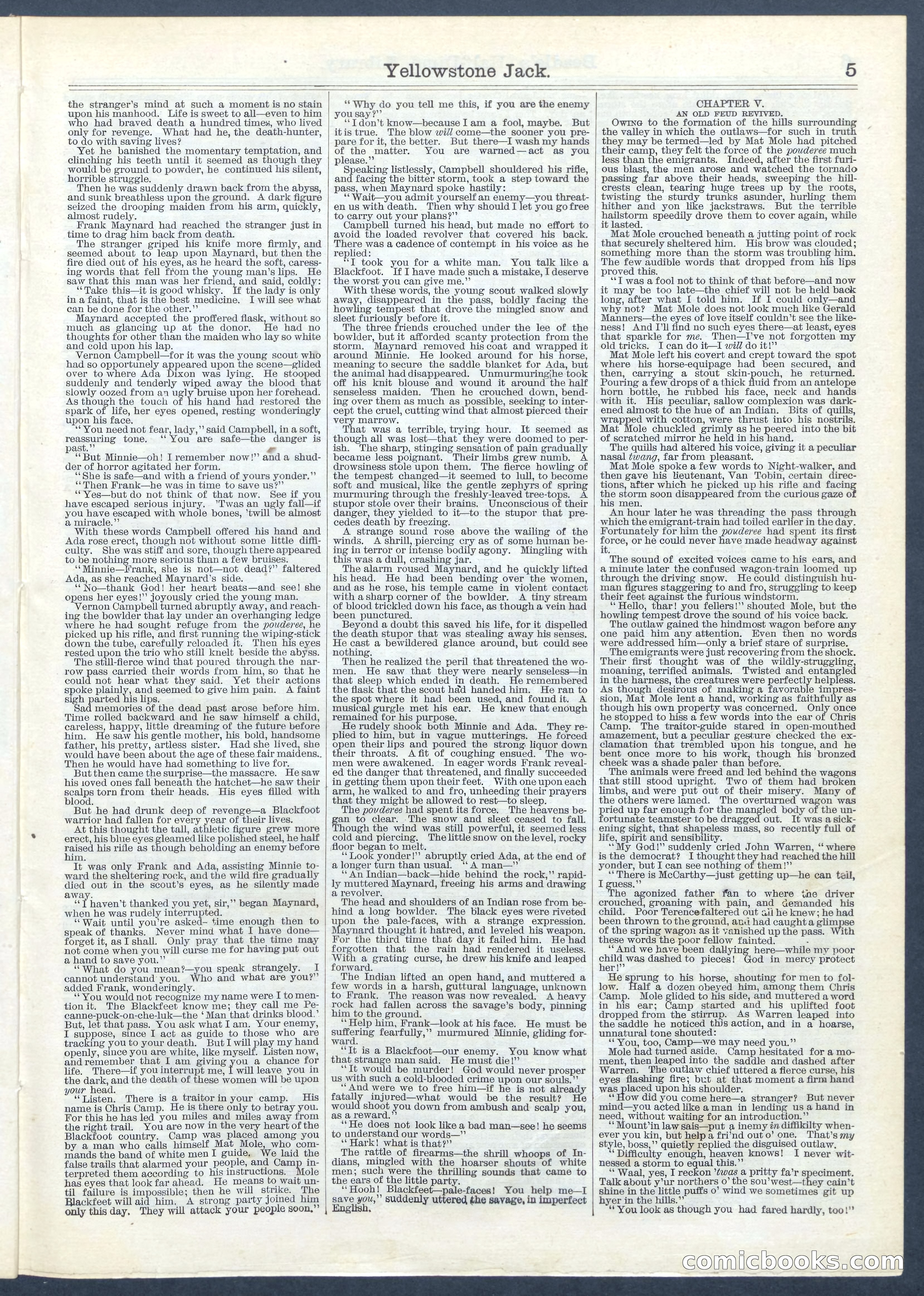
A restored page from Penny Dreadfuls, 1877. Page through the whole issue in the reader above.
📄 Transcribed text from this page (OCR, searchable)
Machine-transcribed from the original scan — historical spelling and the odd misread are preserved.
Yellowstone Jack. the stranger's mind at such a moment is no stain upon his manhood. Life is sweet to all—even to him who had braved death a hundred times, who lived only for revenge. What had he, the death-hunter, to do with saving lives? Yet he banished the momentary temptation, and clinching his teeth until it seemed as though they would be ground to powder, he continued his silent, horrible struggle. Then he was suddenly drawn back from the abyss, and sunk breathless upon the ground. A dark figure seized the drooping maiden from his arm, quickly, almost rudely. Frank Maynard had reached the stranger just in time to drag him back from death. The stranger griped his knife more firmly, and seemed about to leap upon Maynard, but then the fire died out of his eyes, as he heard the soft, caress- ing words that fell fom the young man’s lips, He saw that this man was her fr mea said, coldly: “Take this—it is good whisky. the lady is only in a faint, that is the best medicine, I will see what can be done for the other.”’ Maynard accepted the proffered flask, without so much as glancing up at the donor. He had no thoughts for other than the maiden who lay so white and cold upon his lap. Vernon Campbell—for it was the young scout who had so rend syporae upon the scene—glided over to where Ada Dixon was lying. He stooped suddenly and tenderly wiped away the blood that slowly oozed from an ugly bruise upon her forehead. As though the touch this hand had restored the spark of life, her eyes opened, resting wonderingly upon his face, ‘“You need not fear, lady,’ said Campbell, in a soft, he aaah tone. ‘‘ You are safe—the danger is ast.’ & ‘“But Minnie—oh! I remember now!” and a shud- der of horror agitated her form. ‘‘She is safe—and with a friend of yours yonder.” “Then Frank—he was in time to save us?” ““Yes—but do not think of that now. See if you have escaped serious injury. "Twas an ugly fall—if you have escaped with whole bones, ‘twill be almost a miracle.” With these words Campbell offered his hand and Ada rose erect, though not without some little diffi- culty. She was stiff and sore, though there appeared to be nothing more serious than a few bruises. ‘‘Minnie—Ifrank, she is not—not dead?” faltered Ada, as she reached Maynard’s side. ‘“No—thank God! her heart beats—and see! she oqgus her eyes!”’ joyously cried the young man, ernon Campbell turned abruptly away, and reach- ing the bowlder that lay under an overhanging ledge pe he had sought refuge from the pouderee, he icked up his rifle, and first running the wiping-stick | the tube, carefully reloaded it, Then his eyes rested upon the trio who still knelt beside the abyss. The still-fierce wind that poured through the nar- row pes carried their words from him, so that he eould not hear what they said. Yet their actions slgh | pletely and seemed to give him pain. A faint h parted his lips. memories of the dead past arose before him. Time rolled backward and he saw himself a child, careless, happy, little dreaming of the future before him. e saw his gentle mother, his. bold, handsome father, his pretty, artless sister. Had she lived, she would have been about the age of these fair maidens.. Then he would have had something to live for. But then came the surprise—the massacre. He saw his 1oved ones fall beneath the hatchet—he saw their paler torn from their heads. His eyes filled with blood. But he had drunk deep of revenge—a Blackfoot warrior had fallen for every year of their lives, At this thought the tall, athletic figure grew more erect, his blue eyes gleamed like polished steel, he half Baise his rifle as though beholding an enemy before a, It was only Frank and Ada, assisting Minnie to- ward the sheltering rock, and the wild fire gradually died out in the scout’s eyes, as he silently made away. <a ee thanked you yet, sir,’ began Maynard, when he was rudely interrupted. “Wait until you’re asked- time enough then to speak of thanks. Never mind what I have done— forget it, asI shall. Only pray that the time may not come when you will curse me for having put out a hand to save you.” “What do you mean?—you speak strangely. I cannot understand’ you. ho and what are you? added Frank, wonderingly. “You would not recognize my name were I to men- tion it. The Blackfeet know me; they call me Pe- canne-puck-on-che-luk—the ‘Man that drinks blood. But, let that pees You ask what Iam. Your enemy, I suppose, since I act as guide to those who are tracking you to your death. But Iwill play my hand openly, since you are white, like myself. Listen now, andremember that I am giving you a chance for life. There—if you interrupt me, I will leave you in the dark, and the death of these women will be upon your head. : ; : ; “Listen. There is a traitorin your camp. His name is Chris Camp. He is there only to betray you. For this he has led you miles and miles away from the right trail, You are now in the very heart of the Blackfoot country. Camp wes placed among you by a man who calls himself Mat Mole, who com- mands the band of white men I guide, We laid the false trails that alarmed your people, and Camp in- terpreted them according to his instructions, Mole has eyes that look far ahead. He means to wait un- til failure is impossible; then he will strike. The Blackfeet will aid him, A strong party joined him only this day, They will attack your people soon, ‘‘ Why do you tell me this, if you are the enemy you say?’ “‘T don’t know—because Iam a fool, maybe. But itis true. The blow will come—the sooner you pre- pare for it, the better. But there—I wash my hands of the matter. You are warned—act as you please.” epee listlessly, Campbell shouldered his rifle, and facing the bitter storm, took a step toward the pass, when Maynard spoke hastily: “Wait—you admit yourself an enemy—you threat- en us with death. Then why should I lot you go free to carry out your plans?”’ but made no effort to Campbell turned his hea, avoid the loaded revolver that covered his back. There was a cadence of contempt in his voice as he replied: ‘I took you for a white man. You talk like a Blackfoot. If I have made sucha mistake, I deserve the worst you can give me.”’ With these words, the young scout walked slowly away, disappeared in the pass, boldly facing the howling tempest that drove the mingled snow and sleet furiously before it. The three friends crouched under the lee of the bowlder, but it afforded scanty protection from the storm. Maynard removed his coat and Ale oe it around Minnie. He looked around for his horse, meaning to secure the saddle blanket for Ada, but the animal had disappeared. Unmurmuringjhe took off his kmit blouse and wound it around the half senseless maiden. Then he crouched down, bend- ing over them as much as possible, seeking to inter- cept the cruel, cutting wind that almost pierced their very marrow. That was a terrible, trying hour. It seemed as though all was lost—that they were doomed to per- ish. The sharp, stinging sensation of pain graduall became less poignant. Their limbs grew numb, drowsiness stole upon them. The fierce howling of the tempest changed—it seemed to lull, to become soft and musical, like the gentle zephyrs of sprin, murmurin ee the freshly-leaved tree-tops. 4 stupor stole over their brains, Unconscious of their danger, they yielded to it—to the stupor that pre- cedes death by freezing. A strange sound rose above the wailing of the winds, A shrill, piercing cry as of some human be- ing in terror or intense bodily agony. Mingling with this was a dull, crashing jar. The alarm rouséd Maynard, and he quickly lifted his head. He had been bending over the women, and as he rose, his temple came in violent contact with asharp corner of fhe bowlder. A tiny stream of blood trickled down his face, as though a vein had been punctured. Beyond a doubt this saved his life, for it dispelled the death stupor that was stealing away his senses. He cast a bewildered glance around, but could see nothing, Then he realized the peril that threatened the wo- men. He saw that they were nearly senseless—in that sleep which ended in death. 6 remembered the flask that the scout had handed him. He ran to the spot where it had been used, and found it, A musical a met his ear. He knew that enough remained for his purpose. He rudely shook both Minnie and Ada. They re- plied to him, but in vague mutterings. He forced open their lips and poured the strong liquor down their throats. A fit of coughing ensued. The wo- men were awakened. In eager words Frank reveal- ed the danger that threatened, and finally succeeded in getting them upon theirfeet. With one uponeach arm, he walked to and fro, unheeding their prayers that they might be allowed to rest—to sleep. The povderes had spent its force. The heavens be- fen to clear. .The snow and sleet ceased to fall ough the wind was still powerful, it seemed less cold and piercing. The little snow on the level, rocky floor began to melt. ‘“Look yonder!’ abruptly cried Ada, at the end of a longer turn than usual, ‘tA man—” “An Indian—back—hide behind the rock,’’ rapid- ly muttered Maynard, freeing his arms and drawing a revolver. The head and shoulders of an Indian rose from be- hind a long bowlder. The black eyes were riveted ae the pale-faces, with a strange expression. Maynard thought it hatred, and leveled his weapon. For the third time that day it failed him. He had forgotten that the rain had rendered it useless. With a grating curse, he drew his knife and leaped forward. The Indian lifted an open hand, and muttered a few words in a harsh, guttural age, unknown to Frank. The reason was now revealed, A heavy rock had fallen across the savage’s body, pinning him to the ground. ‘‘ Help him, Frank—look at his face. He must be ie ea fearfully,” murmured Minnie, gliding for- war “Tt is a Blackfoot—our enemy. You know what that strange man said. He must die!” “It would be murder! God would never prosper us with such a cold-blooded crime upon our souls.” “And were we to free him—if he is not alread fatally injured—what would be the result? He would shoot you down from ambush and scalp you, as a, reward,” ‘He does not look like a bad man—see! he seems to understand our words—” “ Hark! what is that?” The rattle of firearms—the shrill whoops of In- dians, mingled with the hoarser shouts of white men; such were the thrilling sounds that came to the ears of the little party, ‘‘Hooh! Blackfee ale-faces! You help me—I save ae suddenly uttered the savage, in imperfect * CHAPTER V. AN OLD FEUD REVIVED. Owrne to the formation of the hills surrounding the valley in which the outlaws—for such in truth they may be termed—led by Mat Mole had pitched their camp, they felt the force of the pouderee much less than the emigrants. Indeed, after the first furi- ous blast, the men arose and watched the tornado passing far above their heads, ic Se the hill- crests clean, tearing huge trees up by the roots, twisting the tig trunks asunder, hurling them hither and yon like jackstraws. But the terrible hailstorm speedily drove them to cover again, while it lasted. Mat Mole crouched beneath a jutting point of rock that securely sheltered him. His brow was clouded; something more than the storm was troubling him, The few audible words that dropped from his lips proved this. ‘‘T was a fool not to think of that before—and now it may be too late—the chief will not be held back long, after what I told him. If I could only—and why not? Mat Mole does not look much like Gerald Manners—the eyes of love itself couldn’t see the like- ness! And I'll find no such eyes there—at least, eyes that sparkle for me, Then—I’ve not forgotten my old tricks. I can do it—I will do it!’ Mat Mole left his covert and crept toward the spot where his horse-equipage had been secured, and then, carryi a stout skin-pouch, he returned. Pouring a = drops of a thick fluid from an antelope horn bottle, he rubbed his face, neck and hands with it. His peculiar, sallow complexion was dark- ened almost to the hue of an Indian. Bits of quills, wrapped with cotton, were thrust into his nostrils. Mat Mole chuckled grimly as he a into the bit of scratched mirror he held in his hand, The quills had altered his voice, giving it a peculiar nasal twang, far from pleasant, Mat Mole spoke a few words to Night-walker, and then gave his Heutenant, Van Tobin, certain direc- tions, after which he picked up his rifle and facin the storm soon disappeared from the curious gaze 0. his men, An hour later he was threading the pass through which the emigrant-train had toiled earlier in the day. Fortunately for him the pouderee had spent its first at or he could never have made headway against The sound of excited voices came to his ears, and a minute later the confused wagon-train loomed up through the driving snow. He could distinguish hu- man figures Shognening Ue and fro, struggling to keep their feet i the ious windstorm. “Hello, thar! you fellers!’’ shouted Mole, but the howling tempest drove the sound of his voice back, The outlaw gained the hindmost ig. before an one paid him any attention. Even then no wor were addressed him—only a brief stare of surprise. The emigrants were just recovering from the shock, Their first thought was of the wildly- ling moaning, terrified animals, Twisted and entan led in the harness, the creatures were perfectly helpless. As though desirous of making a favorable impres- sion, Mat Mole lent a hand, working as fai y as though his own property was concerned, Only once he stopped to hiss a few words into the ear of Chris Camp. The traitor-guide stared in open-mouthed amazement, but a peculiar gesture checked the ex- clamation that trembled upon his tongue, and he bent once more to his bg 5 though his bronzed cheek was a shade paler than before. The animals were freed and led behind the wagons that still stood upright. Two of them had broken limbs, and were put out of their misery. Many of the others were lamed. The overturned wagon was i up far enough for the meee body of the un- ortunate teamster to be dragged out. It was asick- ening sight, that shapeless mass, so recently full of life, spirit and sensibility. ‘“My God!” suddenly cried John Warren, ‘‘ where is the democrat? I neigh wi they had reached the hill yonder, but I can see nothing of them!”’ : "There is McCarthy—just getting up—he can teil, ess. ‘he onized father fan to where ‘~ne driver crouched, groaning with pain, and demanded his child. Poor Terencefaltered out aii he knew; he had been thrown to the ground, ani had caught a glimpse of the spring wagon as it vanished up the pass. With these words the poor fellow fainted. - ‘And we have been dalying here—while my poor child was dashed to pieces! Sine in mercy protect her!’ He sprung to his horse, shouting for men to fol- low. a dozen obeyed him, among them Chris Camp. Mole glided to his side, and muttered a word in his ear; Camp started and his uplifted foot dropped from the stirrup. As Warren leaped into the saddle he noticed this action, and in a hoarse, unnatural tone shouted: “You, too, Camp—we may need you,” Mole had turned aside. mp hesitated for a mo- ment, then leaped into the saddle and dashed after Warren. ‘Phe outlaw chief uttered a flerce curse, his eyes flashing fire; bet at that moment a firm hand was re upon his shoulder. ‘‘How did you come here—a, stranger? But never mind—you acted like a man in lending us a hand in need, without waiting for an introduction,” “ Mount’in law sais—put a inemy én diffkilty when- ever you kin, but help a fri’nd outo’ one, That's my style, boss,” quietly replied the disguised outlaw, ‘Difficulty enough, heaven knows! I never wit- nessed a storm to equal this.” “Waal, yes, I reckon ’/was a pritty fa’r speciment. Talk about y'ur northers o’ the s0u’west—they cain’t shine in the little puffs o’ wind we sometimes git up hyer in the hills.” “You look as though you had fared hardly, too!” econmmiclaooe) S (C(O)