
Penny Dreadfuls, 1877 · page 9 of 16
Beadle's Half Dime Library — page 9: what you’re looking at
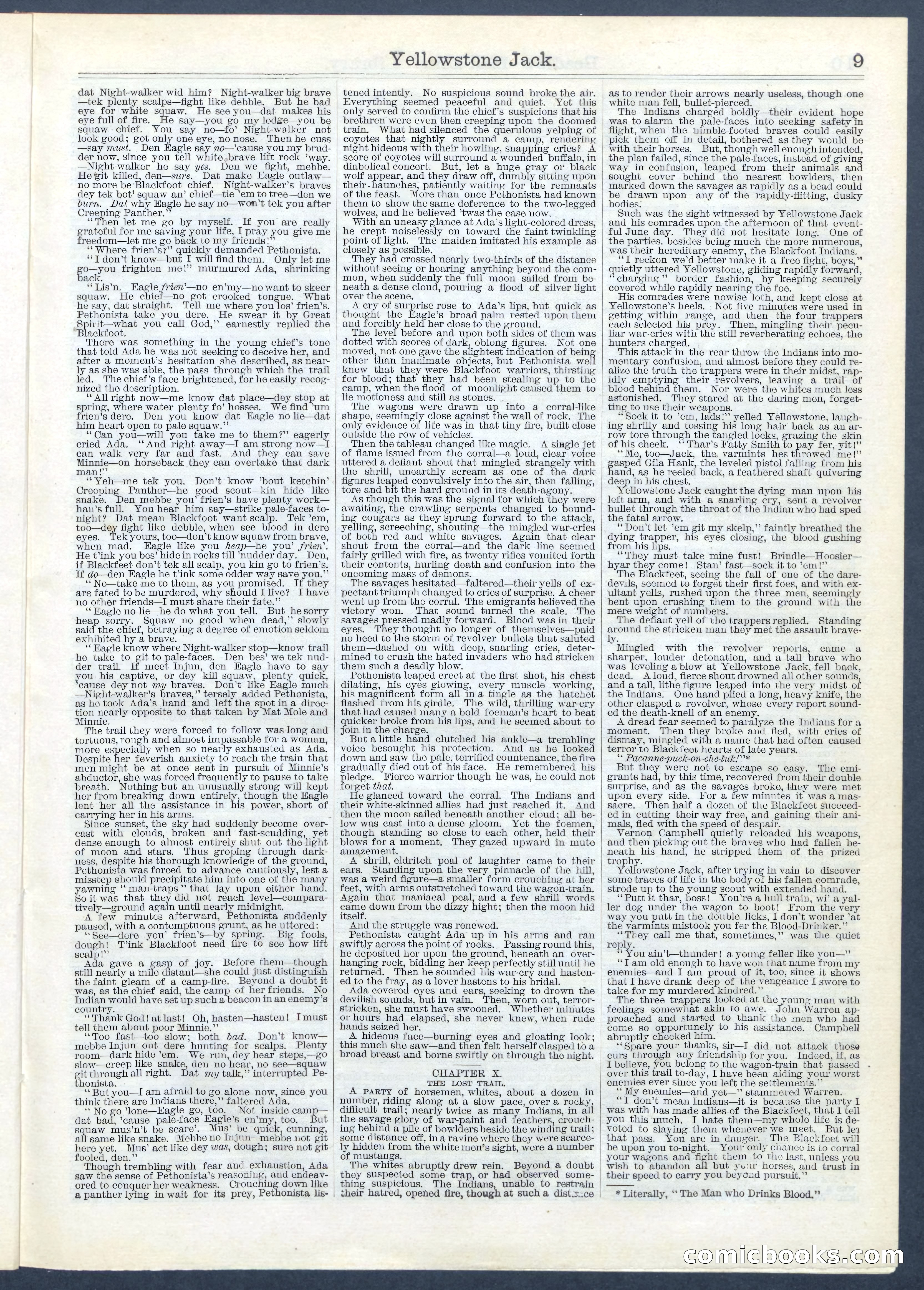
A restored page from Penny Dreadfuls, 1877. Page through the whole issue in the reader above.
📄 Transcribed text from this page (OCR, searchable)
Machine-transcribed from the original scan — historical spelling and the odd misread are preserved.
Yellowstone Jack. 2 dat Night-walker wid him? Night-walker big brave —tek plenty scalps—fight like debble. But ‘he bad eye for white squaw. He see you—dat makes his eye full of fire. € say—you go my lodge—you be squaw chief. You say no—fo’ Night-walker not look good; got only one eye, no nose. Then he cuss —say must. Den Ragle say no—’cause you my brud- der now, since you tell white,brave lift rock 'way. —Night-walker he say yes. Den we fight, mebbe. Heit killed, den—suye. Dat make Eagle outlaw— no more be’Blackfoot chief. Night-walker’s braves dey tek bot’ squaw an’ chief—tie ’em to tree—den we burn, Dat why Hagle he say no—won’t tek you after Creeping Panther,’ ‘Then let me go by myself. If you are really grateful for me saving your life, I pray you give me freedom—let me go back to my friends!” ‘Where frien’s?” quickly demanded Pethonista. “T don't know—but I find them. Only let me o—you frighten me!” murmured Ada, shrinking ack, ‘*Tis’n, say en’my—no want to skeer | c squaw, He ef—no got crooked tongue. What he say, dat straight. Tell me where you los’ frien’s. Pethonista take you dere. He swear it by Great Spirit—what you call God,” earnestly replied the Blackfoot. There was something in the young chief's tone that told Ada he was not seeking to deceive her, and after a moment’s hesitation she described, as near- ly as she was able, the pass through which the trail led. The chief’s face brightened, for he easily recog- nized the description. “All right now—me Iknow dat place—dey stop at spring, where water plenty fo’ hosses. We find *um frien’s dere, Den you Imow dat Hagle no lie—dat him heart open to pale squaw.”’ “Can you—will you take me to them?” eagerly cried Ada, ‘‘And right away—I am strong now—I can walk very far and fast. And they can save Minnie—on horseback they can overtake that dark man!” ‘““Yeh—me tek you. Don’t know ‘bout ketchin’ Creer ne. Panther—he good scout—kin hide like snake. en mebbe you’ frien’s have plenty work— han’s full. You hear him say—strike pale-faces to- night? Dat mean Blackfoot want scalp. Tek ’em, too—dey fight like debble, when see blood in dere eyes. Tel yours, too—don’t know squaw from brave, when mad. Hag)? like you heap—he you’ frien’. He tink you bes’ hidein rocks till nudder day. Den, if Blackfeet don’t tek all scalp, you kin go to frien’s. If do—den Eagle he t’ink some odder way save you.” ‘*No—take me to them, as you promised. If they are fated to ba murdered, why should I live? I have no other friends—I must share their fate.”’ ‘‘Fagle no lie—he do what you tell. But hesorry heap sorry. Squaw no good when dead,” slowly said the chief, betraying a degree of emotion seldom exhibited by a brave. “Bagle know where Night-walker stop—know trail he take to git to pale-faces. Den bes’ we tek nud- der trail meet Injun, den Wagle have to say you his captive, or dey kill squaw, plenty quick, cause dey not my braves. Don’t like Hagle much —Night-walker’s braves,’ tersely added Pethonista, as he took Ada’s hand and left the spot in a direc- tion nearly opposite to that taken by Mat Mole and Minnie. The trail they were forced to follow was long and tortuous, rough and almost impassable for a woman, more especially when so nearly exhausted as Ada. Despite her feverish anxiety to reach the train that men might be at once sent in pursuit of Minnie’s abductor, she was forced frequently to pause to take breath. ‘Nothing but an unusually strong will kept her from breaking down ang tig, Sqn the Eagle lent her all the assistance in | power, short of carrying her in his arms. zi Since sunset, the sky had suddenly become over- cast with clouds, broken and fast-scudding, yet dense enough to almost entirely shut out the light of moon and stars. Thus groping through dark- ness, despite his thorough knowledge of the ground, Pethonista was forced to advance cautiously, lest a misstep should precipitate him into one of the man yawning ‘““man-traps’’ that lay upon either hand. So it was that they did not reach level—compara- tively—ground again until ner midnight, A few minutes afterward, Pethonista suddenly paused, with a contemptuous grunt, as he uttered: “See—dere you’ frien’s—by Stee 8 ay fools e to see how lift dough! T’ink Blackfoot need scalp!” Ada gave a Fine of joy. Before them—though still nearly a mile distant—she could just distinguish the faint gleam of a camp-fire. Beyond a doubt it was, as the chief said, the camp of her friends. No Indian would have set up such a beacon in an enemy’s country. “Thank God! at last! Oh, hasten—hasten! I must tell them about poor Minnie,”’ “Too fast—too slow; both dad. Don't know— mebbe Injun out dere hunting for scalps. Plenty room—dark hide ’em. We run, dey hear steps,—go slow—creep like snake, den no hear, no see—squaw git through all right. Dat my tall,” interrupted Pe- thonista, : : “But you—I am afraid to go alone now, since you think there are Indians there,” faltered Ada. “No go ‘“lone—Eagle go, too. Not inside cam dat bad, ’cause pale-face Eagile’s en’my, too. ut Squaw mus'n’t be scare’, Mus’ be guick, cunning, same like snake, Mebbe no Injun—mebbe not git here yet. Mus’ act like dey was, dough; sure not git fooled, den.”’ Though trembling with fear and exhaustion, Ads, saw the sense of Pethonista’s reasoning, and endeay- ored to conquer her weakness. Crouching down like a panther lying in wait for its prey, Pethonista lis- tened intently. No suspicious sound broke the air. Everything seemed peaceful and quiet. Yet this only served to confirm the chief’s suspicions that his brethren were even then creeping upon the doomed train. What had silenced the querulous yelping of coyotes that nightly surround a camp, rendering night hideous with their howling, es cries? A score of coyotes will surround a woun diabolical concert. But, let a huge gray or black wolf appear, and they draw off, dumbly sitting upon their-haunches, patiently waiting for the remnarts of the feast. More than once Pethonista had known them to show the same deference to the two-legged wolves, and he believed *twas the case now. With an uneasy glance at Ada’s light-colored dress, he crept noiselessly on toward the faint twinkling point of light. The maiden imitated his example as closely as possible, They had crossed nearly two-thirds of the distance without seeing or hearing anything beyond the com- mon, when suddenly the full moon sailed from be- neath a dense cloud, pouring a flood of silver light over the scene. A cry of surprise rose to Ada’s lips, but quick as thought the Ragle’s broad palm rested upon them and forcibly held her close to the ground. The level before and upon both sides of them was dotted with scores of dark, oblong figures. Not one moved, not one gave the slightest indication of bei other than inanimate objects, but Pethonista we knew that they were Blackfoot warriors, thirsting for blood; that they had been stealing up to the camp, when the flood of moonlight caused them to lie motioness and still as stones. . The wagons were drawn up into a corrallike shape, seemingly close against the wall of rock. The only evidence of life was in that tiny fire, built close outside the row of vehicles. Then the tableau changed like magic. A single jet of flame issued from the corral—a loud, clear voice uttered a deflant shout that mingled strangely with | the shrill, unearthly scream as one of the dark | figures leaped convulsively into the air, then falling, tore and bit the hard ground in its death-agony. AS theo this was the signal for which they were awaiting, the crawling serpents changed to bound- ing cougars as they sprung forward to the attack, yelling, screeching, shouting—the mingled war-cries of both red and white savages. Again that clear shout from the corral—and the dark line seemed fairly grilled with fire, as twenty rifles vomited forth their contents, hurling death and confusion into the oncoming mass of demons. The savages hesitated—faltered—their yells of ex- pectant triumph changed to cries of surprise. A cheer went up from the corral. The emigrants believed the victory won. That sound turned the scale. The savages a madly forward. Blood was in their eyes. They thought no longer of themselves—paid no heed to the storm of revolver bullets that saluted them—dashed on with deep, snarling cries, deter- mined to crush the hated invaders who had stricken them such a deadly blow. Pethonista leaped erect at the first shot, his chest dilating, his eyes glowing, every muscle working, his magnificent form all ina fingle as the hatchet flashed from his girdle. that had caused many a bold foeman’s heart to beat uicker broke from his lips, and he seemed about to fon in the charge. But a little hand clutched his ankle—a tremblin voice besought his protection. And as he looke down and saw the pale, terrified countenance, the fire gradually died out of his face. He remembered his ledge. Fierce warrior though he was, he could not lorget that. e glanced toward the corral. The Indians and their white-skinned allies had just reached it. And then the moon sailed beneath another cloud; all be- low was cast intoa dense gloom. Yet the foemen, though standing so close to each other, held their blows fora moment, They gazed upward in mute amazement. A shrill, eldritch peal of laughter came to their | ears, Standing upon the very pinnacle of the hill, was a weird figure—a smaller form crouching at her feet, with arms outstretched toward the wagon-train. Again that maniacal peal, and a few shrill words oo down from the dizzy hight; then the moon hid itself. And the struggle was renewed. Pethonista caught Ada up in his arms and ran swiftly across the point of rocks. Passing round this, he deposited her upon the ground, beneath an over- hanging rock, bidding her keep perfectly still until he returned. Then he sounded his war-cry and hasten- ed to the fray, as a lover hastens to his bridal. Ada covered eyes and ears seeking to drown the devilish sounds, but in vain. Then, worn out, terror- stricken, she must have swooned, Whether minutes or hours had elapsed, she never knew, when rude hands seized her. A hideous face—burning eyes and gloating look; this much she saw—and then felt herself clasped to a broad breast and borne swiftly on through the night. CHAPTER X. THE LOST TRAIL. A Party of horsemen, whites, about a dozen in number, riding along at a slow pace, over a rocky, difficult trail; nearly twice as many Indians, in all the savage glory of war-paint and feathers, crouch- ing behind a pile of bowlders beside the winding trail; some distance off, ina ravine where they were scarce- ly hidden from the white men’s sight, were a number of mustangs. The whites abruptly drew rein. Beyond a doubt they suspected some trap, or had observed some- thing suspicious. The Indians, unable to restrain their hatred, opened fire, though at such a dist>=ce ed buffalo, in | | way in confusion, leape The wild, thrilling war-cry | | | as to render their arrows nearly useless, though one white man fell, bullet-pierced. The Indians charged boldly—their evident hope was to alarm the pale-faces into seeking safety in flight, when the nimble-footed braves could easily pick them off in detail, bothered as they would be with their horses, But, though well enough intended, the plan failed, since the aa instead of givin from their animals an sought cover behind the nearest bowlders, then marked down the savages as rapidly as a bead could 1c Pont gael upon any of the rapidly-flitting, dusky odies; Such was the sight witnessed by Yellowstone Jack | and his comrades upon the afternoon of that event- ful June day. They did not hesitate lony. One of the parties, besides being much the more numerous, was their hereditary enemy, the Blackfoot Indians. “T reckon we'd better make it a free fight, boys,” quietly uttered Yellowstone, gliding rapidly forward, “charging ’’ border fashion, by keeping securely covered while rapidly nearing the foe. His comrades were nowise loth, and kept close at Yellowstone’s heels. Not five minutes were used in getting within range, and then the four trappers each selected his prey. Then, mingling their pecu- liar war-cries with the still reverberating echoes, the hunters charged. This attack in the rear threw the Indians into mo- mentary confusion, and almost before they could re- alize the truth the trappers were in their midst, rap- idly payiy ee their revolvers, leaving a trail of blood behind them. Nor were the whites much less | astonished. They stared at the daring men, forget- ting to use their weapons. “Sock it to 'em, lads!’’ yelled Yellowstone, laugh- ing shrilly and tossing his long hair back as an ar- row tore through the tangled locks, grazing the slxin of his cheek. ‘' Thar’s Fatty Smith to pay fer, yit!” ‘“Me, too—Jack, the, varmints hes throwed me!” asped Gila Hank, the leveled pistol falling from his nd, as he reeled back, a feathered shaft quivering ts in his chest. ellowstone Jack caught the dying man upon his left arm, and with a snarling ery, sent a revolver bullet through the throat of the Indian who had sped the fatal arrow. “Don’t let ’em git my skelp,” faintly breathed the dying trapper, his eyes closing, the blood gushing from his lips. “They must take mine fust! Brindle—Hoosier— hyar they come! Stan’ fast—sock it to ’em!”’ The Blackfeet, seeing the fall of one of the dare- devils, seemed to forget their first foes, and with ex- ultant yells, rushed upon the three men, seemingly bent upon crushing them to the ground with the mere weight of numbers. The defiant yell of the trappersreplied. Standing around the stricken man they met the assault brave- ly. Mingled with ‘the revolver reports, came a sharper, louder detonation, and a tall brave who was leveling a blow at Yellowstone Jack, fell back, dead. A loud, fierce shout drowned all other sounds, and _a tall, lithe figure leaped into the very midst of the Indians. One hand plied a long, heavy knife, the other clasped a revolver, whose every report sound- ed the death-knell of an enemy. A dread fear seemed to peal the Indians for a moment, Then they broke and fled, with cries of dismay, mingled with a name that had often caused terror to Blackfeet hearts of late years, “ Pacanne-puck-on-che-lule!?* But they were not to escape so easy. The emi- grants had, by this time, recovered from their double surprise, and as the savages broke, they were met upon every side. For a few minutes it was a mas- sacre. Then half a dozen of the Blackfeet succeed- ed in cutting their way free, and gaining their ani- mals, fled with the speed of despair. Vernon Campbell quietly reloaded his weapons, and then picking out the braves who had fallen be- ate a his hand, he stripped them of the prized tro 5 bl risios Jack, after ye in vain to discover some traces of life in the body of his fallen comrade, strode up to the young scout with extended hand, “Putt tt thar, boss! You’re a hull train, wi’ a yal- ler dog under the wagon to boot! From the very way you putt in the double licks, I don’t wonder ’at the varmints mistook you fer the Blood-Drinker.” ‘‘Tbey call me that, sometimes,’ was the quiet reply. Pou ain't—thunder! a young feller like you—” “Tam old enough to have won that name from my enemies—and I am proud of it, too, since it shows that I have drank deep of the vengeance I swore to take for my murdered kindred.” The three cageets looked at the young man with Lior somewhat akin to awe, John Warren ap- proached and started to thank the men who had come so opportunely to his assistance. Campbell abruptly checked him. | “Spare your thanks, sir—I did not attack those curs through any friendship for you. Indeed, if, as I believe, you belong to the wagon-train that passed - over this trail to-day, I have been aiding your worst enemies ever since you left the settlements.” “My enemies—and yet—” stammered Warren, “T don't mean Indians—it is because the party I was with has made allies of the Blackfeet, that I tell you this much, I hate them—my whole life is de- voted to slaying them whenever we meet. But ley that pass, You are in danger. Tbe Blackfeet will be upon you to-night. Your only chance is (o corral your wagons aud fight them to tho last, unless you wish to abandon all but yur horses, and trust in their speed to carry you beyoud pursuit,” * Literally, ‘‘ The Man who Drinks Blood.” oO boo (S(O) mM c (C(O)