
Penny Dreadfuls, 1895 · page 231 of 391
Belle-Rose — page 231: what you’re looking at
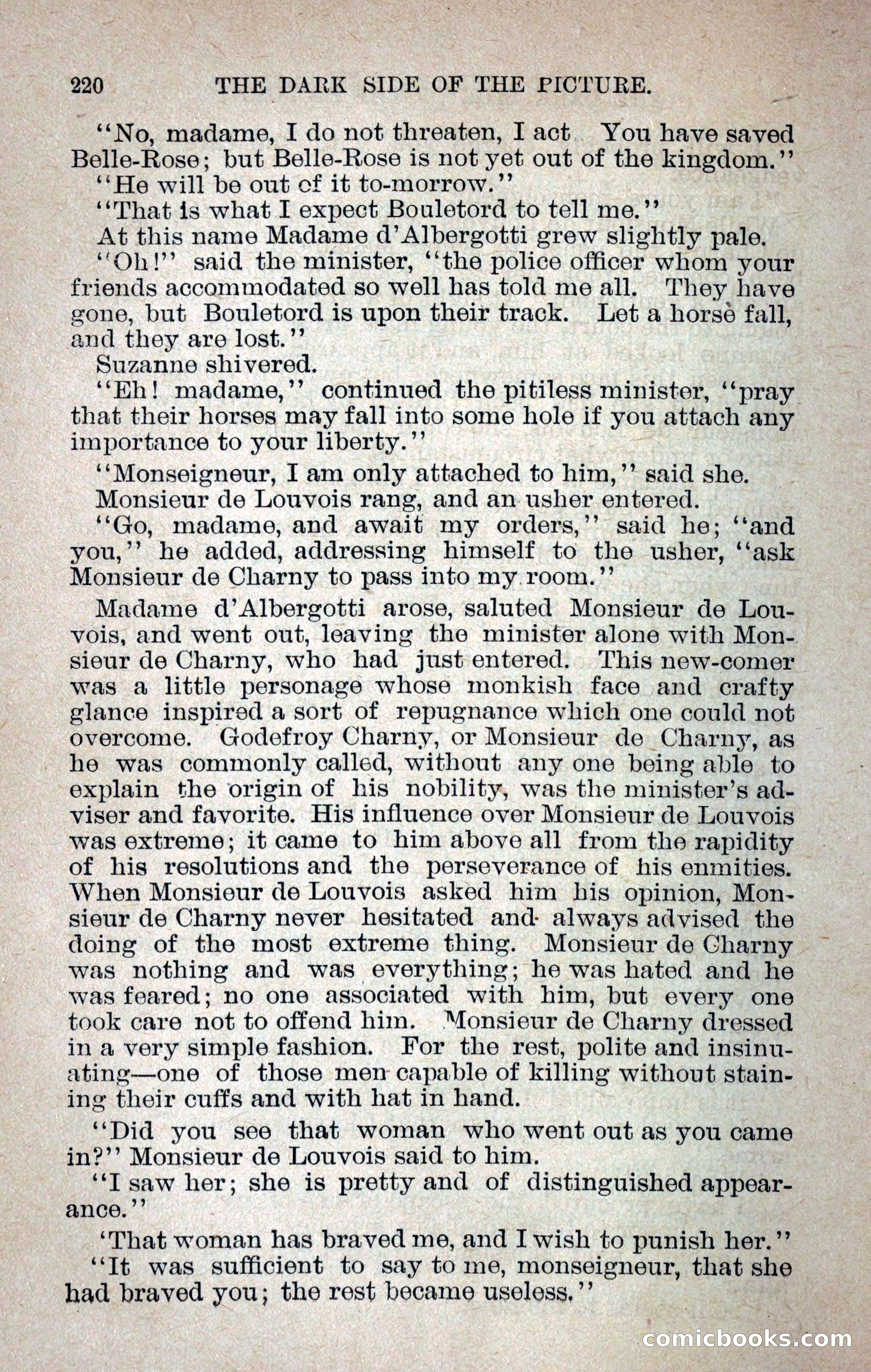
A restored page from Penny Dreadfuls, 1895. Page through the whole issue in the reader above.
📄 Transcribed text from this page (OCR, searchable)
Machine-transcribed from the original scan — historical spelling and the odd misread are preserved.
~~ 2200 THE DARK SIDE OF THE PICTURE. ‘‘No, madame, I do not threaten, I act. You have saved Belle-Rose; but Belle-Rose is not yet out of the kingdom.”’ “He will be out of it to-morrow.’ “That is what I expect Bouletord to tell me.”’ At this name Madame d’Albergotti grew slightly pale. “Ohl? said the minister, ‘‘the police officer whom your friends accommodated so well has told me all. They. have sone, but Bouletord is aPOR their track. Let a horse fall, and they are lost.”’ Suzanne shivered. ‘‘Kh! madame,’’ continued the pitiless minister, ‘‘pray that their horses may fall into some hole if you attach any importance to your liberty.’’ ‘‘Monseigneur, I am only attached to him,’’ said she. Monsieur de Louvois rang, and an usher entered. ‘‘Go, madame, and await my orders,’’ said he; ‘‘and you,’’ he added, addressing himself to the usher, ‘‘ask Monsieur de Charny to pass into my room.”’ Madame d’Albergotti arose, saluted Monsieur de Lou- vois, and went out, leaving the minister alone with Mon-. sieur de Charny, who had just entered. This new-comer was a little personage whose monkish face and crafty glance inspired a sort of repugnance which one could not overcome. Godefroy Charny, or Monsieur de Charny, as he was commonly called, without any one being able to explain the origin of his nobility, was the minister’s ad- viser and favorite. His influence over Monsieur de Louvois was extreme; it came to him above all from the rapidity of his resolutions and the perseverance of his enmities. When Monsieur de Louvois asked him his opinion, Mon- sieur de Charny never hesitated and always advised the doing of the most extreme thing. Monsieur de Charny was nothing and was everything; he was hated and he was feared; no one associated with him, but every one took care not to offend him. Monsieur de Charny dressed in a very simple fashion. For the rest, polite and insinu- ating—one of those men capable of killing without stain- ing their cuffs and with hat in hand. ‘Did you see that woman who went out as you came in?’’ Monsieur de Louvois said to him. ‘‘T saw her; she is pretty and of distinguished appear- ance.’’ ‘That woman has braved me, and I wish to punish her.’ “Tt was sufficient to say to me, monseigneur, that ‘iis had braved you; the rest became useless. 4 ;comicbooks mn? (eo)