
Penny Dreadfuls, 1895 · page 13 of 394
Belle Rose: A Romance of the Cloak and Sword — page 13: what you’re looking at
A restored page from Penny Dreadfuls, 1895. Page through the whole issue in the reader above.
📄 Transcribed text from this page (OCR, searchable)
Machine-transcribed from the original scan — historical spelling and the odd misread are preserved.
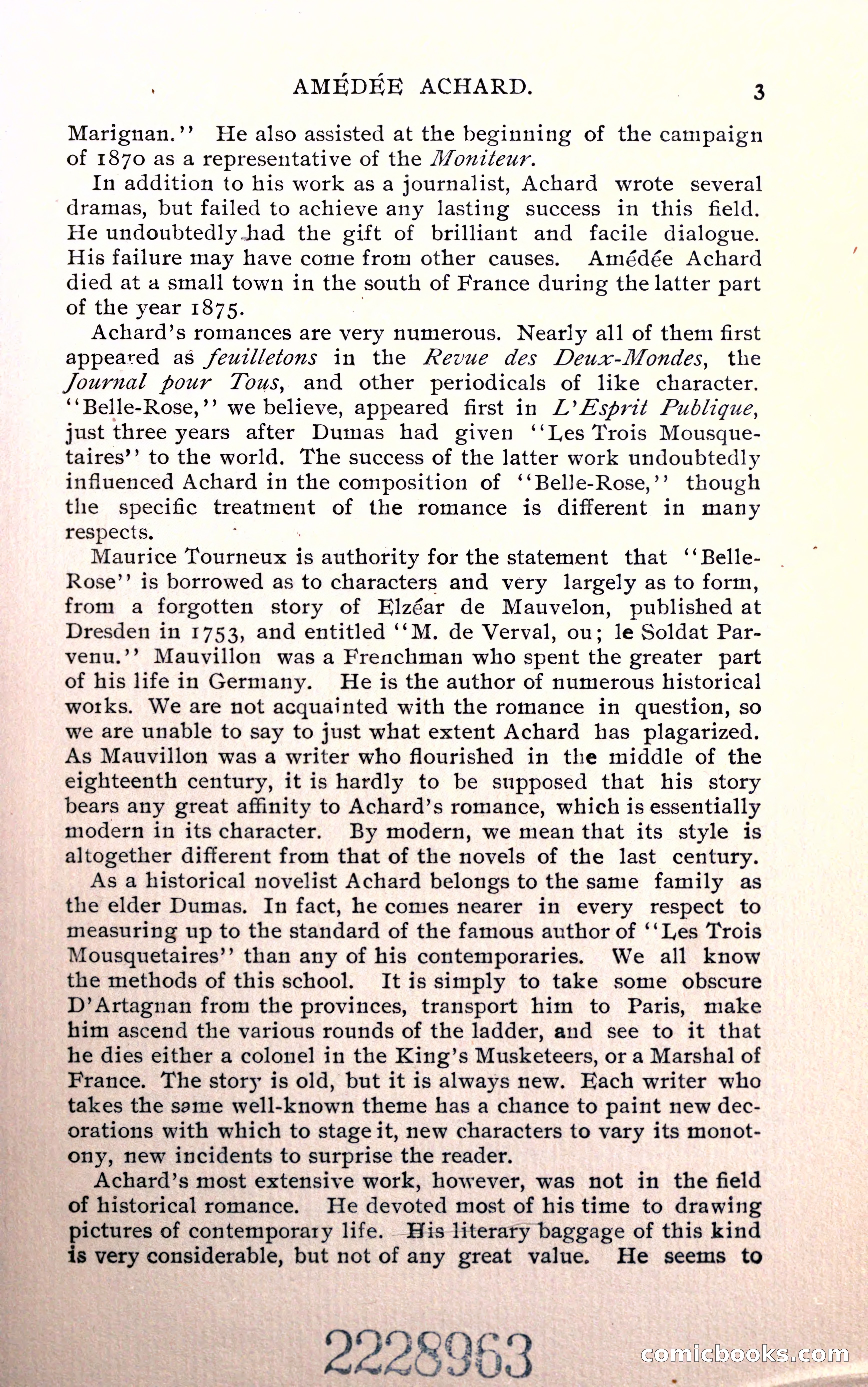
AMEDEE ACHARD. | : Marignan.’’ He also assisted at the beginning of the campaign of 1870 as a representative of the J/onzteur. In addition to his work as a journalist, Achard wrote several dramas, but failed to achieve any lasting success in this field. He undoubtedly had the gift of brilliant and facile dialogue. His failure may have come from other causes. Amédée Achard died at a small town in the south of France during the latter part of the year 1875. | Achard’s romances are very numerous. Nearly all of them first appeared as feuilletons in the Revue des Deux-Mondes, the Journal pour Tous, and other periodicals of like character. ‘‘Belle-Rose,’’ we believe, appeared first in ZL’ Esprit Publique, just three years after Dumas had given ‘‘Les Trois Mousque- taires’’ to the world. The success of the latter work undoubtedly influenced Achard in the composition of ‘‘Belle-Rose,’’ though the specific treatment of the romance is different in many respects. ; Maurice Tourneux is authority for the statement that ‘‘Belle- Rose’’ is borrowed as to characters and very largely as to form, from a forgotten story of Elzéar de Mauvelon, published at Dresden in 1753, and entitled ‘‘M. de Verval, ou; le Soldat Par- venu.’’ Mauvillon was a Frenchman who spent the greater part of his life in Germany. He is the author of numerous historical works. We are not acquainted with the romance in question, so we are unable to say to just what extent Achard has plagarized. As Mauvillon was a writer who flourished in the middle of the eighteenth century, it is hardly to be supposed that his story bears any great affinity to Achard’s romance, which is essentially modern in its character. By modern, we mean that its style is altogether different from that of the novels of the last century. As a historical novelist Achard belongs to the same family as the elder Dumas. In fact, he comes nearer in every respect to measuring up to the standard of the famous author of ‘‘Les Trois Mousquetaires’’ than any of his contemporaries. We all know the methods of this school. It is simply to take some obscure D’ Artagnan from the provinces, transport him to Paris, make him ascend the various rounds of the ladder, and see to it that he dies either a colonel in the King’s Musketeers, or a Marshal of France. The story is old, but it is always new. Each writer who takes the same well-known theme has a chance to paint new dec- orations with which to stageit, new characters to vary its monot- ony, new incidents to surprise the reader. Achard’s most extensive work, however, was not in the field of historical romance. He devoted most of his time to drawing pictures of contemporary life. His literary baggage of this kind is very considerable, but not of any great value. He seems to (E@) LAA) 2228963 Eomicbook