
Penny Dreadfuls, 1868 · page 112 of 400
Black Bess; or, The Knight of the Road — A Tale of the Good Old Times — page 112: what you’re looking at
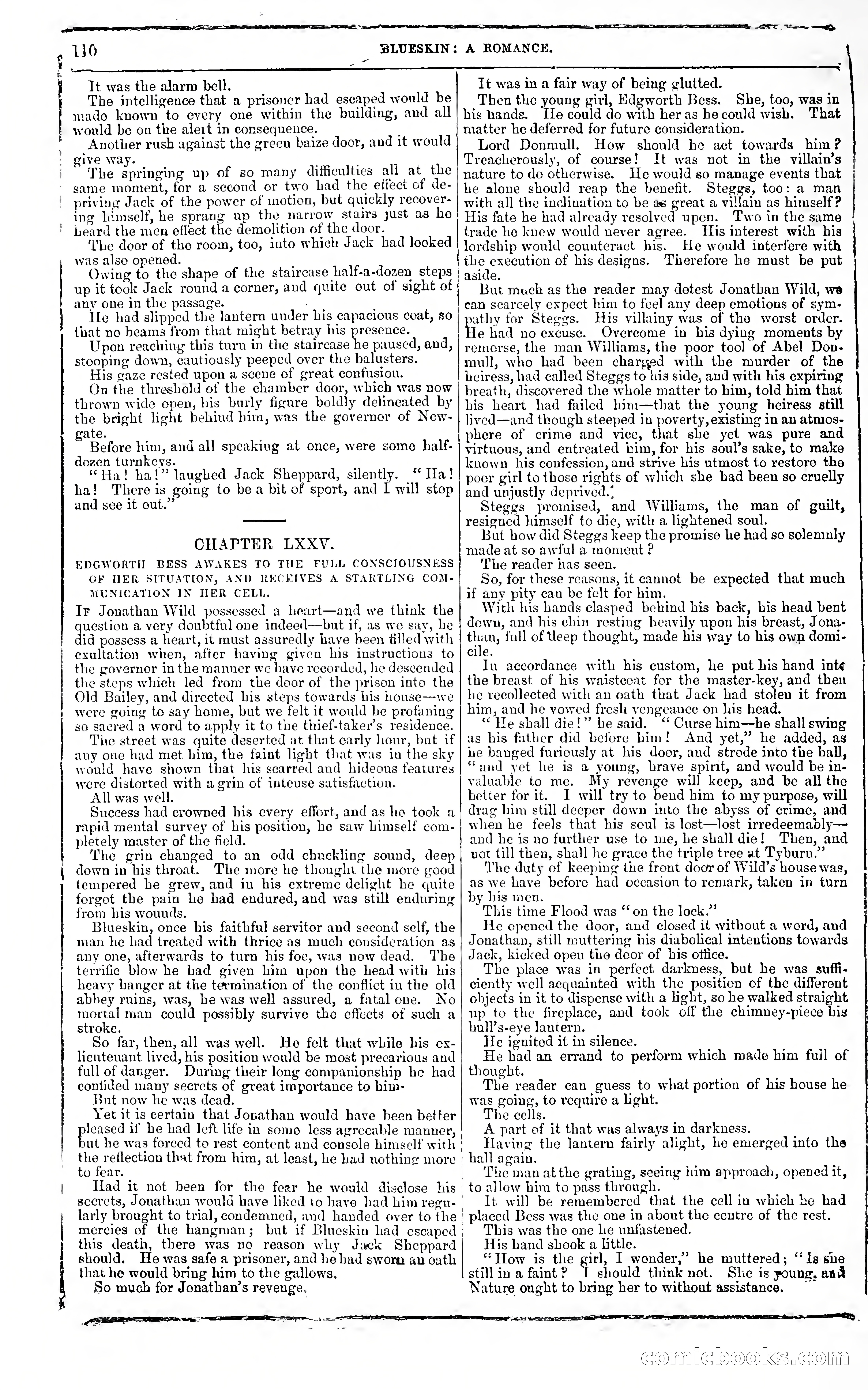
A restored page from Penny Dreadfuls, 1868. Page through the whole issue in the reader above.
📄 Transcribed text from this page (OCR, searchable)
Machine-transcribed from the original scan — historical spelling and the odd misread are preserved.
eo NAPE IS SH A ICIREAO ERE EEIONS, 7a ee oe i af o— ' eer a 116 7 - It was the alarm bell. The intelligence that a prisoner had escaped would be made known to every one within the building, and all would be on the aleit in consequence. Another rush against the green baize door, and it would give way. The springing up of so many difficulties all at the same moment, for a second or two had the effect of de- priving Jack of the power of motion, but quickly recover- _ ing himself, he sprang up the narrow stairs just as he heard the men effect the demolition of the door. The door of the room, too, into which Jack bad looked was also opened. Owing to the shape of the staircase half-a-dozen steps up it took Jack round a corner, and quite out of sight ot any one in the passage. | Ile had slipped the lantern uuder his capacious coat, so that no beams from that might betray his presence. Upon reaching this turn in the staircase he paused, and, stooping down, cautiously peeped over the balusters. His gaze rested upon a scene of great confusion. On the threshold of the chamber door, which was now thrown wide open, his burly figure boldly delineated by the bright light behind him, was the governor of New- ate. ° Before him, and all speaking at once, were some half- dozen turnkevs. “Via! ha!” laughed Jack Sheppard, silently. ‘ Ha! ha! There is going to bea bit of sport, and I will stop and see it out.” CHAPTER LXXYV. EDGWORTI!] BESS AWAKES TO THE FULL CONSCIOUSNESS OF TIER SITUATION, AND RECEIVES A STARTLING COM- MUNICATION IN HER CELL. Ir Jonathan Wild possessed a heart—and we think the question a very doubtful one indeed—but if, as we say, he did possess a heart, it must assuredly have heen filled with exultation when, after having given his instructions to the governor in the manner we have recorded, he descended the steps which led from the door of the prison into the Old Bailey, and directed his steps towards lis house—we were going to say home, but we felt it would be protaning so sacred a word to apply it to the thief-taker’s residence. The street was quite deserted at that early hour, but if any one had met him, the faint light that was in the sky would have shown that his scarred and hideous features were distorted with a grin of inteuse satisfaction. All was well. Success had crowned his every effort, and as he took a rapid mental survey of his position, he saw himself com- pletely master of the field. The grin changed to an odd chuckling sound, deep down in his throat. The more he thought the more good tempered he grew, and in his extreme delight he quite forgot the pain he had endured, and was still enduring from his wounds. Blueskin, once his faithful servitor and second self, the man he had treated with thrice as much consideration as any one, afterwards to turn his foe, was now dead. The terrific blow he had given him upon the head with his heavy hanger at the termination of the conflict in the old abbey ruins, was, he was well assured, a fatal one. No mortal man could possibly survive the effects of such a stroke. So far, then, all was well. He felt that while his ex- hentenant lived, his position would be most precarious and full of danger. During their long companionship he had confided many secrets of great importance to him- But now he was dead. Yet it is certain that Jonathan would have been better pee if he had left life in some less agreeable manner, ut he was forced to rest content and console himself with ne reflection that from him, at least, he had nothing more o fear. Ilad it not been for the fear he would disclose his. secrets, Jonathan would have liked to have had him regu- | larly brought to trial, condemned, and handed over to the | mercies of the hangman; but if Blueskin had escaped | this death, there was no reason why Jack Sheppard should. He was safe a prisoner, and he had sworm an oath that he would bring him to the gallows, So much for Jonathan’s revenge. ES a ———o AER | Uarns, gy SLUESKIN: A ROMANCE, 6 geet cee pele =e Pa Sa Ee ne, It was in a fair way of being glutted. Then the young girl, Edgworth Bess. She, too, was in his hands. He could do with heras he could wish. That matter he deferred for future consideration. Lord Donmull. How should he act towards Treacherously, of course! It was not in the villain’s nature to do otherwise. He would so manage events that he alone should reap the benefit. Steggs, too: a man with all the inclination to be ae great a villain as himself? His fate he had already resolved upon. Two in the same trade he kuew would never agree. Ilis interest with his lordship would counteract his. He would interfere with eheesecution of his designs. Therefore he must be put aside. But mach as the reader may detest Jonathan Wild, we can scarcely expect him to feel any deep emotions of sym. athy for Steggs. His villainy was of the worst order. Te had no excuse. Overcome in his dying moments by remorse, the man Williams, the poor tool of Abel Don- mull, who had been charged with the murder of the heiress, had called Steggs to his side, and with his expinng breath, discovered the whole matter to him, told him that his heart had failed him—that the young heiress still lived—and though steeped in poverty, existing 1n an atmos- phere of crime and vice, that she yet was pure and virtuous, and entreated him, for his soul’s sake, to make known his confession, and strive his utmost to restore tho poor girl to those rights of which she had been so cruelly and unjustly deprived.; Steggs promised, and Williams, the man of guilt, resigned himself to die, with a lightened soul. But how did Steggs keep the promise he had so solemnly made at so awful a moment ? The reader has seen. So, for these reasons, it cannot be expected that much if any pity can be telt for him. With his hands clasped behind his back, his head bent down, and his chin resting heavily upon his breast, Jona- than, full of deep thought, made his way to his own domi- cile. In accordance with his custom, he put his hand int¢ the breast of his waistcoat for the master-key, and then he recollected with an oath that Jack had stolen it from him, and he vowed fresh vengeance on his head. “We shall die!” he said. ‘‘ Curse him—he shall swing as his father did betore him! And yet,’ he added, as he banged furicusly at his door, and strode into the hall, “and yet he is a young, brave spirit, and would be in- valuable to me. My revenge will keep, and be all the better for it. I will try to bend him to my purpose, will drag him still deeper down into the abyss of crime, and when he feels that his soul 1s lost—lost irredeemably— and he is no further use to me, he shall die! Then, and not till then, shall he grace the triple tree at Tyburn.”’ The duty of keeping the front door of Wild’s house was, as we have before had occasion to remark, taken in turn by his men. This time Flood was “on the lock.” He opened the door, and closed it without a word, and Jonathan, still muttering his diabolical intentions towards Jack, kicked open the door of his office. The place was in perfect darkness, but he was suffi- ciently well acquainted with the position of the different objects in it to dispense with a hght, so he walked straight up to the fireplace, and took off the chimney-piece his bull’s-eye Jantern. He ignited it in silence. He had an errand to perform which made him fuil of thought. The reader can guess to what portion of his house he was going, to require a light. The cells. A part of it that was always in darkness. Having the lantern fairly alight, he emerged into the him ? hall again. The man atthe grating, seeing him approach, opened it, to allow him to pass through. It will be remembered that the cell in which be had placed Bess was the one in about the centre of the rest. This was the one he unfastened. His hand shook a little. “ How is the girl, 1 wonder,’ he muttered; “Is sue still in a faint? I should think not. She is poung, and Nature ought to bring her to without assistance. GOMMIGIIOO C <SnGOlin