
Penny Dreadfuls, 1868 · page 242 of 400
Black Bess; or, The Knight of the Road — A Tale of the Good Old Times — page 242: what you’re looking at
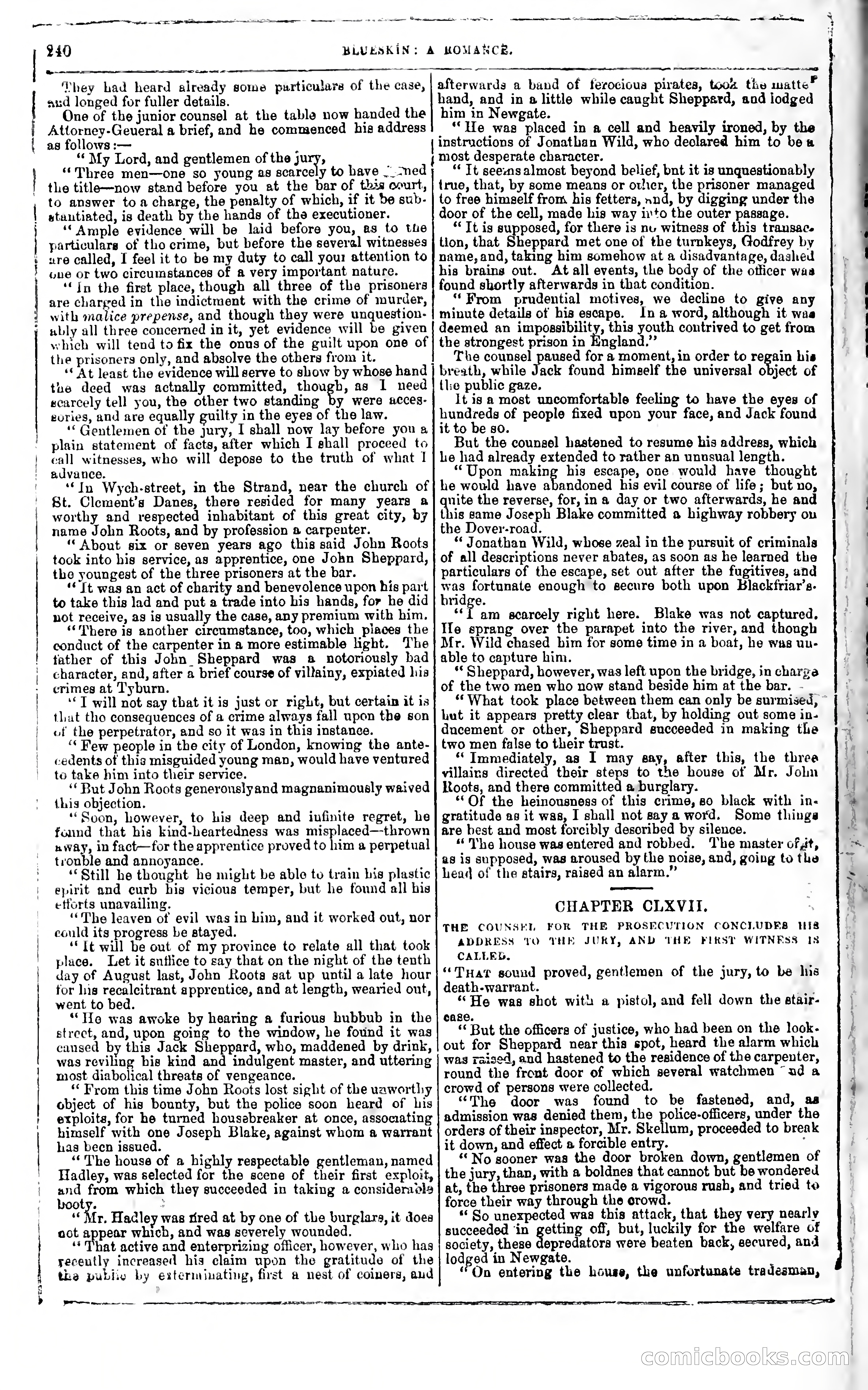
A restored page from Penny Dreadfuls, 1868. Page through the whole issue in the reader above.
📄 Transcribed text from this page (OCR, searchable)
Machine-transcribed from the original scan — historical spelling and the odd misread are preserved.
war ee ee Oe ee — ~~ we ~ em mpm cng cy cr ce oe a eed aS hen rer rn oe ca I IO ig orl ~SaPO Ninel RE ee ee 8 240 Be = es, i en eee aid longed for fuller details. Whey had heard slready some purticulars of the case, | afterwards a band of ferocioua pirates, tooa the matte” eseur - _— as + ee age ee, ey area ee See te a a te pamela. ao lemon ttn, BLUESKIN: A MOMANCR, SS ee pee hand, and in a little while caught Sheppard, and lodged One of the junior counsel at the table now handed the| him in Newgate. Attorney-Geueral a brief, and he commenced hia address as follows :— . ‘‘ My Lord, and gentlemen of the jury, ‘‘Three men—one so young as scarcely to bave ned the title—now stand before you at the bar of this court, to answer toa charge, the penalty of which, if it be sub- atuutiated, is death by the hands of tha executioner. ‘“Ample evidence will be laid before you, as to the particulars of tho crime, but before the several witnesses ure called, I feel it to be my duty to call your attention to oue or two circumstances of a very important nature. ‘(Tn the first place, though all three of the prisoners are charged in the indictment with the crime of murder, with malice prepense, and though they were unquestion- ubly all three concerned in it, yet evidence will be given which will tend ta fix the onus of the guilt upon one of the prisoners only, and absolve the others from it. ‘At least the evidence will serve to show by whose hand | the deed was actnally committed, though, as I need ecarcely tell you, the other two standing by were acces- eories, and are equally guilty in the eyes of the law. ‘“ Gentlemen of the jury, I shall now lay before you a plain statement of facts, after which I shall proceed to call witnesses, who will depose to the truth of what I advance. ‘‘In Wych-street, in the Strand, near the church of St. Clement's Danes, there resided for many yeara a worthy and respected inhabitant of this great city, b7 name John Roots, and by profession a carpenter. ‘“ About six or seven years ago this said John Roots took into his service, as apprentice, one John Sheppard, the youngest of the three prisoners at the bar. ‘“Tt was an act of charity and benevolence upon his part to take this lad and put a trade into bis hands, for he did not receive, as is usually the case, any premium with him. ‘There ig another circumstance, too, which places the conduct of the carpenter in a more estimable hight. The father of this John Sheppard was a notoriously bad character, and, after a brief course of villainy, expiated his crimes at Tyburn. ‘¢T will not say that it is just or right, but certain at 1s tlhat tho consequences of a crime always fall upon the son of the perpetrator, and so it was in this instanee. “« Few people in the city of London, knowing the ante- cedents of this misguided young man, would have ventured to take him into their service. ‘But John Roots generonslyand magnanimously waived {his objection. ‘Soon, however, to his deep and iufinite regret, he found that his kind-heartedness was misplaced—thrown nway, in fact—for the apprentice proved to him a perpetual! trouble and annoyance. ‘Still he thought he might be able to train his plastic epirit and curb hig vicious temper, but he found all his etforts unavailing. “The leaven of evil was in him, and it worked out, nor could its progress be stayed. ‘Tt will be out of my province to relate all that took place. Let it sntlice to say that on the night of the tenth day of August last, John Roots sat up until a late hour for his recalcitrant apprentice, and at length, wearied out, went to bed. “To was awoke by hearing a furious hubbub in the strect, and, upon going to the window, he found it was cansed by this Jack Sheppard, who, maddened by drink, was reviling bis kind and indulgent master, and uttering most diabolical threats of vengeance. “ Brom this time John Roots lost sight of the uaworthy object of his bounty, but the police soon heard of his exploits, for he turned housebreaker at once, associating himself with one Joseph Blake, against whom a warrant has been issued. ‘The house of a highly respectable gentleman, named Hadley, was selected for the scene of their first exploit, and from which they succeeded in taking a considernols booty. , ot Mr. Hacley waa fred at by one of the burglars, it does aot appear which, and was severely wounded. ‘‘ That active and enterprizing officer, however, who hag seceutly increased his claim upon the gratitude of the the publio by exterminating, first a nest of coiners, aud | nie! a ey OR ‘“W{e waa placed in a cell and heavily ironed, by the instructions of Jonathan Wild, who declared him to bea most desperate character. ‘* Tt seexnsalmost beyond belief, but it 1s unquestionably true, that, by some means or other, the prisoner managed to free himaelf from his fetters, nnd, by digging under the door of the cell, made his way into the outer passage. ‘“ Tt is supposed, for there is nu witness of this transac. tion, that Sheppard met one of the turnkeys, Godfrey by name, and, taking him somehow at a disadvantage, dashed his braing out. At all events, the body of the officer waa found shortly afterwards in that condition. “From prudential motives, we decline to give any minute details of his escape. Ina word, although it waa deemed an impossibility, this youth contrived to get from the strongest prison in England.” The counsel paused for a moment, in order to regain his breath, while Jack found himeelf the universal object of {le public gaze. It is a most uncomfortable feeling to have the eyes of hundreds of people fixed upon your face, and Jack found it to be so. But the counsel hastened to resume his address, which lie had already extended to rather an unusual length. “Upon making his escape, one would have thought he would have abandoned his evil course of life; but no, quite the reverse, for, in a day or two afterwards, he and this same Joseph Blake committed a highway robbery ou the Dover-road. “Jonathan Wild, whose zeal in the pursuit of criminals of all descriptions never abates, as soon as he learned the particulars of the escape, set out after the fugitives, and ie fortunate enough to secure both upon Blackfriar’s. ridge. ‘“‘f am scarcely right here. Blake was not captured, Ife sprang over the parapet into the river, and though Mr. Wild chased bim for some time in a boat, he was un- able to capture him. ‘** Sheppard, however, was left upon the bridge, in charge of the two men who now stand beside him at the bar. - ‘What took place between them can only be surmised, ~ hut it appears pretty clear that, by holding out some in- ducement or other, Sheppard succeeded in making the two men false to their trust. ‘Immediately, as I may aay, after this, the three villains directed their steps to the house of Mr. Jolm Roots, and there committed a burglary. ‘““Of the heinousness of this crime, so black with in. gratitude ag it was, I shall not say a word. Some things are best and most forcibly desoribed by silence. ‘“I’he house was entered and robbed. ‘The master of,t, as is supposed, was aroused by the noise, and, going to the head of the stairs, raised an alarm.” CHAPTER CLXVIT. THE COUNSEL FOR THE PROSECUTION CONCLUDES HI8 ADDRESS YO THE JURY, AND THE FIRST WITNESS 18 CALLED. “Tar sound proved, gentlemen of the jury, to be Ins death-warrant. »* ‘He was shot with a pistol, and fell down the atair- onge. ‘‘ But the officera of justice, who had been on the look- out for Sheppard near this spot, heard the alarm which was raised, and hastened to the residence of the carpenter, round the front door of which several watchmen “ad a crowd of persons were collected. ‘<The door was found to be fastened, and, as admission wag denied them, the police-officers, under the orders of their inspector, Mr. Skellum, proceeded to break it down, and effect a forcible entry. ‘No sooner waa the door broken down, gentlemen of the jury, than, with a boldnes that cannot but be wondered at, the three prisoners made a vigorous rush, and tried te force their way through the crowd. ‘So unexpected was this attack, that they very nearly succeeded ‘in getting off, but, luckily for the welfare of society, these depredators were beaten back, secured, and lodged in Newgate. “On entering the house, the unfortunate tradesman, awy t, L ‘ s | | f r 5 \ f \ \ re (C(O) 6) (OC) GC SS} o(CO) 5} i