
Penny Dreadfuls, 1858 · page 107 of 400
The Young Duchess; or, Memoirs of a Lady of Quality — page 107: what you’re looking at
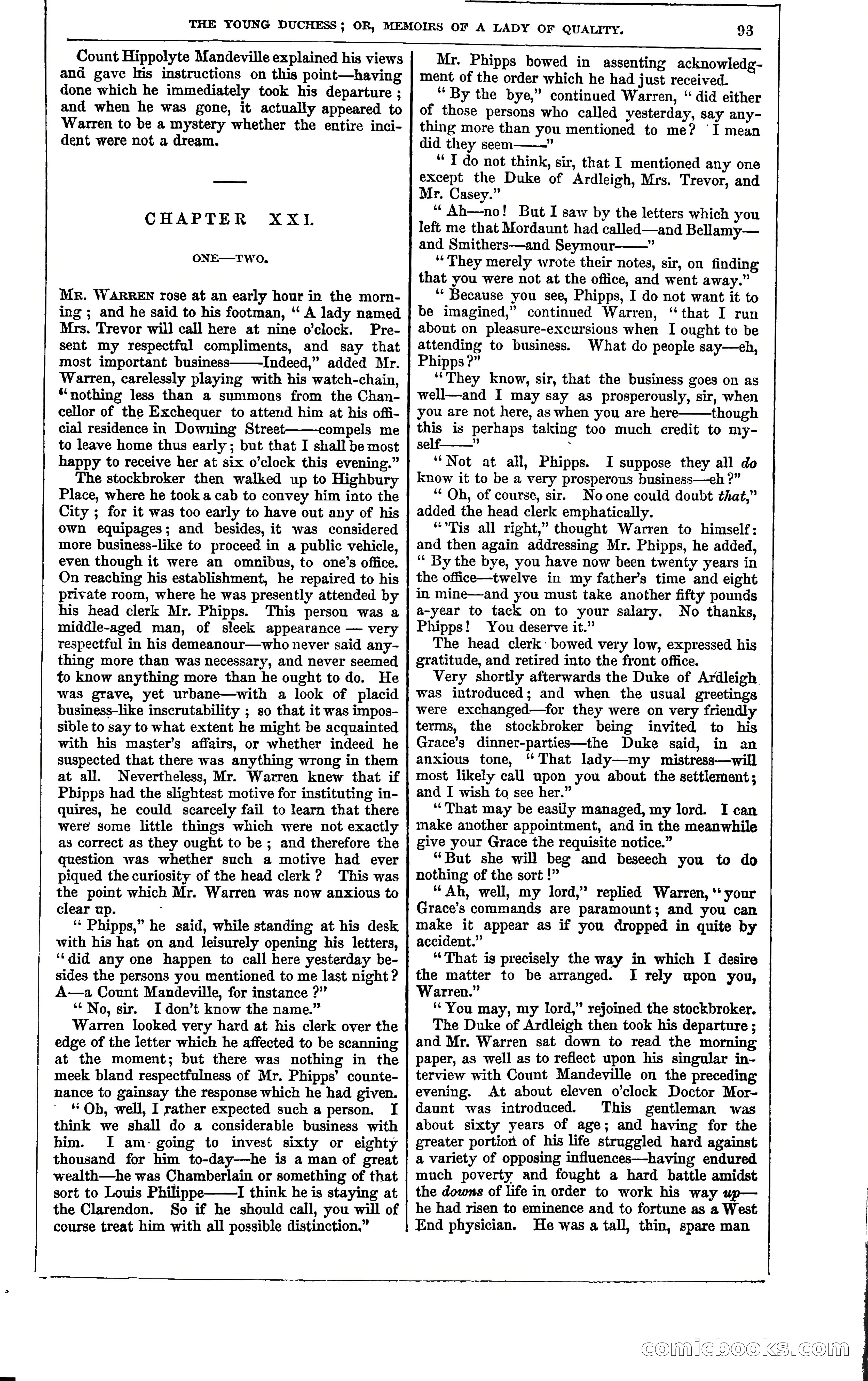
A restored page from Penny Dreadfuls, 1858. Page through the whole issue in the reader above.
📄 Transcribed text from this page (OCR, searchable)
Machine-transcribed from the original scan — historical spelling and the odd misread are preserved.
THE YOUNG DUCHESS; OR, MEMOIRS OF A LADY OF QUALITY. Count Hippolyte Mandeville explained his views and gave lis instructions on this point—having done which he immediately took his departure ; and when he was gone, it actually appeared to Warren to be a mystery whether the entire inci- dent were not a dream. CHAPTER XXI. ONE—TWO, Mr. WARREN rose at an early hour in the morn- ing ; and he said to his footman, “ A lady named Mrs. Trevor will call here at nine o'clock. Pre- sent my respectful compliments, and say that most important business Indeed,” added Mr. Warren, carelessly playing with his watch-chain, “nothing less than a summons from the Chan- cellor of the Exchequer to attend him at his offi- cial residence in Downing Street-——-compels me to leave home thus early ; but that I shall be most happy to receive her at six o’clock this evening.” The stockbroker then walked up to Highbury Place, where he took a cab to convey him into the City ; for it was too early to have out any of his own equipages; and besides, it was considered more business-like to proceed in a public vehicle, even though it were an omnibus, to one’s office. On reaching his establishment, he repaired to his private room, where he was presently attended by his head clerk Mr. Phipps. This person was a middle-aged man, of sleek appearance — very respectful in his demeanour—who never said any- thing more than was necessary, and never seemed to know anything more than he ought to do. He was grave, yet urbane—with a look of placid business-like inscrutability ; so that it was impos- sible to say to what extent he might be acquainted with his master’s affairs, or whether indeed he suspected that there was anything wrong in them at all. Nevertheless, Mr. Warren knew that if Phipps had the slightest motive for instituting in- quires, he could scarcely fail to learn that there were some little things which were not exactly as correct as they ought to be ; and therefore the question was whether such a motive had ever piqued the curiosity of the head clerk ? This was the point which Mr. Warren was now anxious to clear up. ‘“‘ Phipps,” he said, while standing at his desk with his hat on and leisurely opening his letters, ‘did any one happen to call here yesterday be- sides the persons you mentioned to me last night ? A—a Count Mandeville, for instance ?” ‘No, sir. I don’t know the name.” Warren looked very hard at his clerk over the edge of the letter which he affected to be scanning at the moment; but there was nothing in the meek bland respectfulness of Mr. Phipps’ counte- nance to gainsay the response which he had given. ' Qh, well, I rather expected such a person. I think we shall do a considerable business with him. I am-~ going to invest sixty or eighty thousand for him to-day—-he is a man of great wealth—he was Chamberlain or something of that sort to Louis Philippe——I think he is staying at the Clarendon. So if he should call, you will of course treat him with all possible distinction.” 93 Mr. Phipps bowed in assenting acknowledg- ment of the order which he had just received. ‘‘ By the bye,” continued Warren, “ did either of those persons who called yesterday, say any- thing more than you mentioned to me? ‘I mean did they seem ” “I do not think, sir, that I mentioned any one except the Duke of Ardleigh, Mrs. Trevor, and Mr. Casey.” ‘“‘ Ah—no! But I saw by the letters which you left me that Mordaunt had called—and Bellamy— and Smithers—and Seymour ‘. ‘They merely wrote their notes, sir, on finding that you were not at the office, and went away.” ‘* Because you see, Phipps, I do not want it to be imagined,” continued Warren, “that I run about on pleasure-excursions when I ought to be attending to business. What do people say—eh, Phipps ?” “They know, sir, that the business goes on as well—and I may say as prosperously, sir, when you are not here, as when you are here though this is perhaps taking too much credit to my- self. 39 ‘ “Not at all, Phipps. I suppose they all do know it to be a very prosperous business—eh ?” ‘* Oh, of course, sir. Noone could doubt that,” added the head clerk emphatically. “Tis all right,” thought Warren to himself: and then again addressing Mr. Phipps, he added, ‘‘ By the bye, you have now been twenty years in the office—twelve in my father’s time and eight in mine—and you must take another fifty pounds a-year to tack on to your salary. No thanks, Phipps! You deserve it.” The head clerk: bowed very low, expressed his gratitude, and retired into the front office. Very shortly afterwards the Duke of Ardleigh was introduced; and when the usual greetings were exchanged—for they were on very friendly terms, the stockbroker being invited, to his Grace’s dinner-parties—the Duke said, in an anxious tone, “That lady—my mistress—will most likely call upon you about the settlement; and I wish to see her.” “That may be easily managed, my lord. I can make another appointment, and in the meanwhile give your Grace the requisite notice.” “But she will beg and beseech you to do nothing of the sort !” ‘“‘ Ah, well, my lord,” replied Warren, ‘* your Grace’s commands are paramount; and you can make it appear as if you dropped in quite by accident.” “That is precisely the way in which I desire the matter to be arranged. I rely upon you, Warren.” ‘You may, my lord,” rejoined the stockbroker. The Duke of Ardleigh then took his departure ; and Mr. Warren sat down to read the morning paper, as well as to reflect upon his singular in- terview with Count Mandeville on the preceding evening. At about eleven o’clock Doctor Mor- daunt was introduced. This gentleman was about sixty years of age; and having for the greater portion of his life struggled hard against a variety of opposing influences—having endured much poverty and fought a hard battle amidst the downs of life in order to work his way wp— he had risen to eminence and to fortune as a West End physician. He was a tall, thin, spare man COMO oO Colin