
Penny Dreadfuls, 1858 · page 113 of 400
The Young Duchess; or, Memoirs of a Lady of Quality — page 113: what you’re looking at
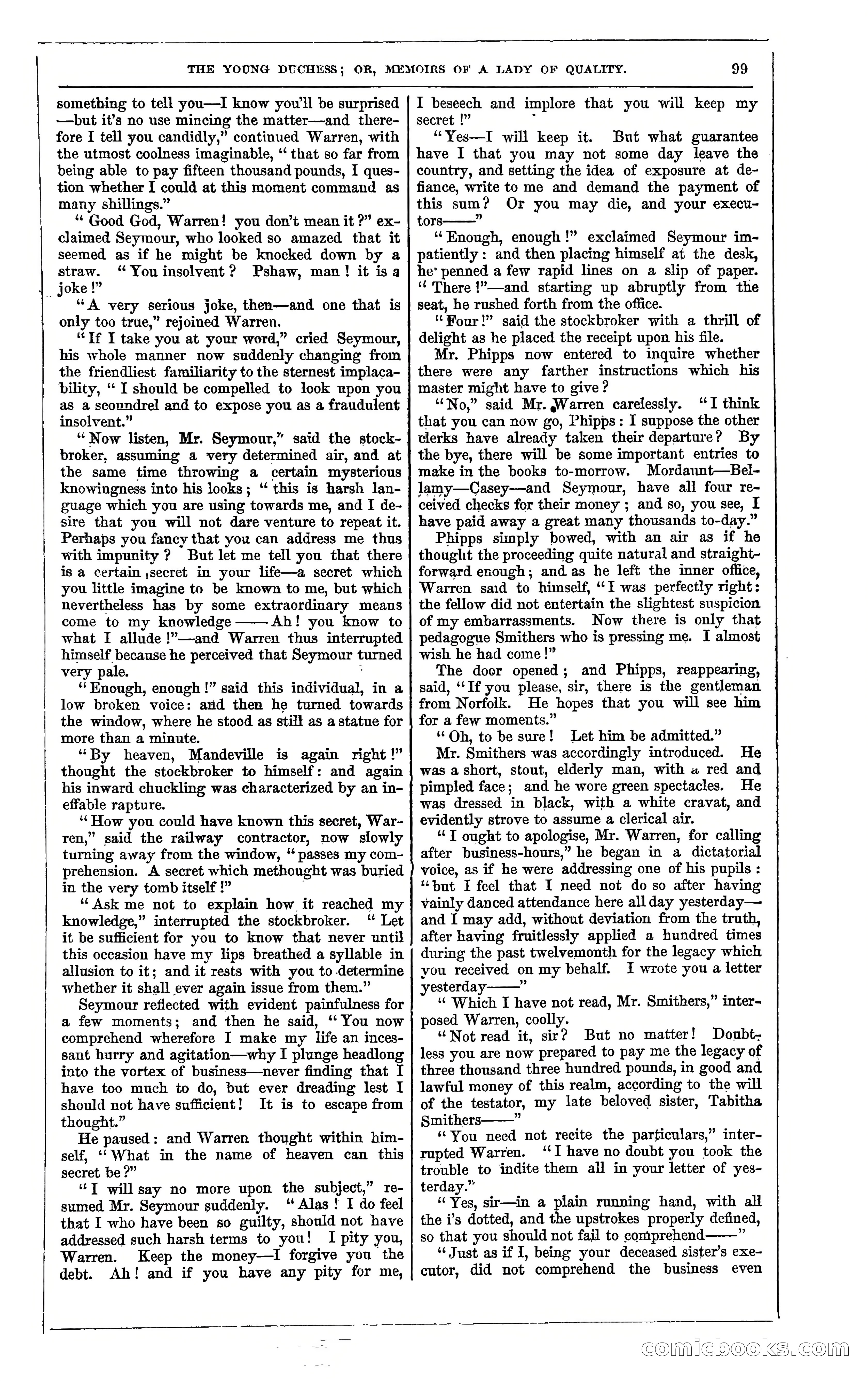
A restored page from Penny Dreadfuls, 1858. Page through the whole issue in the reader above.
📄 Transcribed text from this page (OCR, searchable)
Machine-transcribed from the original scan — historical spelling and the odd misread are preserved.
THE YOUNG DUCHESS; OR, MEMOIRS OF A LADY OF QUALITY. something to tell you—I know you'll be surprised —but it’s no use mincing the matter—and there- fore I tell you candidly,” continued Warren, with the utmost coolness imaginable, ‘‘ that so far from being able to pay fifteen thousand pounds, I ques- tion whether I could at this moment command as many shillings.” “‘ Good God, Warren! you don’t mean it ?” ex- claimed Seymour, who looked so amazed that it seemed as if he might be knocked down by a straw. “You insolvent? Pshaw, man! it is a _ joke!” ‘““A very serious joke, then—and one that is only too true,” rejoined Warren. “If I take you at your word,” cried Seymour, his whole manner now suddenly changing from the friendliest familiarity to the sternest implaca- bility, ‘‘ I should be compelled to look upon you as a scoundrel and to expose you as a fraudulent insolvent.” ‘“‘ Now listen, Mr. Seymour,” said the stock- broker, assuming a very determined air, and at the same time throwing a certain mysterious knowingness into his looks; “ this is harsh lan- guage which you are using towards me, and I de- sire that you will not dare venture to repeat it. Perhaps you fancy that you can address me thus with impunity ? But let me tell you that there is a certain ,secret in your life—a secret which you little imagine to be known to me, but which nevertheless has by some extraordinary means come to my knowledge Ah! you know to what I allude !"—and Warren thus interrupted himself because he perceived that Seymour turned very pale. : ‘Enough, enough !” said this individual, in a low broken voice: and then he turned towards the window, where he stood as still as a statue for more than a minute. “‘By heaven, Mandeville is again right!” thought the stockbroker to himself: and again his inward chuckling was characterized by an in- effable rapture. ‘How you could have known this secret, War- ren,” said the railway contractor, now slowly turning away from the window, “‘ passes my com- prehension. A secret which methought was buried in the very tomb itself !” . ““Ask me not to explain how it reached my knowledge,” interrupted the stockbroker. ‘“ Let it be sufficient for you to know that never until this occasion have my lips breathed a syllable in allusion to it; and it rests with you to determine whether it shall ever again issue from them.” Seymour reflected with evident painfulness for a few moments; and then he said, ‘‘ You now comprehend wherefore I make my life an inces- sant hurry and agitation—why I plunge headlong into the vortex of business—never finding that I have too much to do, but ever dreading lest I should not. have sufficient! It is to escape from thought.” He paused: and Warren thought within bhim- self, ‘‘What in the name of heaven can this secret be ?” “‘T willsay no more upon the subject,” re- sumed Mr. Seymour suddenly. ‘Alas! I do feel that I who have been so guilty, should not have addressed such harsh terms to you! I pity you, Warren. Keep the money—lI forgive you the debt. Ah! and if you have any pity for me, 99 I beseech and implore that you will keep my secret !” ° ““Yes—I will keep it. But what guarantee have I that you may not some day leave the - country, and setting the idea of exposure at de- fiance, write to me and demand the payment of this sum? Or you may die, and your execu- tors 2 ‘“‘Knough, enough!” exclaimed Seymour im- patiently: and then placing himself at the desk, he’ penned a few rapid lines on a slip of paper. ‘‘ There !’—and starting up abruptly from the seat, he rushed forth from the office. our!” said the stockbroker with a thrill of delight as he placed the receipt upon his file. Myr. Phipps now entered to inquire whether there were any farther instructions which his master might have to give? “No,” said Mr. Warren carelessly. “I think that you can now go, Phipps: I suppose the other clerks have already taken their departure? By the bye, there will be some important entries to make in the books to-morrow. Mordaunt—Bel- lamy—Casey—-and Seymour, have ali four re- ceived checks for their money ; and so, you see, I have paid away a great many thousands to-day.” Phipps simply bowed, with an air as if he thought the proceeding quite natural and straight- forward enough; and as he left the inner office, Warren said to himself, “I was perfectly right: the fellow did not entertain the slightest suspicion of my embarrassments. Now there is only that pedagogue Smithers who is pressing me. I almost wish he had come!” The door opened; and Phipps, reappearing, said, “If you please, sir, there is the gentleman from Norfolk. He hopes that you will see him for a few moments.” “Qh, to be sure! Let him be admitted.” Mr. Smithers was accordingly introduced. He was a short, stout, elderly man, with a red and pimpled face; and he wore green spectacles. He was dressed in black, with a white cravat, and evidently strove to assume a clerical air. “‘T ought to apologise, Mr. Warren, for calling after business-hours,” he began in a dictatorial voice, as if he were addressing one of his pupils : “but I feel that I need not do so after having vainly danced attendance here all day yesterday— and I may add, without deviation from the truth, after having fruitlessly applied a hundred times during the past twelvemonth for the legacy which you received on my behalf. I wrote you a letter yesterday ” ‘““ Which I have not read, Mr. Smithers,” inter- posed Warren, coolly. ‘Not read it, sir? But no matter! Doubt- less you are now prepared to pay me the legacy of three thousand three hundred pounds, in good and lawful money of this realm, according to the will of the testator, my late beloved sister, Tabitha Smithers e ‘‘You need not recite the particulars,” inter- rupted Warren. ‘I have no doubt you took the trouble to indite them all in your letter of yes- terday.” “Yes, sir—in a plain running hand, with all the i’s dotted, and the upstrokes properly defined, so that you should not fail to comprehend 2 “Just as if I, being your deceased sister’s exe- cutor, did not comprehend the business even oO COMO Colin