
Penny Dreadfuls, 1858 · page 140 of 400
The Young Duchess; or, Memoirs of a Lady of Quality — page 140: what you’re looking at
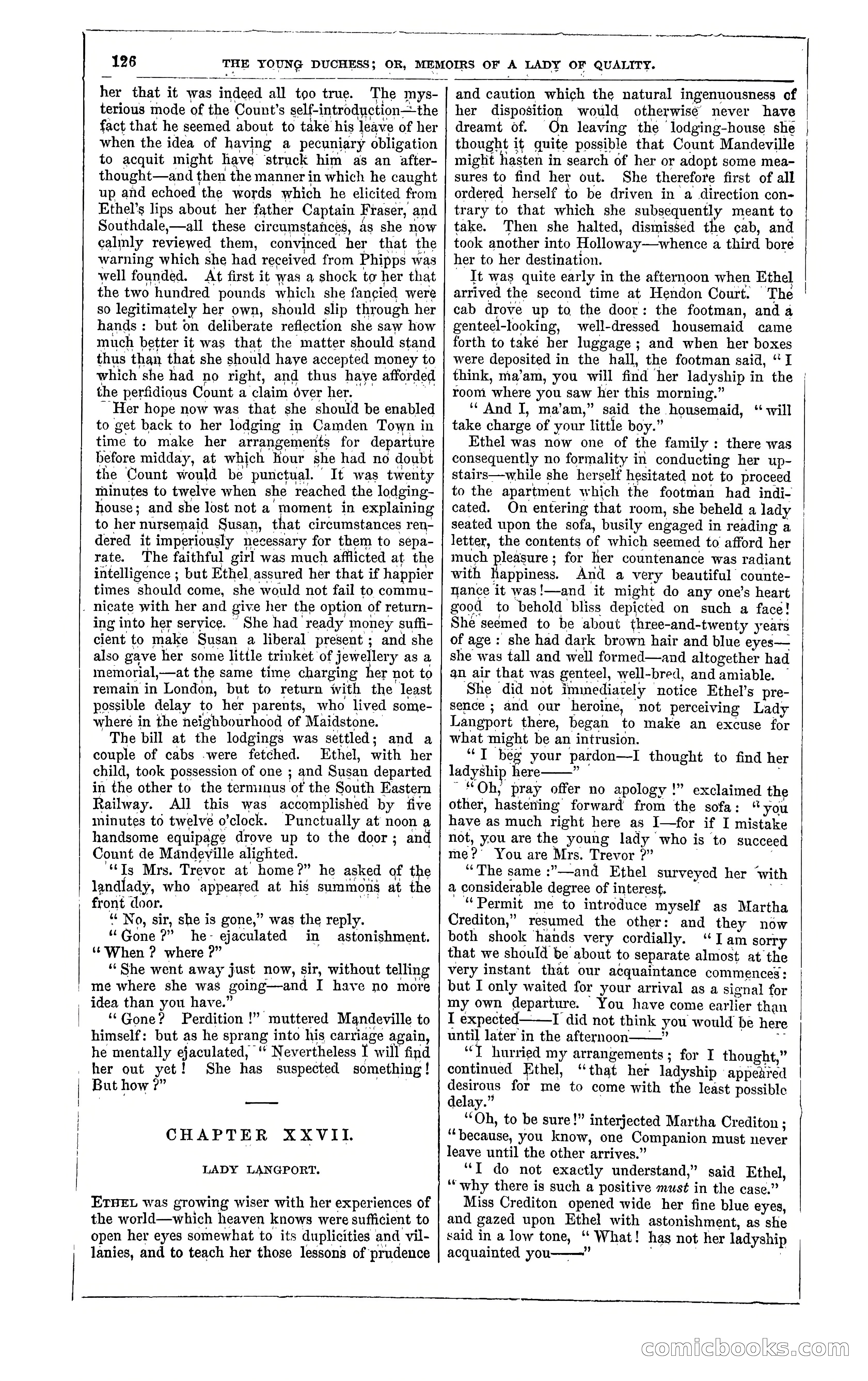
A restored page from Penny Dreadfuls, 1858. Page through the whole issue in the reader above.
📄 Transcribed text from this page (OCR, searchable)
Machine-transcribed from the original scan — historical spelling and the odd misread are preserved.
a ee pe A OE ee A et a ee 126 her that it was was indeed all too true. The mys- terious mode of the Count’ s self-introdyction—the fact that he seemed about to take his leave of her when the idea of having a pecuniary obligation to acquit might have ‘struck him as an after- thought—and t then the manner in which he caught up and echoed ‘the words which he elicited from Ethel’s lips about her father Captain Fraser, and Southdale,—all these circumstances, as she now calmly reviewed them, convinced her that the warning which she had received from Phipps was well founded. At first it was a shock to her that the two hundred pounds which she fancied were SO legitimately her own, should slip through her hands: but on deliberate reflection she saw how much better it was that the matter should stand thus than that she should haye accepted money to which she had no right, and thus haye afforded the perfidious Count a claim over her. ~ Her hope now was that she should be enabled to get back to her lodging in Camden Town in time to make her arrangements for departure before midday, at which Hour she had no doubt the Count would be punctual. It was twenty thinutes to twelve when she reached the lodging- house; and she lost not a moment in explaining to her: nursemaid Susan, that circumstances ren- dered it imperiously necessary for them to sepa- rate. The faithful girl was much afflicted at the intelligence ; but Ethel, assured her that if happier times should come, she would not fail to commu- . nicate with her and give her the option of return- ing into her service. “ She had ready money suffi- cient to make Susan a liberal present ; and she also gave her some little trinket of jewellery as a memorial,—at the same time charging her not to remain in London, but to return with the least possible delay to her parents, who lived some- where in the neighbourhood of Maidstone. The bill at the lodgings was settled; and a couple of cabs -were fetched. Ethel, with her child, took possession of one ; ; and Susan departed in the other to the ternunus of the South Eastern Railway. All this was accomplished by five minutes to twelve o ’clock. Punctually at noon a handsome equipage drove up to the door; and Count de Mandeville alighted. ‘Ig Mrs, Trevor at ‘home ?” he asked of the landlady, who appeared at his summons at the | front door. “ No, sir, she is gone,” was the reply. u Gone ?” he- ejaculated in astonishment. ‘t When ? where ?” “She went away just now, sir, without tellin ' me where she was going—and I have no more idea than you have.” ‘““Gone? Perdition !” muttered Mandeville to himself: but as he spr ang into his carriage again, he mentally ejaculated, ‘“ Nevertheless I will find her out yet! She has suspected something ! But how 2” 19 —<a CHAPTER XXVII. LADY LANGPORT. ETHEL was growing wiser with her experiences of the world—which heaven knows were sufficient to open her eyes somewhat to its duplicities and ‘vil- | lanies, and to teach her those lessons of prudence TRE TOUNG DUCHESS 5 OR, MEMOIRS OF A LADY OF QUALITY. and caution which the natural ingenuousness of her disposition would otherwise never have dreamt of. On leaving the lodging-house she thought it quite possible that Count Mandeville might asten in search of her or adopt some mea- sures to find her out. She therefore first of all ordered herself to be driven in a direction con- trary to that which she subsequently meant to take. Then she halted, dismissed the cab, and took another into Holloway—whence a third bore her to her destination. It was quite early in the afternoon when Ethel arrived the second time at Hendon Court. The cab drove up to the door: the footman, and a genteel- looking, well-dressed housemaid came forth to take her luggage; and when her boxes were deposited i in the hall, the footman said, “I | | think, ma’am, you will find ‘her ladyship i in the | room. ‘where you saw her this morning.” ‘And I, ma’am,” said the housemaid, take charge of your little boy.” Ethel was now one of the family : there was consequently no formality in conducting her up- stairs—while she herself hesitated not to proceed to the apartment which the footman had indi- cated. On entering that room, she beheld a lady seated upon the sofa, busily engaged j in reading a letter, the contents of which seemed to afford her much pleasure ; for her countenance was radiant with happiness. And a very beautiful counte- nance it was!—and it might do any one’s heart good to ‘behold. bliss depicted on such a face! She seemed to be about three- and-twenty years of age: she had dark brown hair and blue eyes— she was tall and well formed—and altogether had an air that was genteel, well-bred, and amiable. ~ She did not immediately notice Ethel’s pre- sence ; and our heroine, not perceiving Lady Langport there, began to make an excuse for what might be an intrusion. “T bes your pardon—I thought to find her ladyship | here "Oh, pray offer no apology !” exctalmed the other, hastening forward from the sofa: “you have as much right here as I—for if I mistake not, you are the young lady who i is to succeed me?’ You are Mrs, Trevor 2” “The same :”—and Ethel surveyed her ‘with a considerable degree of interest, “Permit me to introduce myself as Martha Crediton,” resumed the other: and they now both shook hands very cordially. “Iam sorry that we should be about to separate almost at the very instant that our acquaintance commences : but I only waited for your arrival as a signal for my own departure. You have come earlier than I expected——T did not think you would be here until later in the afternoon——” “T hurried my arrangements ; for I thought,” continued Ethel, “that her ladyship appeared tae for me to come with the least possible elay.’ ‘‘Oh, to be sure!” interjected Martha Crediton ; “ because, you know, one Companion must never leave until the other arrives.” “I do not exactly understand,” said Ethel, ‘“why there is such a positive must in the case.” Miss Crediton opened wide her fine blue eyes, and gazed upon Ethel with astonishment, as she said in a low tone, “ What! has not her ladyship acquainted you ” (29 will a COMO Colin