
Penny Dreadfuls, 1858 · page 163 of 400
The Young Duchess; or, Memoirs of a Lady of Quality — page 163: what you’re looking at
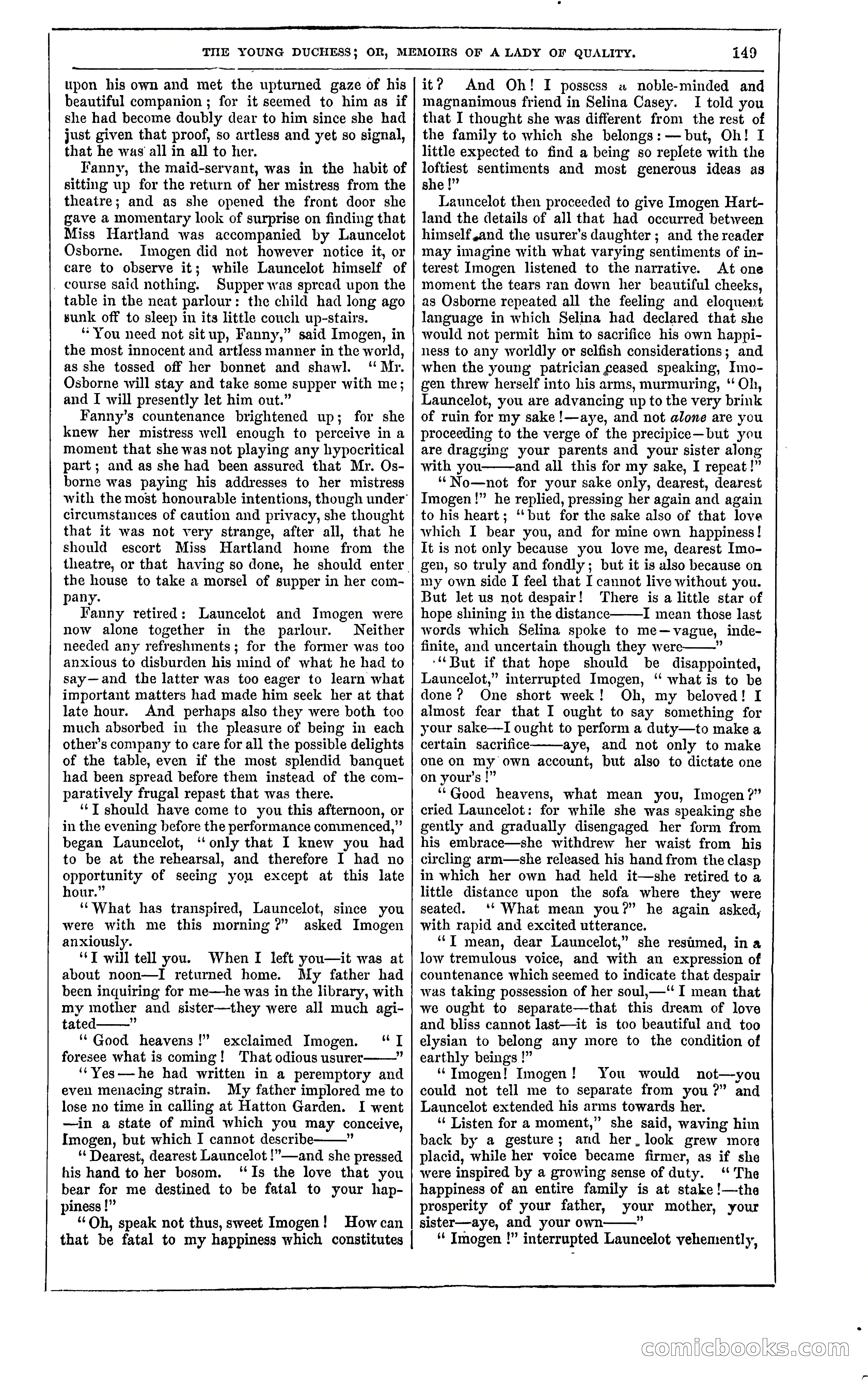
A restored page from Penny Dreadfuls, 1858. Page through the whole issue in the reader above.
📄 Transcribed text from this page (OCR, searchable)
Machine-transcribed from the original scan — historical spelling and the odd misread are preserved.
TIE YOUNG DUCHESS; OR, MEMOIRS OF A LADY OF QUALITY. 149 — upon his own and met the upturned gaze of his beautiful companion ; for it seemed to him as if she had become doubly dear to him since she had just given that proof, so artless and yet so signal, that he was all in all to her. T'anny, the maid-servant, was in the habit of sitting up for the return of her mistress from the theatre; and as she opened the front door she gave a momentary look of surprise on finding that Miss Hartland was accompanied by Launcelot Osborne. Imogen did not however notice it, or care to observe it; while Launcelot himself of . course said nothing. Supper was spread upon the table in the neat parlour: the child had long ago bunk off to sleep in its little couch up-stairs. “You need not sit up, Fanny,” said Imogen, in the most innocent and artless manner in the world, as she tossed off her bonnet and shawl. ‘ Mr. Osborne will stay and take some supper with me; and I will presently let him out.” Fanny’s countenance brightened up; for she knew her mistress well enough to perceive in a moment that she was not playing any hypocritical part ; and as she had been assured that Mr. Os- borne was paying his addresses to her mistress with the most honourable intentions, though under’ circumstances of caution and privacy, she thought that it was not very strange, after all, that he should escort Miss Hartland home from the theatre, or that having so done, he should enter. the house to take a morsel of supper in her com- pany. Fanny retired: Launcelot and Imogen were now alone together in the parlour. Neither needed any refreshments; for the former was too anxious to disburden his mind of what he had to say—and the latter was too eager to learn what important matters had made him seek her at that late hour. And perhaps also they were both teo much absorbed in the pleasure of being in each other’s company to care for all the possible delights of the table, even if the most splendid banquet had been spread before them instead of the com- paratively frugal repast that was there. ‘“‘T should have come to you this afternoon, or in the evening before the performance commenced,” began Launcelot, ‘only that I knew you had to be at the rehearsal, and therefore I had no opportunity of seeing you except at this late hour.” ‘“What has transpired, Launcelot, since you were with me this morning ?” asked Imogen anxiously. ‘*T will tell you. When I left you—it was at about noon—I returned home. My father had been inquiring for me—he was in the library, with my mother and sister—they were all much agi- tated-———” “Good heavens!” exclaimed Imogen. foresee what is coming! That odious usurer ‘‘“Yes—he had written in a peremptory and even menacing strain. My father implored me to lose no time in calling at Hatton Garden. I went —in a state of mind which you may conceive, Imogen, but which I cannot describe ” ‘‘ Dearest, dearest Launcelot !”—and she pressed his hand to her bosom. ‘‘Is the love that you bear for me destined to be fatal to your hap- piness !” “Oh, speak not thus, sweet Imogen! How can ef 39 it? And Oh! I possess a noble-minded and magnanimous friend in Selina Casey. I told you that I thought she was different from the rest of the family to which she belongs: — but, Oh! I little expected to find a being so replete with the loftiest sentiments and most generous ideas as she !” Launcelot then proceeded to give Imogen Hart- land the details of all that had occurred between himself ,and the usurer’s daughter ; and the reader may imagine with what varying sentiments of in- terest Imogen listened to the narrative. At one moment the tears ran down her beautiful cheeks, as Osborne repeated all the feeling and eloquent language in which Selina had declared that she would not permit him to sacrifice his own happi- ness to any worldly or selfish considerations; and when the young patrician ceased speaking, Imo- gen threw herself into his arms, murmuring, ‘‘ Oh, Launcelot, you are advancing up to the very brink of ruin for my sake !—aye, and not alone are you proceeding to the verge of the precipice—but you are dragging your parents and your sister along with you and all this for my sake, I repeat!” ‘*No—not for your sake only, dearest, dearest Imogen!” he replied, pressing her again and again to his heart; ‘‘but for the sake also of that love which I bear you, and for mine own happiness! It is not only because you love me, dearest Imo- gen, so truly and fondly; but it is also because on my own side I feel that I cannot live without you. But let us not despair! There is a little star of hope shining in the distance I mean those last words which Selina spoke to me—vague, inde- finite, and uncertain though they were——” ‘But if that hope should be disappointed, Launcelot,” interrupted Imogen, ‘ what is to be done? One short week! Oh, my beloved! I almost fear that I ought to say something for your sake—I ought to perform a duty—to make a certain sacrifice aye, and not only to make one on my own account, but also to dictate one on your’s !” ‘““Good heavens, what mean you, Imogen?” cried Launcelot: for while she was speaking she gently and gradually disengaged her form from his embrace—she withdrew her waist from his circling arm—she released his hand from the clasp in which her own had held it—she retired to a little distance upon the sofa where they were seated. ‘' What mean you?” he again asked, with rapid and excited utterance. ““T mean, dear Launcelot,” she resumed, in a low tremulous voice, and with an expression of countenance which seemed to indicate that despair was taking possession of her soul,—“‘ I mean that we ought to separate—that this dream of love and bliss cannot last—it is too beautiful and too elysian to belong any more to the condition of earthly beings !” “ Imogen! Imogen! You would not—you could not tell me to separate from you ?” and Launcelot extended his arms towards her. “ Listen for a moment,” she said, waving him back by a gesture; and her, look grew more placid, while her voice became firmer, as if she were inspired by a growing sense of duty. ‘The happiness of an entire family is at stake!—the prosperity of your father, your mother, your sister—aye, and your own - that be fatal to my happiness which constitutes | ‘‘ Imogen !” interrupted Launcelot vehemently, a TR A COMO YN Wn) Colin