
Penny Dreadfuls, 1858 · page 186 of 400
The Young Duchess; or, Memoirs of a Lady of Quality — page 186: what you’re looking at
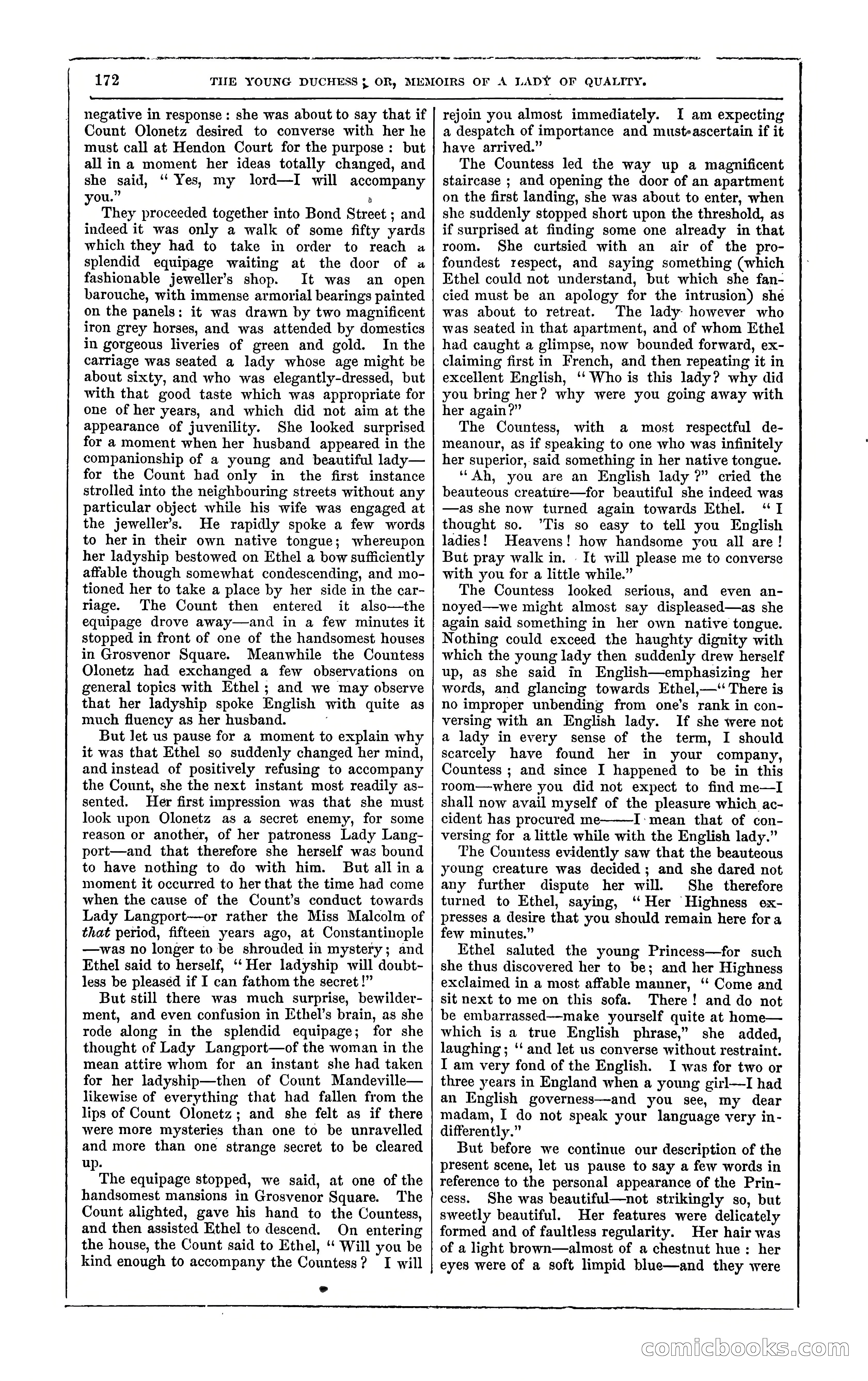
A restored page from Penny Dreadfuls, 1858. Page through the whole issue in the reader above.
📄 Transcribed text from this page (OCR, searchable)
Machine-transcribed from the original scan — historical spelling and the odd misread are preserved.
RE IT 172 ——_ i a a I EO RL, ME RPM of PY TIE YOUNG DUCHESS; OR, MEMOIRS OF A LADY OF QUALITY. negative in response: she was about to say that if Count Olonetz desired to converse with her he must call at Hendon Court for the purpose: but all in a moment her ideas totally changed, and she said, ‘‘ Yes, my lord—I will accompany you.” : They proceeded together into Bond Street ; and indeed it was only a walk of some fifty yards which they had to take in order to reach a splendid equipage waiting at the door of a fashionable jeweller’s shop. It was an open barouche, with immense armorial bearings painted on the panels: it was drawn by two magnificent iron grey horses, and was attended by domestics in gorgeous liveries of green and gold. In the carriage was seated a lady whose age might be about sixty, and who was elegantly-dressed, but with that good taste which was appropriate for one of her years, and which did not aim at the appearance of juvenility. She looked surprised for a moment when her husband appeared in the companionship of a young and beautiful lady— for the Count had only in the first instance strolled into the neighbouring streets without any particular object while his wife was engaged at the jeweller’s. He rapidly spoke a few words to her in their own native tongue; whereupon her ladyship bestowed on Ethel a bow sufficiently affable though somewhat condescending, and mo- tioned her to take a place by her side in the car- riage. The Count then entered it also—the equipage drove away—and in a few minutes it stopped in front of one of the handsomest houses in Grosvenor Square. Meanwhile the Countess Olonetz had exchanged a few observations on general topics with Ethel ; and we may observe that her ladyship spoke English with quite as much fluency as her husband. But let us pause for a moment to explain why it was that Ethel so suddenly changed her mind, and instead of positively refusing to accompany the Count, she the next instant most readily as- sented. Her first impression was that she must look upon Olonetz as a secret enemy, for some reason or another, of her patroness Lady Lang- port—and that therefore she herself was bound to have nothing to do with him. But allina moment it occurred to her that the time had come when the cause of the Count’s conduct towards Lady Langport—or rather the Miss Malcolm of that period, fifteen years ago, at Constantinople —was no longer to be shrouded in mystery; and Ethel said to herself, ‘‘Her ladyship will doubt- less be pleased if I can fathom the secret !” But still there was much surprise, bewilder- ment, and even confusion in Ethel’s brain, as she rode along in the splendid equipage; for she thought of Lady Langport—of the woman in the mean attire whom for an instant she had taken for her ladyship—then of Count Mandeville— likewise of everything that had fallen from the lips of Count Olonetz; and she felt as if there were more mysteries than one to be unravelled and more than one strange secret to be cleared up. The equipage stopped, we said, at one of the handsomest mansions in Grosvenor Square. The Count alighted, gave his hand to the Countess, and then assisted Ethel to descend. On entering the house, the Count said to Ethel, “‘ Will you be kind enough to accompany the Countess? I will rejoin you almost immediately. I am expecting a despatch of importance and musteascertain if it have arrived.” The Countess led the way up a magnificent staircase ; and opening the door of an apartment on the first landing, she was about to enter, when she suddenly stopped short upon the threshold, as if surprised at finding some one already in that room. She curtsied with an air of the pro- foundest respect, and saying something (which Ethel could not understand, but which she fan- cied must be an apology for the intrusion) she was about to retreat. The lady however who was seated in that apartment, and of whom Ethel had caught a glimpse, now bounded forward, ex- claiming first in French, and then repeating it in excellent English, ‘‘ Who is this lady? why did you bring her? why were you going away with her again?” The Countess, with a most respectful de- meanour, as if speaking to one who was infinitely her superior, said something in her native tongue. ““Ah, you are an English lady ?” cried the beauteous creatiire—for beautiful she indeed was —as she now turned again towards Ethel. “I thought so. "Tis so easy to tell you English ladies! Heavens! how handsome you all are! But pray walk in. - It will please me to converse with you for a little while.” The Countess looked serious, and even an- noyed—we might almost say displeased—as she again said something in her own native tongue. Nothing could exceed the haughty dignity with which the young lady then suddenly drew herself up, as she said in English—emphasizing her words, and glancing towards Ethel,—‘ There is no improper unbending from one’s rank in con- versing with an English lady. If she tere not a lady in every sense of the term, I should scarcely have found her in your company, Countess ; and since I happened to be in this room—where you did not expect to find me—I shall now avail myself of the pleasure which ac- cident has procured me I:mean that of con- versing for a little while with the English lady.” The Countess evidently saw that the beauteous young creature was decided ; and she dared not any further dispute her will. She therefore turned to Ethel, saying, “Her Highness ex- presses a desire that you should remain here fora few minutes.” Ethel saluted the young Princess—for such she thus discovered her to be; and her Highness exclaimed in a most affable manner, “ Come and sit next to me on this sofa. There! and do not be embarrassed—make yourself quite at home— which is a true English phrase,” she added, laughing; ‘‘ and let us converse without restraint. I am very fond of the English. I was for two or three years in England when a young girl—I had an Iinglish governess—and you see, my dear madam, I do not speak your language very in- differently.” But before we continue our description of the present scene, let us pause to say a few words in reference to the personal appearance of the Prin- cess. She was beautiful—not strikingly so, but sweetly beautiful. Her features were delicately formed and of faultless regularity. Her hair was of a light brown—almost of a chestnut hue: her eyes were of a soft limpid blue—and they were YN Wn) COMO ee ys oe,’ Colin