
Penny Dreadfuls, 1858 · page 253 of 400
The Young Duchess; or, Memoirs of a Lady of Quality — page 253: what you’re looking at
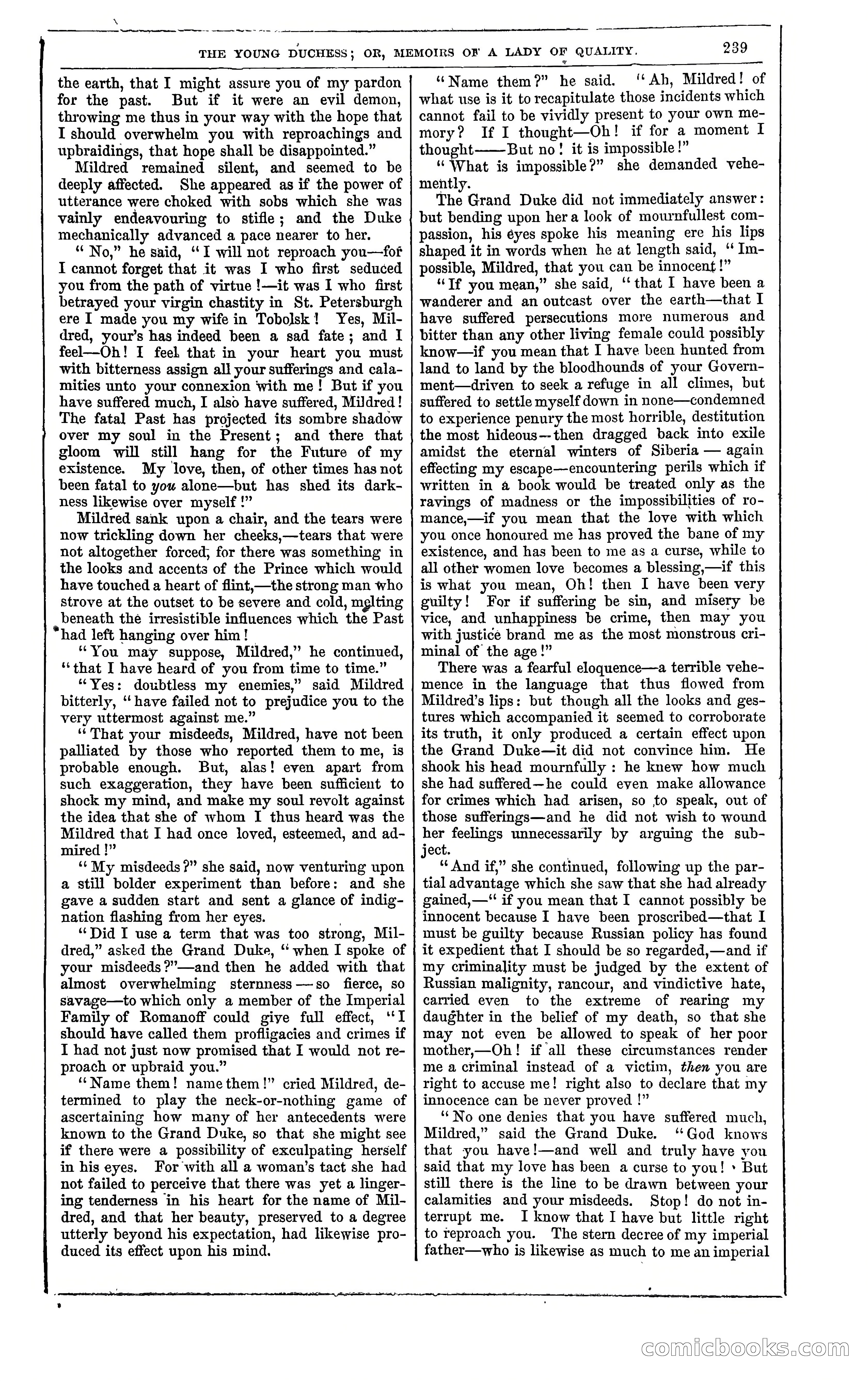
A restored page from Penny Dreadfuls, 1858. Page through the whole issue in the reader above.
📄 Transcribed text from this page (OCR, searchable)
Machine-transcribed from the original scan — historical spelling and the odd misread are preserved.
\ , i, ern RS wy ey ee THE YOUNG DUCHESS ; OR, MEMOIRS OF A LADY OF QUALITY. the earth, that I might assure you of my pardon for the past. But if it were an evil demon, throwing me thus in your way with the hope that I should overwhelm you with reproachings and upbraidings, that hope shall be disappointed.” Mildred remained silent, and seemed to be deeply affected. She appeared as if the power of utterance were choked with sobs which she was vainly endeavouring to stifle; and the Duke mechanically advanced a pace nearer to her. “ No,” he said, “I will not reproach you—fof I cannot forget that it was 1 who first seduced you from the path of virtue !—it was I who first betrayed your virgin chastity in St. Petersburgh ere I made you my wife in Tobolsk! Yes, Mil- dred, your’s has indeed been a sad fate; and I feel—Oh! I feel that in your heart you must with bitterness assign all your sufferings and cala- mities unto your connexion with me! But if you have suffered much, I also have suffered, Mildred! The fatal Past has projected its sombre shadow over my soul in the Present; and there that gloom will still hang for the Future of my existence. My love, then, of other times has not been fatal to you alone—but has shed its dark- ness likewise over myself !” Mildred sank upon a chair, and the tears were now trickling down her cheeks,—tears that were not altogether forced, for there was something in the looks and accents of the Prince which would have touched a heart of flint,—the strong man who strove at the outset to be severe and cold, mglting , beneath the irresistible influences which the Past had left hanging over him! “You may suppose, Mildred,” he continued, “that I have heard of you from time to time.” “Yes: doubtless my enemies,” said Mildred bitterly, “‘ have failed not to prejudice you to the very uttermost against me.” ‘That your misdeeds, Mildred, have not been palliated by those who reported them to me, is probable enough. But, alas! even apart from such exaggeration, they have been sufficient to shock my mind, and make my soul revolt against the idea that she of whom I thus heard was the Mildred that I had once loved, esteemed, and ad- mired !” ‘“‘My misdeeds ?” she said, now venturing upon a still bolder experiment than before: and she gave a sudden start and sent a glance of indig- nation flashing from her eyes. “Did I use a term that was too strong, Mil- dred,” asked the Grand Duke, “ when I spoke of your misdeeds ?”’—and then he added with that almost overwhelming sternness—so fierce, so savage—to which only a member of the Imperial Family of Romanoff could giye full effect, ‘I should have called them profligacies and crimes if I had not just now promised that I would not re- proach or upbraid you.” “Name them! namethem!” cried Mildred, de- termined to play the neck-or-nothing game of ascertaining how many of her antecedents were known to the Grand Duke, so that she might see if there were a possibility of exculpating herself in his eyes. For with all a woman’s tact she had not failed to perceive that there was yet a linger- ing tenderness in his heart for the name of Mil- dred, and that her beauty, preserved to a degree utterly beyond his expectation, had likewise pro- duced its effect upon his mind. 239 ‘Name them?” he said. ‘‘Ah, Mildred! of what use is it to recapitulate those incidents which cannot fail to be vividly present to your own me- mory? If I thought—Oh! if for a moment I thought——But no! it is impossible!” “What is impossible?” she demanded vehe- mently. The Grand Duke did not immediately answer: but bending upon her a look of mournfullest com- passion, his ¢éyes spoke his meaning ere his lips shaped it in words when he at length said, “ Im- possible, Mildred, that you can be innocent!” “Tf you mean,” she said, “that I have been a wanderer and an outcast over the earth—that I have suffered persecutions more numerous and bitter than any other living female could possibly know—if you mean that I have been hunted from land to land by the bloodhounds of your Govern- ment—driven to seek a refuge in all climes, but suffered to settle myself down in none—condemned to experience penury the most horrible, destitution the most hideous--then dragged back into exile amidst the eternal winters of Siberia — again effecting my escape—encountering perils which if written in a book would be treated only as the ravings of madness or the impossibilities of ro- mance,—if you mean that the love with which you once honoured me has proved the bane of my existence, and has been to me as a curse, while to all other women love becomes a blessing,—if this is what you mean, Oh! then I have been very guilty! For if suffering be sin, and misery be vice, and unhappiness be crime, then may you with justice brand me as the most monstrous cri- minal of the age!” There was a fearful eloquence—a terrible vehe- mence in the language that thus flowed from Mildred’s lips: but though all the looks and ges- tures which accompanied it seemed to corroborate its truth, it only produced a certain effect upon the Grand Duke—it did not convince him. He shook his head mournfully : he knew how much she had suffered—he could eyen make allowance for crimes which had arisen, so to speak, out of those sufferings—and he did not wish to wound her feelings unnecessarily by arguing the sub- ject. “* And if,” she continued, following up the par- tial advantage which she saw that she had already gained,—“ if you mean that I cannot possibly be innocent because I have been proscribed—that I must be guilty because Russian policy has found it expedient that I should be so regarded,—and if my criminality must be judged by the extent of Russian malignity, rancour, and vindictive hate, carried even to the extreme of rearing my daughter in the belief of my death, so that she may not even be allowed to speak of her poor mother,—Oh! if all these circumstances render me a criminal instead of a victim, then you are right to accuse me! right also to declare that my innocence can be never proved !” ‘No one denies that you have suffered much, Mildred,” said the Grand Duke. “God knows that you have!—and well and truly have you said that my love has been a curse to you! » But still there is the line to be drawn between your calamities and your misdeeds. Stop! do not in- terrupt me. I know that I have but little right to reproach you. The stern decree of my imperial father—who is likewise as much to me an imperial COMO YN Wn) Colin