
Penny Dreadfuls, 1858 · page 257 of 400
The Young Duchess; or, Memoirs of a Lady of Quality — page 257: what you’re looking at
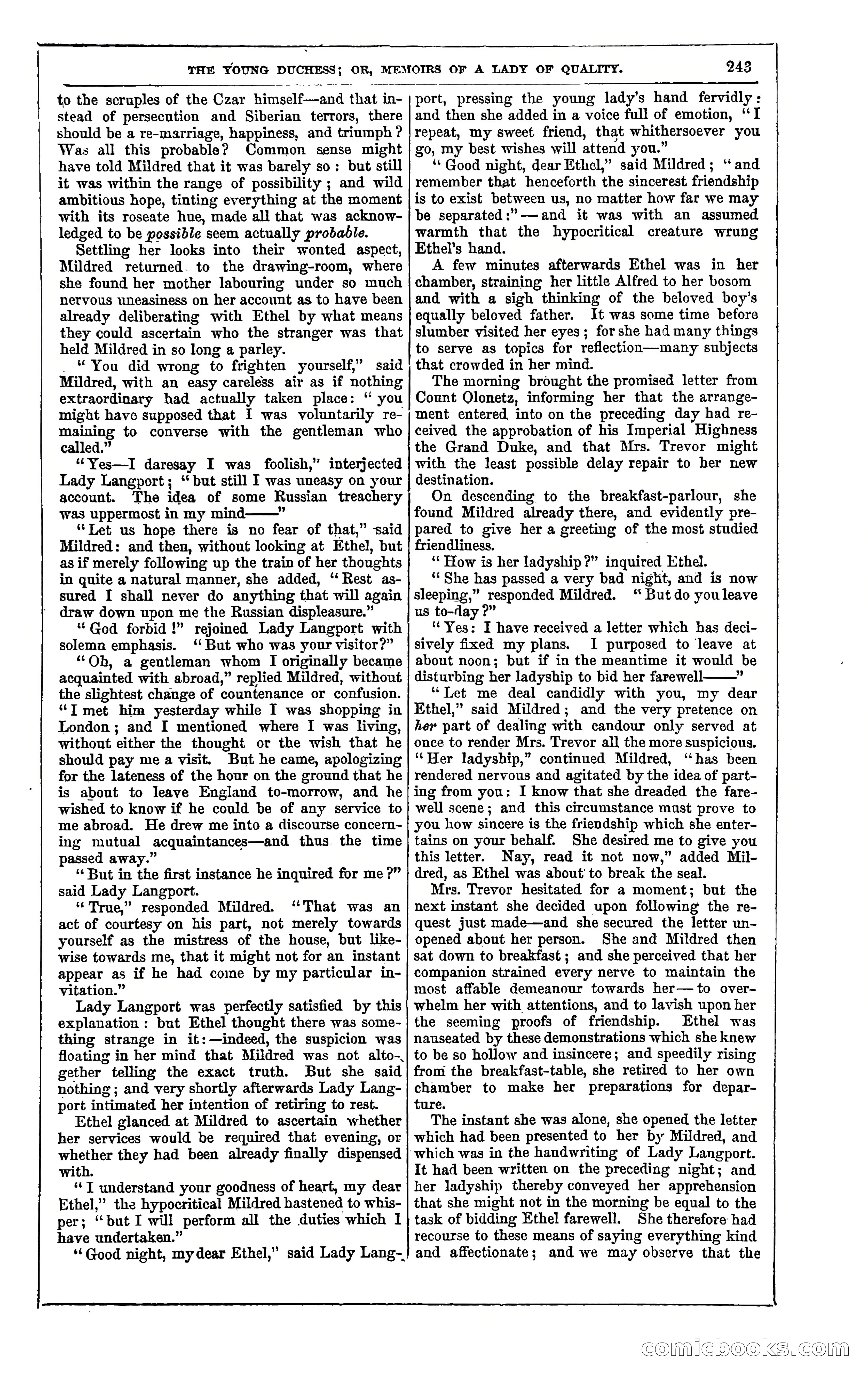
A restored page from Penny Dreadfuls, 1858. Page through the whole issue in the reader above.
📄 Transcribed text from this page (OCR, searchable)
Machine-transcribed from the original scan — historical spelling and the odd misread are preserved.
THE YOUNG DUCHESS; OR, MEMOIRS OF A LADY OF QUALITY. 2438 to the scruples of the Czar himself—and that i in- stead of persecution and Siberian terrors, there should be a re-marriage, happiness, and triumph ? Was all this probable? Common sense might have told Mildred that it was barely so: but still it was within the range of possibility ; and wild ambitious hope, tinting everything at the moment with its roseate hue, made all that was acknow- ledged to be possible seem actually probable. Settling her looks into their wonted aspect, Mildred returned. to the drawing-room, where she found her mother labouring under so much nervous uneasiness on her account as to have been already deliberating with Ethel by what means they could ascertain who the stranger was that held Mildred in so long a parley. _ “You did wrong to frighten yourself,” said Mildred, with an easy careless air as if nothing extraordinary had actually taken place: “ you might have supposed that I was voluntarily re- maining to converse with the gentleman who called.” ‘“'Yes—I daresay I was foolish,” interjected Lady Langport; ‘but still I was uneasy on your account. The idea of some Russian treachery Was uppermost in my mind “Let us hope there is no fear of that,” said Mildred: and then, without looking at Ethel, but as if merely following up the train of her thoughts in quite a natural manner, she added, ‘“‘ Rest as- sured I shall never do anything that will again draw down upon me the Russian displeasure.” “God forbid !” rejoined Lady Langport with solemn emphasis. ‘“ But who was your visitor?” “Ob, a gentleman whom I originally became acquainted with abroad,” replied Mildred, without the slightest change of countenance or confusion. “T met him yesterday while I was shopping in London ; and I mentioned where I was living, without either the thought or the wish that he should pay me a visit. But he came, apologizing for the lateness of the hour on the ground that he is about to leave England to-morrow, and he wished to know if he could be of any service to me abroad. He drew me into a discourse concern- ing mutual acquaintances—and thus. the time passed away.’ ‘But in the first instance he inquired for me ?” said Lady Langport. “True,” responded Mildred. ‘That was an act of courtesy on his part, not merely towards yourself as the mistress of the house, but like- wise towards me, that it might not for an instant appear as if he had come by my particular in- vitation.” Lady Langport was perfectly satisfied by this explanation : but Ethel thought there was some- thing strange in it: —indeed, the suspicion was floating in her mind that Mildred was not alto- gether telling the exact truth. But she said nothing ; and very shortly afterwards Lady Lang- port intimated her intention of retiring to rest. Ethel glanced at Mildred to ascertain whether her services would be required that evening, or whether they had been already finally dispensed with. “J understand your goodness of heart, my dear Ethel,” the hypocritical Mildred hastened to whis- per; “but I will perform all the duties which 1 have undertaken.” ‘Good night, mydear Ethel,” said Lady Lang-. port, pressing the young lady's hand fervidly: and then she added in a voice full of emotion, “I repeat, my sweet friend, that whithersoever you go, my best wishes will attend you.” ‘‘ Good night, dear Ethel,” said Mildred; ‘and remember that henceforth the sincerest friendship is to exist between us, no matter how far we may be separated:”—and it was with an assumed warmth that the hypocritical creature wrung Ethel’s hand. A few minutes afterwards Ethel was in her chamber, straining her little Alfred to her bosom and with a sigh thinking of the beloved boy’s equally beloved father. It was some time before slumber visited her eyes; forshe had many things to serve as topics for reflection—many subjects that crowded in her mind. The morning brought the promised letter from Count Olonetz, informing her that the arrange- ment entered into on the preceding day had re- ceived the approbation of his Imperial Highness the Grand Duke, and that Mrs. Trevor might with the least possible delay repair to her new destination. On descending to the breakfast-parlour, she found Mildred already there, and evidently pre- pared to give her a greeting of the most studied friendliness. “* How is her ladyship?” inquired Ethel. ‘“‘ She has passed a very bad night, and is now sleeping,” responded Mildred. ‘“ But do youleave us to-day ?” “Yes: I have received a letter which has deci- sively fixed my plans. I purposed to leave at about noon; but if in the meantime it would be disturbing her ladyship to bid her farewell “Let me deal candidly with you, my dear Ethel,” said Mildred; and the very pretence on her part of dealing with candour only served at once to render Mrs. Trevor all the more suspicious. “Her ladyship,” continued Mildred, ‘has been rendered nervous and agitated by the idea of part- ing from you: I know that she dreaded the fare- well scene; and this circumstance must prove to you how sincere is the friendship which she enter- tains on your behalf. She desired me to give you this letter. Nay, read it not now,” added Mil- dred, as Ethel was about to break the seal. Mrs. Trevor hesitated for a moment; but the next instant she decided upon following the re- quest just made—and she secured the letter un- opened about her person. She and Mildred then sat down to breakfast ; and she perceived that her companion strained every nerve to maintain the most affable demeanour towards her—to over- whelm her with attentions, and to lavish upon her the seeming proofs of friendship. Ethel was nauseated by these demonstrations which she knew to be so hollow and insincere; and speedily rising from the breakfast-table, she retired to her own chamber to make her preparations for depar- ture. The instant she was alone, she opened the letter which had been presented to her by Mildred, and ‘which was in the handwriting of Lady Langport. It had been written on the preceding night; and her ladyship thereby conveyed her apprehension that she might not in the morning be equal to the task of bidding Ethel farewell. She therefore had recourse to these means of saying everything kind and affectionate; and we may observe that the oO conniclooolk Colin