
Penny Dreadfuls, 1858 · page 272 of 400
The Young Duchess; or, Memoirs of a Lady of Quality — page 272: what you’re looking at
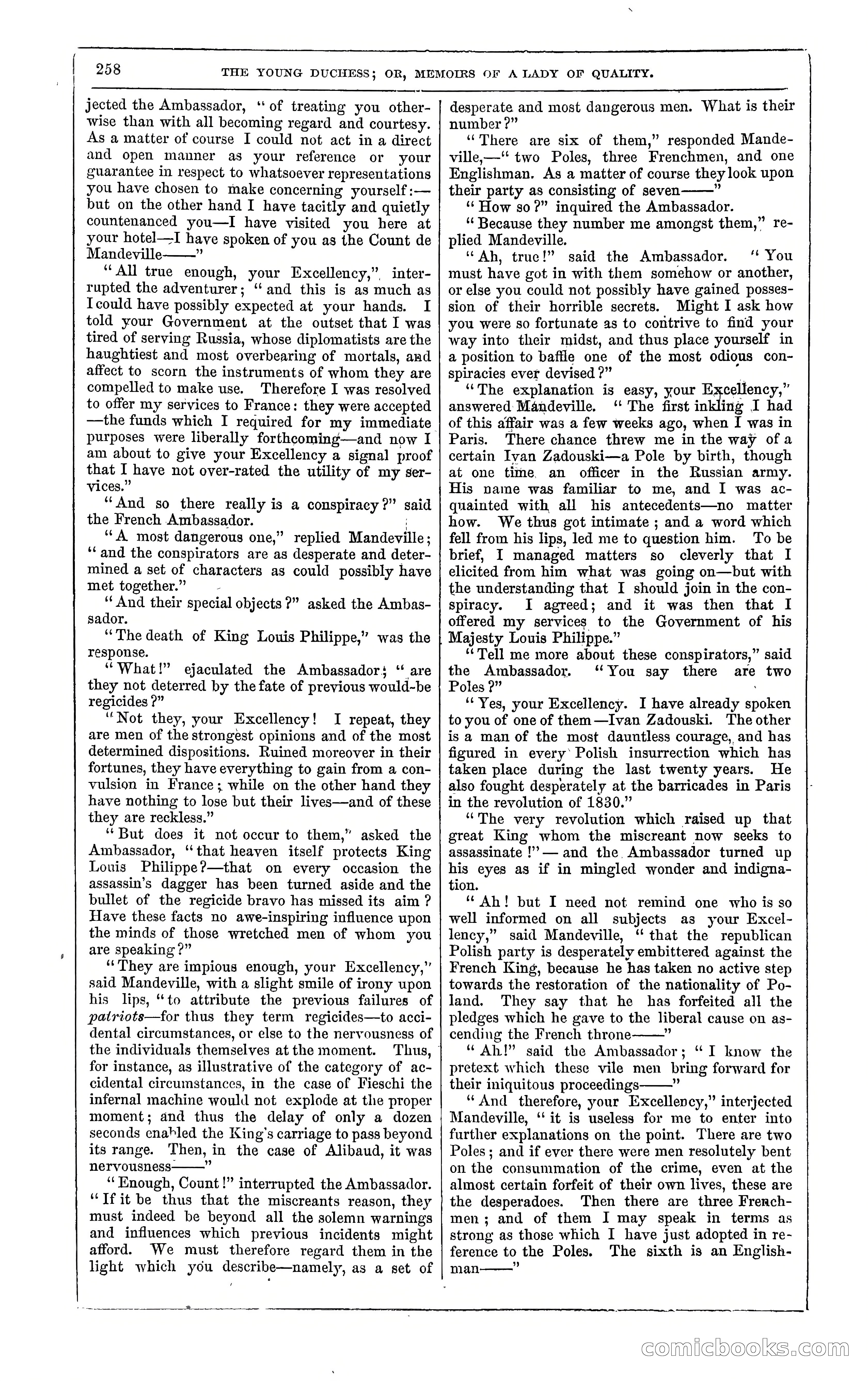
A restored page from Penny Dreadfuls, 1858. Page through the whole issue in the reader above.
📄 Transcribed text from this page (OCR, searchable)
Machine-transcribed from the original scan — historical spelling and the odd misread are preserved.
a a I a 258 jected the Ambassador, “of treating you other- wise than with all becoming regard and courtesy. As a matter of course I could not act in a direct and open manner as your reference or your guarantee in respect to whatsoever representations you have chosen to make concerning yourself :— but on the other hand I have tacitly and quietly countenanced you—I have visited you here at your hotel—I have spoken of you as the Count de Mandeville——” ‘All true enough, your Excellency,” inter- rupted the adventurer; “and this is as much as Icould have possibly expected at your hands. I told your Government at the outset that I was tired of serving Russia, whose diplomatists are the haughtiest and most overbearing of mortals, aad affect to scorn the instruments of whom they are compelled to make use. Therefore I was resolved to offer my services to France: they were accepted —the funds which I required for my immediate purposes were liberally forthcoming—and now I am about to give your Excellency a signal proof that I have not over-rated the utility of my ser- vices.” ‘And so there really is a conspiracy?” said the French Ambassador. ‘‘A most dangerous one,” replied Mandeville; ‘‘and the conspirators are as desperate and deter- mined a set: of characters as could possibly have met together.” 2 ‘‘ And their special objects ?” asked the Ambas- sador. ‘The death of King Louis Philippe,” was the response. “What!” ejaculated the Ambassadors “ are they not deterred by the fate of previous would-be regicides ?” ‘Not they, your Excellency! I repeat, they are men of the strongest opinions and of the most determined dispositions. Ruined moreover in their fortunes, they have everything to gain from a con- vulsion in France; while on the other hand they have nothing to lose but their lives—and of these they are reckless.” ‘But does it not occur to them,” asked the Ambassador, “that heaven itself protects King Louis Philippe?—that on every occasion the assassin’s dagger has been turned aside and the bullet of the regicide bravo has missed its aim ? Have these facts no awe-inspiring influence upon the minds of those wretched men of whom you are speaking ?” “They are impious enough, your Excellency,” said Mandeville, with a slight smile of irony upon his lips, “to attribute the previous failures of patriots—for thus they term regicides—to acci- dental circumstances, or else to the nervousness of the individuals themselves at the moment. for instance, as illustrative of the category of ac- cidental circumstances, in the case of Fieschi the infernal machine would not explode at the proper moment; and thus the delay of only a dozen seconds enabled the King’s carriage to pass beyond its range. Then, in the case of Alibaud, it was neryousness——” ‘‘ Enough, Count!” interrupted the Ambassador. “Tfit be thus that the miscreants reason, they must indeed be beyond all the solemn warnings and influences which previous incidents might afford. We must therefore regard them in the light which you describe—namely, as a set of ——-2®. ad Thus, © THE YOUNG DUCHESS; OR, MEMOIRS OF A LADY OF QUALITY. desperate and most dangerous men. What is their number ?” “There are six of them,” responded Mande- ville,—“ two Poles, three Frenchmen, and one Englishman. As a matter of course they look upon their party as consisting of seven m ‘“‘ How so?” inquired the Ambassador. “Because they number me amongst them,” re- plied Mandeville. ‘‘Ah, true!” said the Ambassador. ‘ You must have got in with them somehow or another, or else you could not possibly have gained posses- sion of their horrible secrets. Might I ask how you were so fortunate as to contrive to find your way into their midst, and thus place yourself in a position to baffle one of the most odious con- spiracies ever devised ?” - “The explanation is easy, your Excellency,” answered Mandeville. “ The first inkling I had of this affair was a few weeks ago, when I was in Paris. There chance threw me in the way of a certain Ivan Zadouski—a Pole by birth, though at one time. an officer in the Russian army. His name was familiar to me, and I was ac- quainted with all his antecedents—no matter how. We thus got intimate ; and a word which fell from his lips, led me to question him. To be brief, I managed matters so cleverly that I elicited from him what was going on—but with the understanding that I should join in the con- spiracy. I agreed; and it was then that I offered my services to the Government of his Majesty Louis Philippe.” ‘Tell me more about these conspirators,” said the Ambassador. ‘You say there are two Poles ?” ‘* Yes, your Excellency. I have already spoken to you of one of them—Ivan Zadouski. The other is a man of the most dauntless courage, and has figured in every’ Polish insurrection which has taken place during the last twenty years. He also fought desperately at the barricades in Paris in the revolution of 1830.” “The very revolution which raised up that great King whom the miscreant now seeks to assassinate !’"— and the, Ambassador turned up his eyes as if in mingled wonder and indigna- tion. ‘* Ah! but I need not remind one who is so well informed on all subjects as your Excel- lency,” said Mandeville, ‘‘ that the republican Polish party is desperately embittered against the French King, because he has taken no active step towards the restoration of the nationality of Po- land. They say that he has forfeited all the pledges which he gave to the liberal cause on as- cending the French throne 2 “Ah!” said the Ambassador; “I know the pretext which these vile men bring forward for their iniquitous proceedings “And therefore, your Excellency,” interjected Mandeville, ‘‘ it is useless for me to enter into further explanations on the point. There are two Poles; and if ever there were men resolutely bent on the consummation of the crime, even at the almost certain forfeit of their own lives, these are the desperadoes. Then there are three French- men; and of them I may speak in terms as strong as those which I have just adopted in re- ference to the Poles. The sixth is an English- man - — COMO YN Wn) Colin