
Penny Dreadfuls, 1858 · page 282 of 400
The Young Duchess; or, Memoirs of a Lady of Quality — page 282: what you’re looking at
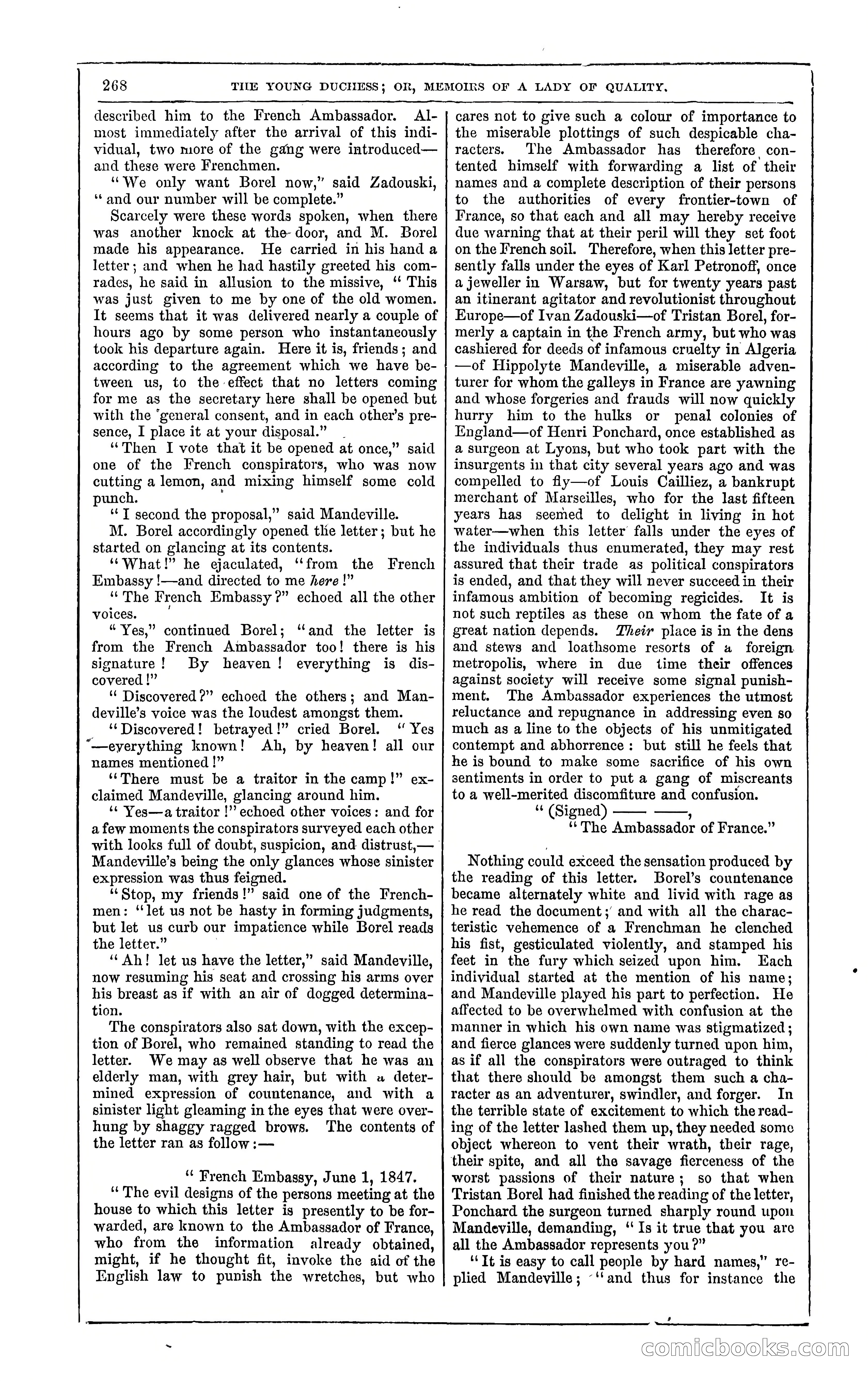
A restored page from Penny Dreadfuls, 1858. Page through the whole issue in the reader above.
📄 Transcribed text from this page (OCR, searchable)
Machine-transcribed from the original scan — historical spelling and the odd misread are preserved.
268 described him to the French Ambassador. AI- most immediately after the arrival of this indi- vidual, two more of the gang were introduced— and these were Frenchmen. “We only want Borel now,” said Zadouski, ‘and our number will be complete.” Scarcely were these words spoken, when there was another knock at the door, and M. Borel made his appearance. He carried in his hand a letter ; and when he had hastily greeted his com- rades, he said in allusion to the missive, ‘‘ This was just given to me by one of the old women. It seems that it was delivered nearly a couple of hours ago by some person who instantaneously took his departure again. Here it is, friends; and according to the agreement which we have be- tween us, to the effect that no letters coming for me as the secretary here shall be opened but with the ‘general consent, and in each other’s pre- sence, I place it at your disposal.” ‘““Then I vote that it be opened at once,” said one of the French conspirators, who was now cutting a lemon, and mixing himself some cold punch. ‘“‘T second the proposal,” said Mandeville. M. Borel accordingly opened tlie letter; but he started on glancing at its contents. “What!” he ejaculated, ‘‘from the French Embassy !—and directed to me here !” ‘‘'The French Embassy ?” echoed all the other voices. “Yes,” continued Borel; ‘and the letter is from the French Ambassador too! there is his signature! By heaven! everything is dis- covered !” ‘“‘ Discovered ?” echoed the others; and Man- deville’s voice was the loudest amongst them. _ Discovered! betrayed!” cried Borel. “ Yes “——-eyerything known! Ah, by heaven! all our names mentioned !” ‘‘There must be a traitor in the camp!” ex- claimed Mandeville, glancing around him. ‘« Yes—a traitor !” echoed other voices: and for afew moments the conspirators surveyed each other with looks fwll of doubt, suspicion, and distrust,— Mandeville’s being the only glances whose sinister expression was thus feigned. “Stop, my friends!” said one of the TFrench- men: “let us not be hasty in forming judgments, but let us curb our impatience while Borel reads the letter.” . ““Ah! let us have the letter,” said Mandeville, now resuming his seat and crossing his arms over his breast as if with an air of dogged determina- tion. The conspirators also sat down, with the excep- tion of Borel, who remained standing to read the letter. We may as well observe that he was an elderly man, with grey hair, but with a deter- mined expression of countenance, and with a sinister light gleaming in the eyes that were over- hung by shaggy ragged brows. The contents of the letter ran as follow :— ‘“‘ French Embassy, June 1, 1847. ‘The evil designs of the persons meeting at the house to which this letter is presently to be for- warded, are known to the Ambassador of France, who from the information already obtained, might, if he thought fit, invoke the aid of the English law to punish the wretches, but who THE YOUNG DUCHESS; OR, MEMOIRS OF A LADY OF QUALITY, cares not to give such a colour of importance to the miserable plottings of such despicable cha- racters. The Ambassador has therefore con- tented himself with forwarding a list of their names and a complete description of their persons to the authorities of every frontier-town of France, so that each and all may hereby receive due warning that at their peril will they set foot on the French soil. Therefore, when this letter pre- sently falls under the eyes of Karl Petronoff, once a jeweller in Warsaw, but for twenty years past an itinerant agitator and revolutionist throughout Europe—of Ivan Zadouski—of Tristan Borel, for- merly a captain in the French army, but who was cashiered for deeds of infamous cruelty in Algeria —of Hippolyte Mandeville, a miserable adven- turer for whom the galleys in France are yawning and whose forgeries and frauds will now quickly hurry him to the hulks or penal colonies of England—of Henri Ponchard, once established as a surgeon at Lyons, but who took part with the insurgents in that city several years ago and was compelled to fly—of Louis Cailliez, a bankrupt merchant of Marseilles, who for the last fifteen years has seemed to delight in living in hot water—when this letter falls under the eyes of the individuals thus enumerated, they may rest assured that their trade as political conspirators is ended, and that they will never succeed in their infamous ambition of becoming regicides. It is not such reptiles as these on whom the fate of a great nation depends. Their place is in the dens and stews and loathsome resorts of a foreign. metropolis, where in due time their offences against society will receive some signal punish- ment. The Ambassador experiences the utmost reluctance and repugnance in addressing even so much as a line to the objects of his unmitigated contempt and abhorrence: but still he feels that he is bound to make some sacrifice of his own sentiments in order to put a gang of miscreants to a well-merited discomfiture and confusion. “ (Signed) ’ ‘‘ The Ambassador of France.” Nothing could exceed the sensation produced by the reading of this letter. Borel’s countenance became alternately white and livid with rage as he read the document;’ and with all the charac- teristic vehemence of a Frenchman he clenched his fist, gesticulated violently, and stamped his feet in the fury which seized upon him. Each individual started at the mention of his name; and Mandeville played his part to perfection. He affected to be overwhelmed with confusion at the manner in which his own name was stigmatized ; and fierce glances were suddenly turned upon him, as if all the conspirators were outraged to think that there should be amongst them such a cha- racter as an adventurer, swindler, and forger. In the terrible state of excitement to which the read- ing of the letter lashed them up, they needed some object whereon to vent their wrath, their rage, their spite, and all the savage fierceness of the worst passions of their nature; so that when Tristan Borel had finished the reading of the letter, Ponchard the surgeon turned sharply round upon Mandeville, demanding, ‘Is it true that you are all the Ambassador represents you ?” ‘Tt is easy to call people by hard names,” re- plied Mandeville; -‘‘and thus for instance the a COMO YN Wn) AAR CA ET SR A RO Colin