
Penny Dreadfuls, 1858 · page 346 of 400
The Young Duchess; or, Memoirs of a Lady of Quality — page 346: what you’re looking at
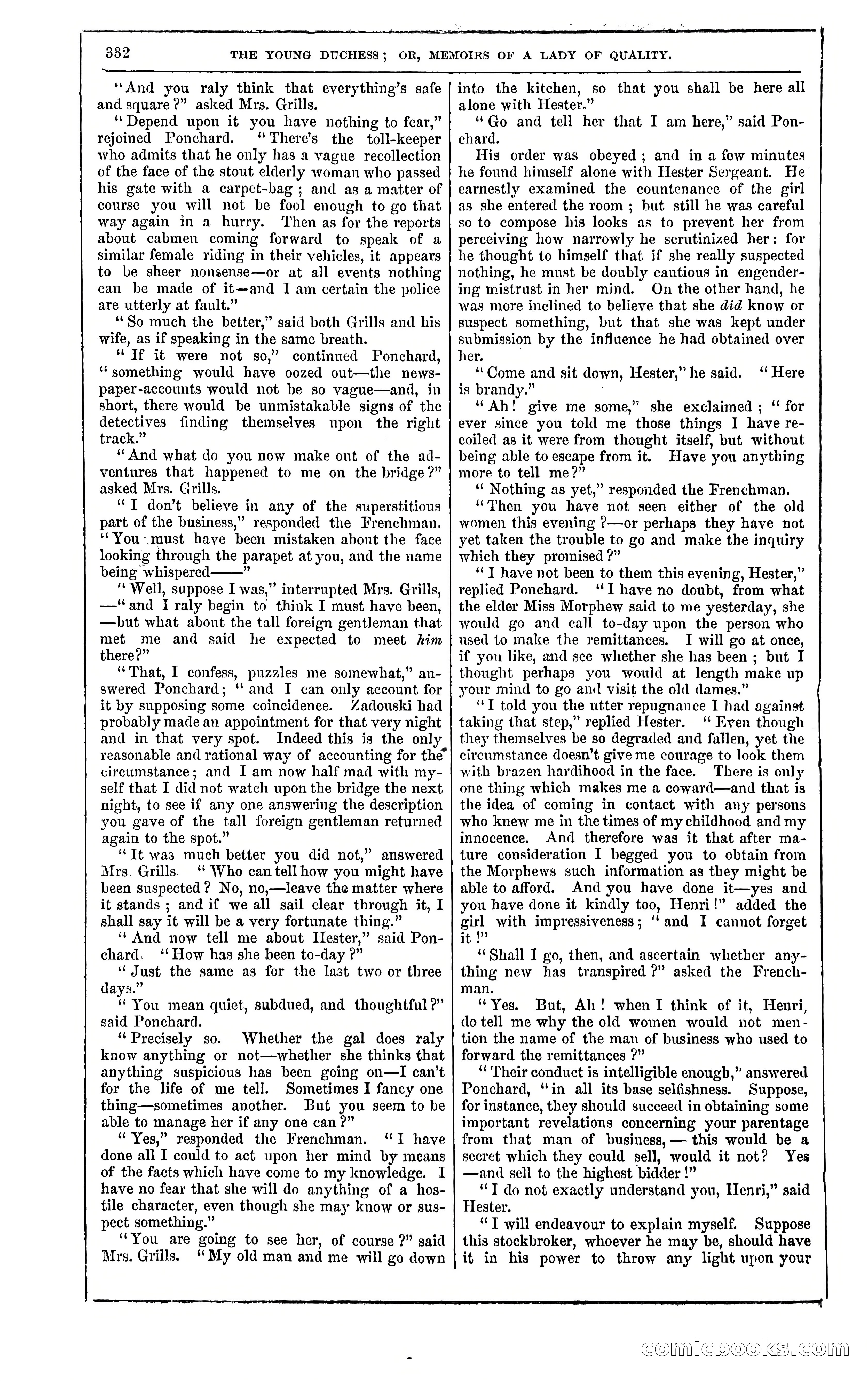
A restored page from Penny Dreadfuls, 1858. Page through the whole issue in the reader above.
📄 Transcribed text from this page (OCR, searchable)
Machine-transcribed from the original scan — historical spelling and the odd misread are preserved.
332 Fe 3 KS pha =o om PENS inc She = A AA at a tr et gan eat ‘ee sm " L ead 2 THE YOUNG DUCHESS; OR, MEMOIRS OF A LADY OF QUALITY. ‘‘And you raly think that everything’s safe and square ?” asked Mrs. Grills. ‘‘Depend upon it you have nothing to fear,” rejoined Ponchard. ‘There’s the toll-keeper who admits that he only has a vague recollection of the face of the stout elderly woman who passed his gate with a carpet-bag; and as a matter of course you will not be fool enough to go that way again in a hurry. Then as for the reports about cabmen coming forward to speak of a similar female riding in their vehicles, it appears to be sheer nonsense—or at all events nothing can be made of it~—and I am certain the police are utterly at fault.” ‘‘So much the better,” said both Grills and his wife, as if speaking in the same breath. “If it were not so,” continued Ponchard, ‘something would have oozed out—the news- paper-accounts would not be so vague—and, in short, there would be unmistakable signs of the detectives finding themselves upon the right track.” ““And what do you now make out of the ad- ventures that happened to me on the bridge ?” asked Mrs. Grills. ‘TY don’t believe in any of the superstitious part of the business,” responded the Frenchman. ‘“You-~ must haye been mistaken about the face looking through the parapet at you, and the name being whispered. a ‘Well, suppose I was,” interrupted Mrs. Grills, —“‘and I raly begin to think I must have been, —but what about the tall foreign gentleman that met me and said he expected to meet him there?” “That, I confess, puzzles me somewhat,” an- swered Ponchard; ‘‘ and I can only account for it by supposing some coincidence. Zadouski had probably made an appointment for that very night and in that very spot. Indeed this is the only reasonable and rational way of accounting for the’ circumstance; and I am now half mad with my- self that I did not watch upon the bridge the next night, to see if any one answering the description you gave of the tall foreign gentleman returned again to the spot.” ‘Tt was much better you did not,” answered Mrs. Grills. ‘‘ Who can tell how you might have been suspected ? No, no,—leave the matter where it stands ; and if we all sail clear through it, I shall say it will be a very fortunate thing.” ‘‘ And now tell me about Hester,” said Pon- chard. ‘‘ How has she been to-day ?” ‘‘ Just the same as for the last two or three days.” “You mean quiet, subdued, and thoughtful ?” said Ponchard. “Precisely so. Whether the gal does raly know anything or not—whether she thinks that anything suspicious has been going on—lI can’t for the life of me tell. Sometimes I fancy one thing—sometimes another. But you seem to be able to manage her if any one can ?” ‘“‘ Yes,” responded the Frenchman. “I have done all I could to act upon her mind by means of the facts which have come to my knowledge. I have no fear that she will do anything of a hos- tile character, even though she may know or sus- pect something.” ‘You are going to see her, of course ?” said Mrs. Grills, ‘My old man and me will go down into the kitchen, so that you shall be here all alone with Hester.” ““Go and tell her that I am here,” said Pon- chard. Ilis order was obeyed ; and in a few minutes he found himself alone with Hester Sergeant. He earnestly examined the countenance of the girl as she entered the room ; but still he was careful so to compose his looks as to prevent her from perceiving how narrowly he scrutinized her: for he thought to himself that if she really suspected nothing, he must be doubly cautious in engender- ing mistrust in her mind. On the other hand, he was more inclined to believe that she did know or suspect something, but that she was kept under submission by the influence he had obtained over her. “Come and sit down, Hester,” he said. is brandy.” ' ‘Ah! give me some,” she exclaimed ; ‘ for ever since you told me those things I have re- coiled as it were from thought itself, but without being able to escape from it. Have you anything more to tell me?” ‘“* Nothing as yet,” responded the Frenchman. “Then you have not seen either of the old women this evening ?—or perhaps they have not yet taken the trouble to go and make the inquiry which they promised ?” ‘“‘T have not been to them this evening, Hester,” replied Ponehard. “I have no doubt, from what the elder Miss Morphew said to me yesterday, she would go and call to-day upon the person who used to make the remittances. I will go at once, if you like, and see whether she has been ; but I thought perhaps you would at length make up your mind to go and visit the old dames.” “T told you the utter repugnance I had against taking that step,” replied Hester. ‘ Even though | they themselves be so degraded and fallen, yet the circumstance doesn’t give me courage to look them with brazen hardihood in the face. There is only one thing which makes me a coward—and that is the idea of coming in contact with any persons who knew me in the times of my childhood and my innocence. And therefore was it that after ma- ture consideration 1 begged you to obtain from the Morphews such information as they might be able to afford. And you have done it—yes and you have done it kindly too, Henri!” added the girl with impressiveness; ‘‘ and I cannot forget it!” “Shall I go, then, and ascertain whether any- thing new has transpired ?” asked the French- man. “Yes. But, Ah! when I think of it, Henri, do tell me why the old women would not men- tion the name of the mau of business who used to forward the remittances ?” ‘* Their conduct is intelligible enough,” answered Ponchard, ‘in all its base selfishness. Suppose, for instance, they should succeed in obtaining some important revelations concerning your parentage from that man of business, — this would be a secret which they could sell, would it not? Yes —and sell to the highest bidder !” ‘“‘T do not exactly understand you, Henri,” said Hester. “J will endeavour to explain myself. Suppose this stockbroker, whoever he may be, should have it in his power to throw any light upon your ‘‘ Here TA a RT a oO Connicloooks Colin