
Penny Dreadfuls, 1858 · page 42 of 400
The Young Duchess; or, Memoirs of a Lady of Quality — page 42: what you’re looking at
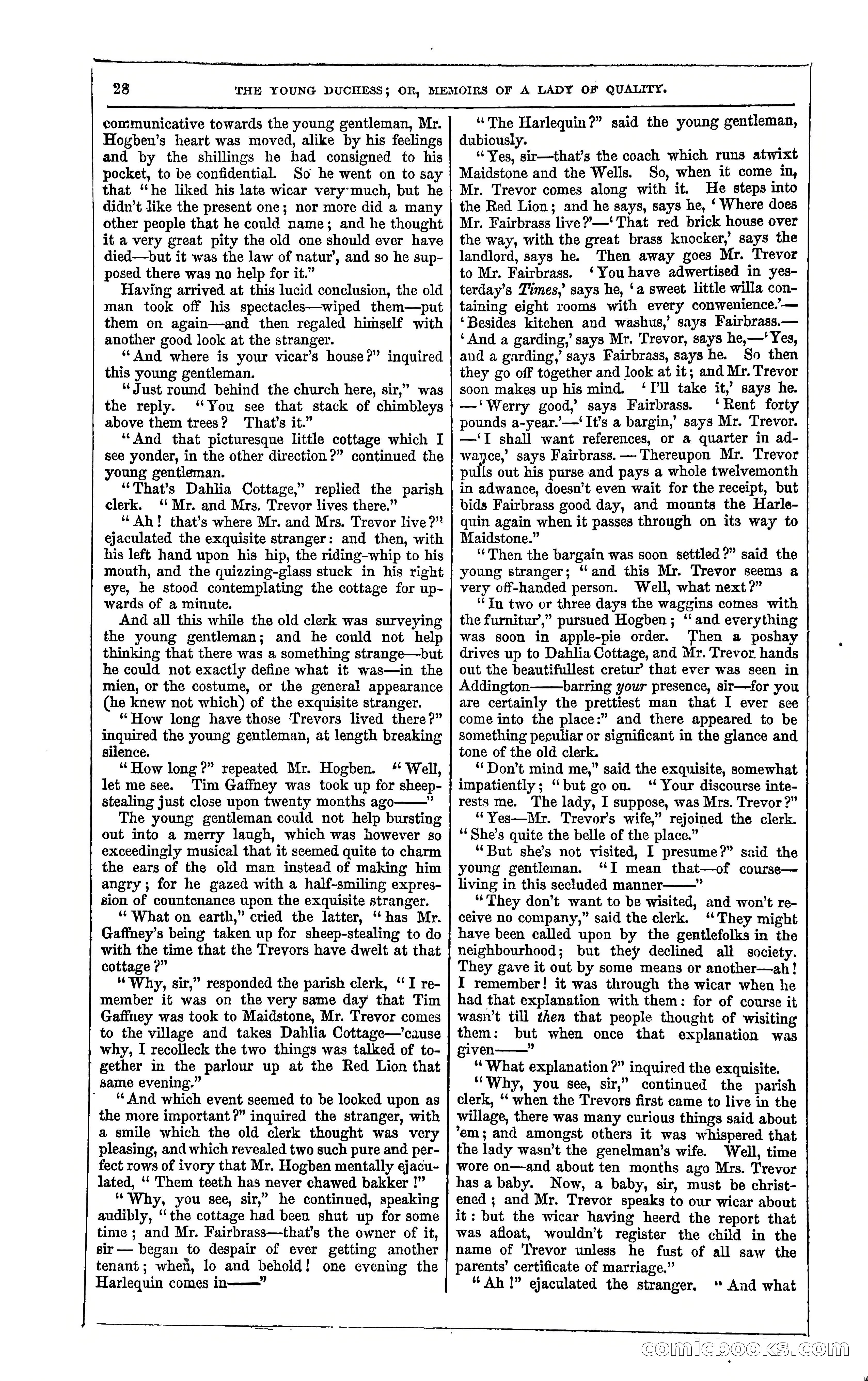
A restored page from Penny Dreadfuls, 1858. Page through the whole issue in the reader above.
📄 Transcribed text from this page (OCR, searchable)
Machine-transcribed from the original scan — historical spelling and the odd misread are preserved.
‘ a ce ni A emer mee Sine cam SS a5 28 THE YOUNG DUCHESS; OR, MEMOIRS OF A LADY OF QUALITY. communicative towards the young gentleman, Mr. Hogben’s heart was moved, alike by his feelings and by the shillings he had consigned to his pocket, to be confidential. So he went on to say that “he liked his late wicar very’much, but he didn’t like the present one; nor more did a many other people that he could name; and he thought it a very great pity the old one should ever have died—but it was the law of natur’, and so he sup- posed there was no help for it.” Having arrived at this lucid conclusion, the old man took off his spectacles—wiped them—put them on again—and then regaled himself with another good look at the stranger. ‘“‘And where is your vicar’s house?” inquired this young gentleman. “Just round behind the church here, sir,” was the reply. ‘‘You see that stack of chimbleys above them trees? That’s it.” “And that picturesque little cottage which I see yonder, in the other direction?” continued the young gentleman. ““That’s Dahlia Cottage,” replied the parish clerk. ‘Mr. and Mrs. Trevor lives there.” ‘“‘ Ah! that’s where Mr. and Mrs. Trevor live?” ejaculated the exquisite stranger: and then, with his left hand upon his hip, the riding-whip to his mouth, and the quizzing-glass stuck in his right eye, he stood contemplating the cottage for up- wards of a minute. . And all this while the old clerk was surveying the young gentleman; and he could not help thinking that there was a something strange—but he could not exactly define what it was—in the mien, or the costume, or the general appearance (he knew not which) of the exquisite stranger. “How long have those Trevors lived there?” inquired the young gentleman, at length breaking silence. “‘ How long?” repeated Mr. Hogben. 4 Well, let me see. Tim Gaffney was took up for sheep- stealing just close upon twenty months ago——” The young gentleman could not help bursting out into a merry laugh, which was however so exceedingly musical that it seemed quite to charm the ears of the old man instead of making him angry; for he gazed with a half-smiling expres- sion of countenance upon the exquisite stranger. ** ‘What on earth,” cried the latter, ‘has Mr. Gaffney’s being taken up for sheep-stealing to do with the time that the Trevors have dwelt at that cottage ?” “Why, sir,” responded the parish clerk, “I re- member it was on the very same day that Tim Gaffney was took to Maidstone, Mr. Trevor comes to the village and takes Dahlia Cottage—cause why, I recolleck the two things was talked of to- gether in the parlour up at the Red Lion that same evening.” “‘ And which event seemed to be looked upon as the more important?” inquired the stranger, with a smile which the old clerk thought was very pleasing, and which revealed two such pure and per- fect rows of ivory that Mr. Hogben mentally ejacu- lated, ‘‘ Them teeth has never chawed bakker !” “Why, you see, sir,” he continued, speaking audibly, ‘the cottage had been shut up for some time ; and Mr. Fairbrass—that’s the owner of it, sir — began to despair of ever getting another tenant; when, lo and behold! one evening the Harlequin comes in——” “The Harlequin?” said the young gentleman, dubiously. . ‘Yes, sir—that’s the coach which runs atwixt Maidstone and the Wells. So, when it come in, Mr. Trevor comes along with it. He steps into the Red Lion; and he says, says he, ‘ Where does Mr. Fairbrass live?—‘ That red brick house over the way, with the great brass knocker,’ says the landlord, says he. Then away goes Mr. Trevor to Mr. Fairbrass. ‘Youhave adwertised in yes- terday’s Times,’ says he, ‘a sweet little willa con- taining eight rooms with every conwenience.— ‘Besides kitchen and washus,’ says Fairbrass.— ‘And a garding,’ says Mr. Trevor, says he,—‘ Yes, and a garding,’ says Fairbrass, says he. So then they go off together and look at it; and Mr. Trevor soon makes up his mind. ‘I'll take it,’ says he. —‘Werry good, says Fairbrass. ‘Rent forty pounds a-year.’—‘ It’s a bargin,’ says Mr. Trevor. —T shall want references, or a quarter in ad- wance,’ says Fairbrass.— Thereupon Mr. Trevor pulls out his purse and pays a whole twelvemonth in adwance, doesn’t even wait for the receipt, but bids Fairbrass good day, and mounts the Harle- quin again when it passes through on its way to Maidstone.” ‘Then the bargain was soon settled?” said the young stranger; “‘and this Mr. Trevor seems a very off-handed person. Well, what next?” “In two or three days the waggins comes with the furnitur’,” pursued Hogben; “and everything was soon in apple-pie order. ‘Then a poshay drives up to Dahlia Cottage, and Mr. Trevor. hands out the beautifullest cretur’ that ever was seen in Addington barring your presence, sir—for you are certainly the prettiest man that I ever see come into the place:” and there appeared to be something peculiar or significant in the glance and tone of the old clerk. “Don’t mind me,” said the exquisite, somewhat impatiently ; “but go on. ‘ Your discourse inte- rests me. The lady, I suppose, was Mrs. Trevor ?” ““Yes—Mr. Trevor’s wife,” rejoined the clerk. ‘‘She’s quite the belle of the place.” “But she’s not visited, I presume?” said the young gentleman. ‘“‘I mean that—of course— living in this secluded manner ” “They don’t want to be wisited, and won't re- ceive no company,” said the clerk. ‘They might have been called upon by the gentlefolks in the neighbourhood; but they declined all society. They gave it out by some means or another—ah! I remember! it was through the wicar when he had that explanation with them: for of course it wasn’t till then that people thought of wisiting them: but when once that explanation was given ” ‘What explanation ?” inquired the exquisite. “Why, you see, sir,” continued the parish clerk, ‘“‘ when the Trevors first came to live in the Willage, there was many curious things said about "em; and amongst others it was whispered that the lady wasn’t the genelman’s wife. Well, time wore on—and about ten months ago Mrs. Trevor has a baby. Now, a baby, sir, must be christ- ened ; and Mr. Trevor speaks to our wicar about it: but the wicar having heerd the report that was afloat, wouldn’t register the child in the name of Trevor unless he fust of all saw the parents’ certificate of marriage.” “Ah !” ejaculated the stranger. * And what SSS ee re Ea oO SS COMICEHOO