
Penny Dreadfuls, 1858 · page 73 of 400
The Young Duchess; or, Memoirs of a Lady of Quality — page 73: what you’re looking at
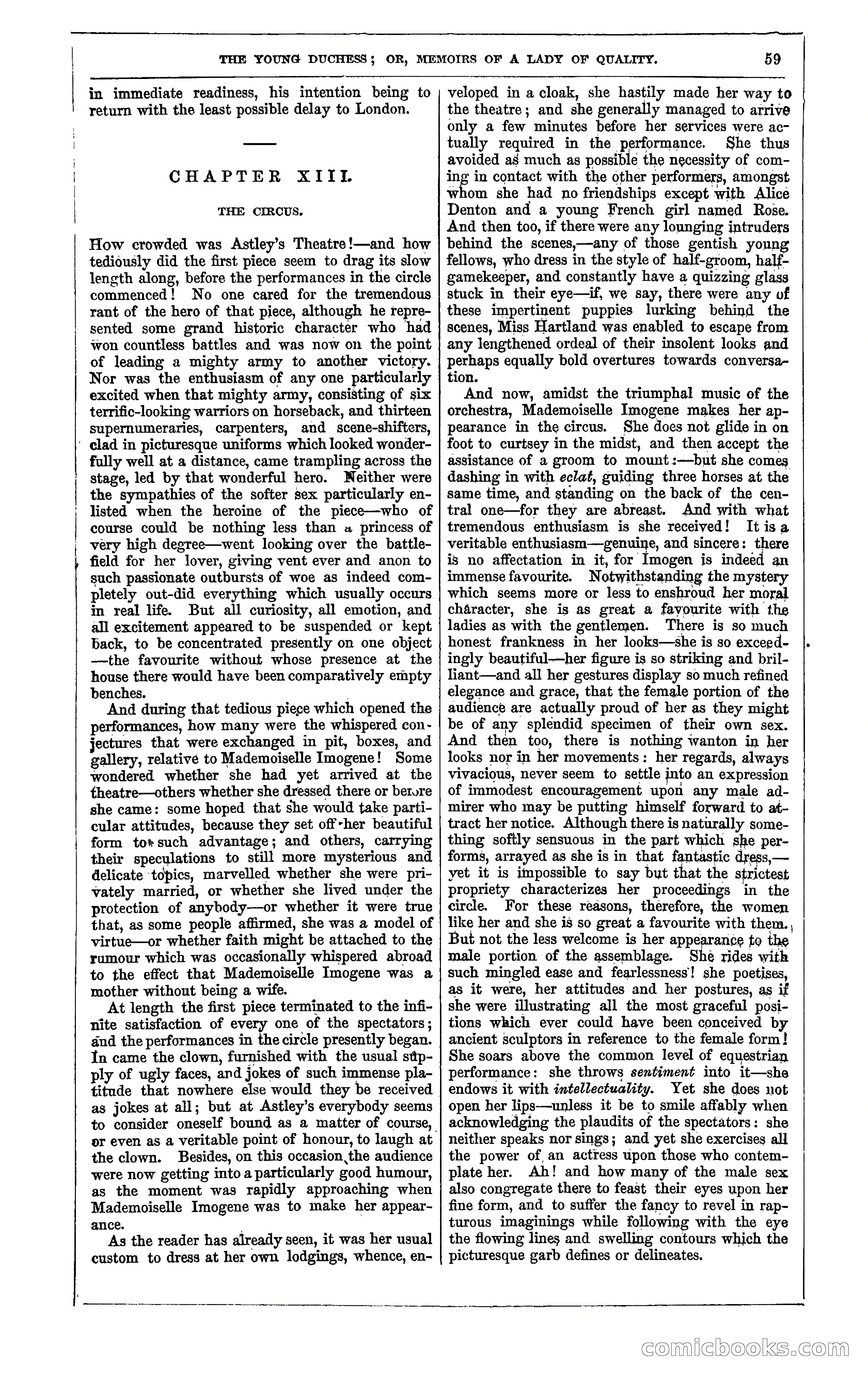
A restored page from Penny Dreadfuls, 1858. Page through the whole issue in the reader above.
📄 Transcribed text from this page (OCR, searchable)
Machine-transcribed from the original scan — historical spelling and the odd misread are preserved.
THE YOUNG DUCHESS; OR, MEMOIRS OF A LADY OF QUALITY. in immediate readiness, his intention being to return with the least possible delay to London. CHAPTER XIII. THE CIRCUS. How crowded was Astley’s Theatre!—and how tediously did the first piece seem to drag its slow length along, before the performances in the circle commenced! No one cared for the tremendous rant of the hero of that piece, although he repre- sented some grand historic character who had won countless battles and was now on the point of leading a mighty army to another victory. Nor was the enthusiasm of any one particularly excited when that mighty army, consisting of six terrific-looking warriors on horseback, and thirteen supernumeraries, carpenters, and scene-shifters, ‘ elad in picturesque uniforms which looked wonder- fully well at a distance, came trampling across the stage, led by that wonderful hero. Neither were the sympathies of the softer sex particularly en- listed when the heroine of the piece—who of course could be nothing less than a princess of very high degree—went looking over the battle- field for her lover, giving vent ever and anon to such passionate outbursts of woe as indeed com- pletely out-did everything which usually occurs in real life. But all curiosity, all emotion, and all excitement appeared to be suspended or kept back, to be concentrated presently on one object —the favourite without whose presence at the house there would have been comparatively empty benches. And during that tedious piece which opened the performances, how many were the whispered con- jectures that were exchanged in pit, boxes, and gallery, relative to Mademoiselle Imogene! Some wondered whether she had yet arrived at the theatre—others whether she dressed there or berure she came: some hoped that she would take parti- cular attitudes, because they set off-her beautiful form totsuch advantage; and others, carrying their speculations to still more mysterious and delicate ‘topics, marvelled whether she were pri- vately married, or whether she lived under the protection of anybody—-or whether it were true that, as some people affirmed, she was a model of virtue—or whether faith might be attached to the yumour which was occasionally whispered abroad to the effect that Mademoiselle Imogene was a mother without being a wife. At length the first piece terminated to the infi- nite satisfaction of every one of the spectators ; and the performances in the circle presently began. In came the clown, furnished with the usual stp- ply of ugly faces, and jokes of such immense pla- titude that nowhere else would they be received as jokes at all; but at Astley’s everybody seems to consider oneself bound as a matter of course, or even as a veritable point of honour, to laugh at the clown. Besides, on this occasion the audience were now getting into a particularly good humour, as the moment was rapidly approaching when Mademoiselle Imogene was to make her appear- ance. As the reader has already seen, it was her usual custom to dress at her own lodgings, whence, en- 59 veloped in a cloak, she hastily made her way to the theatre; and she generally managed to arrive only a few minutes before her services were ac- tually required in the performance. She thus avoided ag much as possible the necessity of com- ing in contact with the other performers, amongst whom she had no friendships except with Alice Denton and a young French girl named Rose. And then too, if there were any lounging intruders behind the scenes,—any of those gentish young fellows, who dress in the style of half-groom, half- gamekeeper, and constantly have a quizzing glass stuck in their eye—if, we say, there were any of these impertinent puppies lurking behind the scenes, Miss Hartland was enabled to escape from any lengthened ordeal of their insolent looks and perhaps equally bold overtures towards conversa- tion. And now, amidst the triumphal music of the orchestra, Mademoiselle Imogene makes her ap- pearance in the circus. She does not glide in on foot to curtsey in the midst, and then accept the assistance of a groom to mount:—but she comes dashing in with eclat, guiding three horses at the same time, and standing on the back of the cen- tral one—for they are abreast. And with what tremendous enthusiasm is she received! Itisa veritable enthusiasm—genuine, and sincere: there is no affectation in it, for Imogen is indeed an immense favourite. Notwithstanding the mystery which seems more or less to enshroud her moral character, she is as great a favourite with the ladies as with the gentlemen. There is so much honest frankness in her looks—she is so exceed- ingly beautiful—her figure is so striking and bril- liant—and all her gestures display so much refined elegance and grace, that the female portion of the audience are actually proud of her as they might be of any splendid specimen of their own sex. And then too, there is nothing wanton in her looks nor in her movements: her regards, always vivacious, never seem to settle jnto an expression of immodest encouragement upon any male ad- mirer who may be putting himself forward to at- tract her notice. Although there is naturally some- thing softly sensuous in the part which she per- forms, arrayed as she is in that fantastic dress,— yet it is impossible to say but that the strictest propriety characterizes her proceedings in the circle. For these reasons, therefore, the women like her and she is so great a favourite with them. , But not the less welcome is her appearance to the male portion of the assemblage. She rides with such mingled ease and fearlessness! she poetises, as it were, her attitudes and her postures, as if she were illustrating all the most graceful posi- tions which ever could have been conceived by ancient sculptors in reference to the female form! She soars above the common level of equestrian performance: she throws sentiment into it—she endows it with intellectuality. Yet she does not open her lips—unless it be to smile affably when acknowledging the plaudits of the spectators: she neither speaks nor sings; and yet she exercises all the power of, an actress upon those who contem- plate her. Ah! and how many of the male sex also congregate there to feast their eyes upon her fine form, and to suffer the fancy to revel in rap- turous imaginings while following with the eye the flowing lines and swelling contours which the picturesque garb defines or delineates. COMO YN Wn) Colin