
Penny Dreadfuls, 1858 · page 77 of 400
The Young Duchess; or, Memoirs of a Lady of Quality — page 77: what you’re looking at
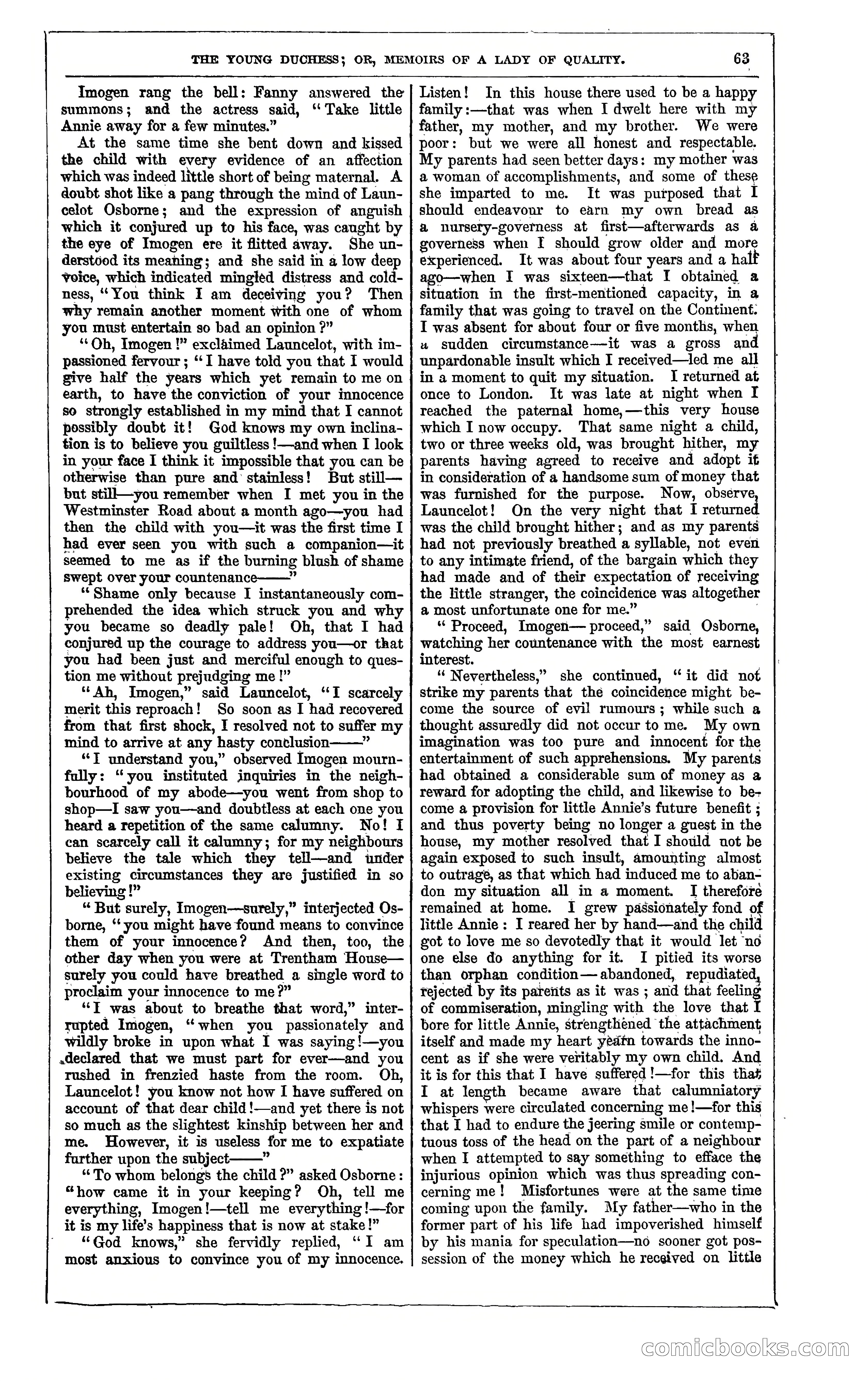
A restored page from Penny Dreadfuls, 1858. Page through the whole issue in the reader above.
📄 Transcribed text from this page (OCR, searchable)
Machine-transcribed from the original scan — historical spelling and the odd misread are preserved.
THE YOUNG DUCHESS; OR, MEMOIRS OF A LADY OF QUALITY. Imogen rang the bell: Fanny answered the summons; and the actress said, ‘ Take little Annie away for a few minutes.” At the same time she bent down and kissed the child with every evidence of an affection which was indeed little short of being maternal. A doubt shot like a pang through the mind of Laun- celot Osborne; and the expression of anguish which it conjured up to his face, was caught by the eye of Imogen ere it flitted away. She un- derstood its meahing; and she said in a low deep voice, which indicated mingled distress and cold- ness, “You think I am deceiving you? Then why remain another moment with one of whom you must entertain so bad an opinion ?” “Qh, Imogen !” exclaimed Launcelot, with im- passioned fervour ; ‘‘I have told you that I would give half the years which yet remain to me on earth, to have the conviction of your mnocence so strongly established in my mind that I cannot possibly doubt it! God knows my own inclina- tion is to believe you guiltless !—and when I look in your face I think it impossible that you can be otherwise than pure and stainless! But still— but still—you remember when I met you in the Westminster Road about a month ago—you had then the child with you—it was the first time I had ever seen you with such a companion—it seemed to me as if the burning blush of shame Swept over your countenance-———” ‘*Shame only because I instantaneously com- prehended the idea which struck you and why you became so deadly pale! Oh, that I had conjured up the courage to address you—or that you had been just and merciful enough to ques- tion me without prejudging me !” “Ah, Imogen,” said Launcelot, ‘I scarcely merit this reproach! So soon as I had recovered from that first shock, I resolved not to suffer my mind to arrive at any hasty conclusion ? ‘“¥ understand you,” observed Imogen mourn- fully: ‘you instituted inquiries in the neigh- bourhood of my abode—you went from shop to shop—I saw you—and doubtless at each one you heard a repetition of the same calumny. No! I ean scarcely call it calumny; for my neighbours believe the tale which they tell—and under existing circumstances they are justified in so believing !” “ But surely, Imogen—surely,” interjected Os- borne, ‘‘ you might have found means to convince them of your innocence? And then, too, the other day when you were at Trentham House— surely you could have breathed a single word to proclaim your innocence to me?” “FT was about to breathe that word,” inter- rupted Imogen, “‘when you passionately and wildly broke in upon what I was saying !—you adeclared that we must part for ever—and you rushed in frenzied haste from the room. Oh, Launcelot! you know not how I have suffered on account of that dear child!—and yet there is not so much as the slightest kinship between her and me. However, it is useless for me to expatiate further upon the subjec 7 “To whom belongs the child ?” asked Osborne: “how came it in your keeping? Oh, tell me everything, Imogen!—tell me everything !—for it is my life’s happiness that is now at stake!” ' “God knows,” she fervidly replied, “I am most anxious to convince you of my innocence. 63 Listen! In this house there used to be a happy family :—that was when I dwelt here with my father, my mother, and my brother. We were poor: but we were all honest and respectable. My parents had seen better days: my mother was a woman of accomplishments, and some of these she imparted to me. It was purposed that I should endeavonr to earn my own bread as & nursery-governess at first—afterwards as a governess when I should grow older and more experienced. It was about four years and ah ago—when I was sixteen—that I obtained a situation in the first-mentioned capacity, in a family that was going to travel on the Continent. I was absent for about four or five months, when wu sudden circumstance—it was a gross an unpardonable insult which I received—led me all in a moment to quit my situation. I returned at once to London. It was late at night when I reached the paternal home,—this very house which I now occupy. That same night a child, two or three weeks old, was brought hither, my parents having agreed to receive and adopt it in consideration of a handsome sum of money that was furnished for the purpose. Now, observ Launcelot! On the very night that I returned was the child brought hither; and as my parents had not previously breathed a syllable, not even to any intimate friend, of the bargain which they had made and of their expectation of receiving the little stranger, the coinciderice was altogether a most unfortunate one for me.” | “* Proceed, Imogen— proceed,” said Osborne, watching her countenance with the most earnest interest. “ Nevertheless,” she continued, “it did not strike my parents that the coincidence might be- come the source of evil rumours; while such a thought assuredly did not occur tome. My own imagination was too pure and innocent for the entertainment of such apprehensions. My parents had obtained a considerable sum of money as a reward for adopting the child, and likewise to be- come a provision for little Annie’s future benefit ; and thus poverty being no longer a guest in the house, my mother resolved that I should not be again exposed to such insult, amounting almost to outrag®, as that which had induced me to aban- don my situation all in a moment. I therefore remained at home. I grew passionately fond of little Annie: I reared her by hand—and the child got to love me so devotedly that it would let no one else do anything for it. I pitied its worse than orphan condition— abandoned, repudiated, rejected by its parerits as it was ; and that feelin of commiseration, mingling with the love that bore for little Annie, strengthened the attachment itself and made my heart yedim towards the inno- cent as if she were veritably my own child. And it is for this that I have suffered!—for this that I at len: became aware that calumniatory whispers were circulated concerning me !—for this that I had to endure the jeering smile or contemp- tuous toss of the head on the part of a neighbour when I attempted to say something to efface the injurious opinion which was thus spreading con- cerning me! Misfortunes were at the same time coming upon the family. My father—who in the former part of his life had impoverished himself by his mania for speculation—no sooner got pos- session of the money which he received on little A a p oO COMO Colin