
Penny Dreadfuls, 1901 · page 199 of 324
D'Artagnan, the King Maker — page 199: what you’re looking at
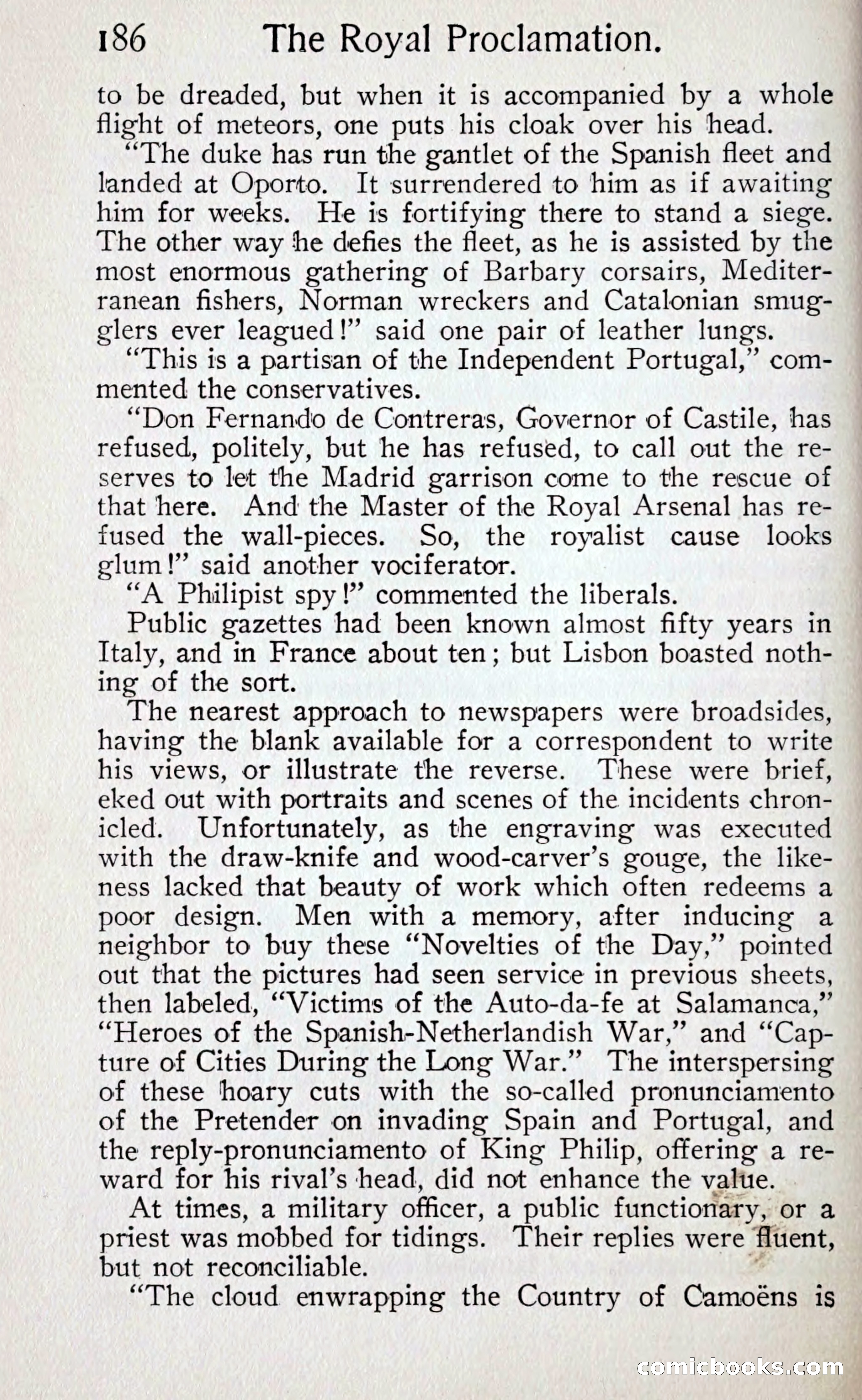
A restored page from Penny Dreadfuls, 1901. Page through the whole issue in the reader above.
📄 Transcribed text from this page (OCR, searchable)
Machine-transcribed from the original scan — historical spelling and the odd misread are preserved.
186 The Royal Proclamation. to be dreaded, but when it is accompanied by a whole flight of meteors, one puts his cloak over his head. ‘The duke has run the gantlet of the Spanish fleet and landed at Oporto. It surrendered to him as if awaiting him for weeks. He is fortifying there to stand a siege. The other way he defies the fleet, as he is assisted by the most enormous gathering of Barbary corsairs, Mediter- ranean fishers, Norman wreckers and Catalonian smug- elers ever leagued!’’ said one pair of leather lungs. “This is a partisan of the Independent Portugal,” com- mented the conservatives. “Don Fernando de Contreras, Governor of Castile, has refused, politely, but he has refused, to call out the re- serves to let the Madrid garrison come to the rescue of that here. And the Master of the Royal Arsenal has re- fused the wall-pieces. So, the royalist cause looks glum!” said another vociferator. “A Philipist spy!’ commented the liberals. Public gazettes had been known almost fifty years in Italy, and in France about ten; but Lisbon boasted noth- ing of the sort. The nearest approach to newspapers were broadsides, having the blank available for a correspondent to write his views, or illustrate the reverse. These were brief, eked out with portraits and scenes of the incidents chron- icled. Unfortunately, as the engraving was executed with the draw-knife and wood-carver’s gouge, the like- ness lacked that beauty of work which often redeems a poor design. Men with a memory, after inducing a neighbor to buy these “Novelties of the Day,” pointed out that the pictures had seen service in previous sheets, then labeled, ‘Victims of the Auto-da-fe at Salamanca,” “Heroes of the Spanish-Netherlandish War,” and “Cap- ture of Cities During the Long War.” The interspersing of these hoary cuts with the so-called pronunciamento of the Pretender on invading Spain and Portugal, and the reply-pronunciamento of King Philip, offering a re- ward for his rival’s head, did not enhance the value. At times, a military officer, a public functionary, or a priest was mobbed for tidings. Their replies were fluent, but not reconciliable. fs “The cloud enwrapping the Country of Camoéns is Gomicbookseom