
Penny Dreadfuls, 1895 · page 20 of 215
A Daughter of Maryland — page 20: what you’re looking at
A restored page from Penny Dreadfuls, 1895. Page through the whole issue in the reader above.
📄 Transcribed text from this page (OCR, searchable)
Machine-transcribed from the original scan — historical spelling and the odd misread are preserved.
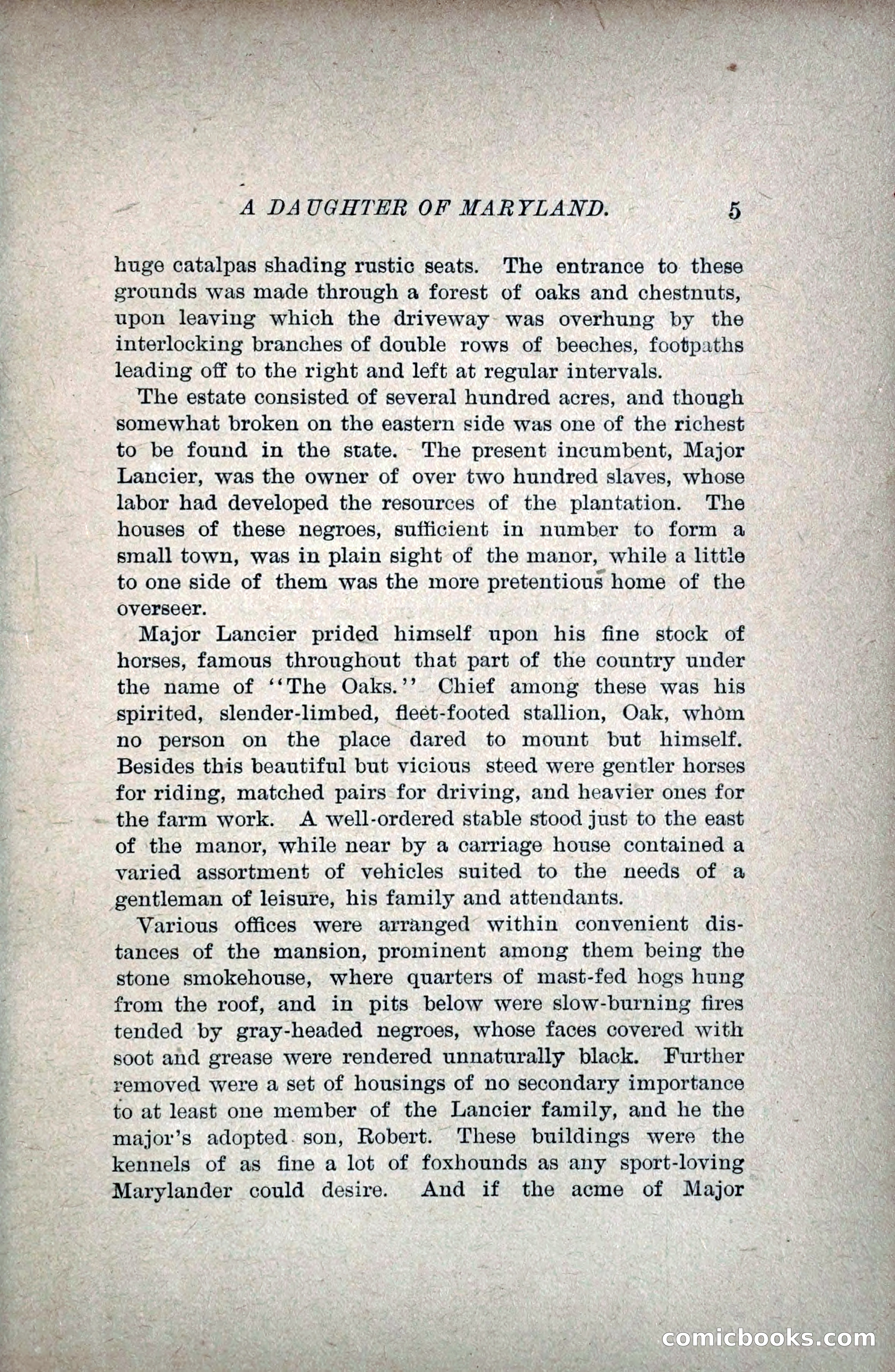
~ A DAUGHTER OF MARYLAND. 5 huge catalpas shading rustic seats. The entrance to these grounds was made through a forest of oaks and chestnuts, upon leaving which the driveway was overhung by the interlocking branches of double rows of beeches, footpaths leading off to the right and left at regular intervals. The estate consisted of several hundred acres, and though somewhat broken on the eastern side was one of the richest to be found in the state. The present incumbent, Major Lancier, was the owner of over two hundred slaves, whose labor had developed the resources of the plantation. The houses of these negroes, sufficient in number to form a small town, was in plain sight of the manor, while a little to one side of them was the more pretentious home of the overseer. Major Lancier prided himself upon his fine stock of horses, famous throughout that part of the country under the name of ‘‘The Oaks.’’ Chief among these was his spirited, slender-limbed, fleet-footed stallion, Oak, whom no person on the place dared to mount but himself. Besides this beautiful but vicious steed were gentler horses for riding, matched pairs for driving, and heavier ones for the farm work. A well-ordered stable stood just to the east of the manor, while near by a carriage house contained a varied assortment of vehicles suited to the needs of a gentleman of leisure, his family and attendants. Various offices were arranged within convenient dis- tances of the mansion, prominent among them being the stone smokehouse, where quarters of mast-fed hogs hung from the roof, and in pits below were slow-burning fires tended by gray-headed negroes, whose faces covered with soot and grease were rendered unnaturally black. Further removed were a set of housings of no secondary importance to at least one member of the Lancier family, and he the major’s adopted. son, Robert. These buildings were the kennels of as fine a lot of foxhounds as any sport-loving Marylander could desire. And if the acme of Major SE aie es Wis 2 | te GOomIicboo co cS