
Penny Dreadfuls, 1890 · page 140 of 263
Detective Bob Bridger — page 140: what you’re looking at
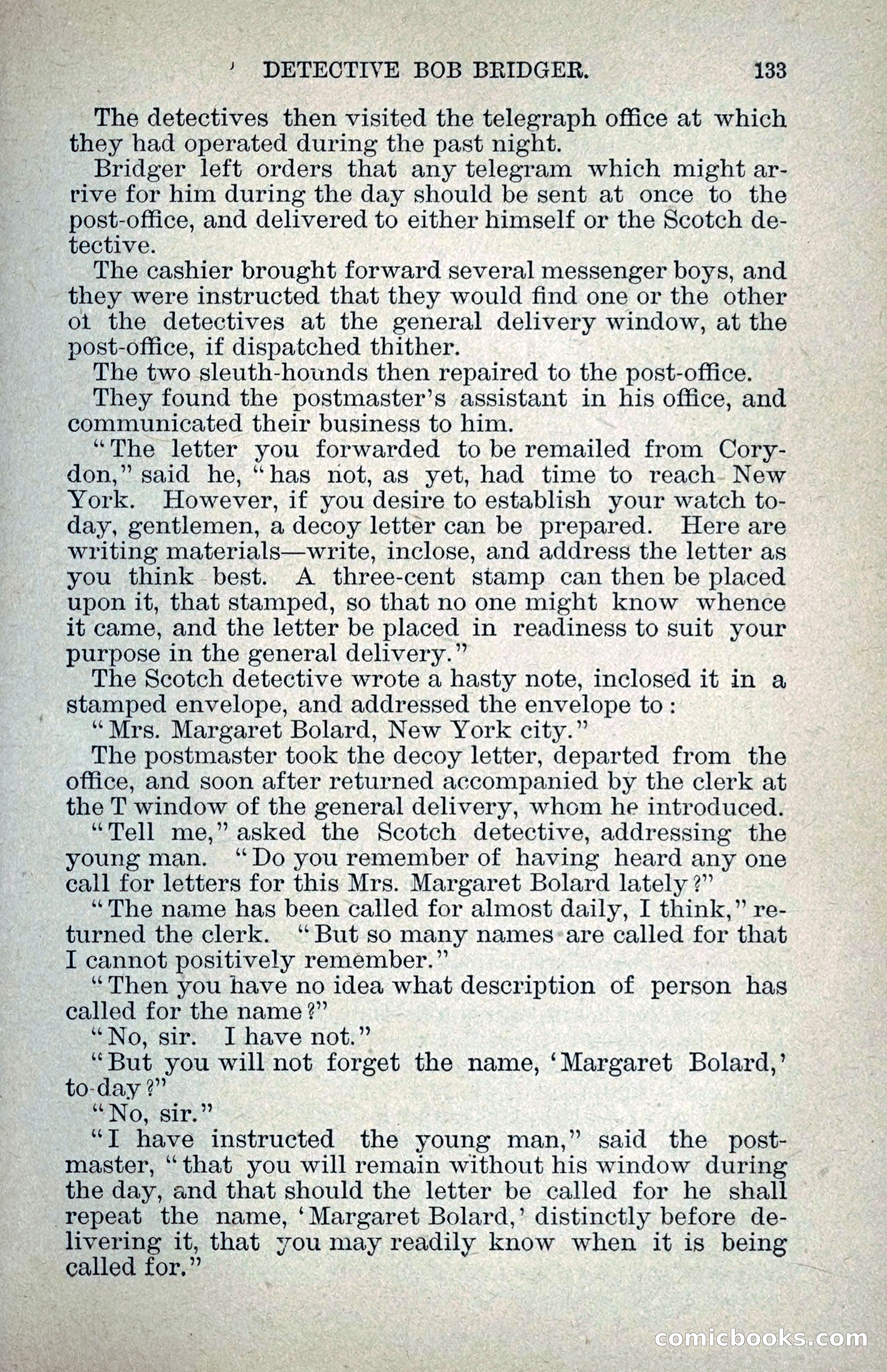
A restored page from Penny Dreadfuls, 1890. Page through the whole issue in the reader above.
📄 Transcribed text from this page (OCR, searchable)
Machine-transcribed from the original scan — historical spelling and the odd misread are preserved.
* DETECTIVE BOB BRIDGER. 133 The detectives then visited the telegraph office at which they had operated during the past night. Bridger left orders that any telegram which might ar- rive for him during the day should be sent at once to the post-office, and delivered to either himself or the Scotch de- tective. The cashier brought forward several messenger boys, and they were instructed that they would find one or the other oi the detectives at the general delivery window, at the post-office, if dispatched thither. The two sleuth-hounds then repaired to the post-office. They found the postmaster’s assistant in his office, and communicated their business to him. “The letter you forwarded to be remailed from Cory- don,” said he, “has not, as yet, had time to reach. New York. However, if you desire to establish your watch to- day, gentlemen, a decoy letter can be prepared. Here are writing materials—write, inclose, and address the letter as you think best. <A three-cent stamp can then be placed upon it, that stamped, so that no one might know whence it came, and the letter be placed in readiness to suit your purpose in the general delivery.” The Scotch detective wrote a hasty note, inclosed it in a stamped envelope, and addressed the envelope to: “Mrs. Margaret Bolard, New York city.” The postmaster took the decoy letter, departed from the office, and soon after returned accompanied by the clerk at the T window of the general delivery, whom he introduced. “Tell me,” asked the Scotch detective, addressing the young man. “Do you remember of having heard any one call for letters for this Mrs. Margaret Bolard lately ?” “The name has been called for almost daily, I think,” re- turned the clerk. ‘But so many names:are called for that I cannot positively remember.” “Then you have no idea what description of person has called for the name ?” “No, sir. JI have not.” “But you will not forget the name, ‘Margaret Bolard,’ to-day ?” “No, sir.” | “I have instructed the young man,” said the _ post- master, “that you will remain without his window during the day, and that should the letter be called for he shall repeat the name, ‘Margaret Bolard,’ distinctly before de- livering it, that you may readily know when it is being called for,” (ao palicel eve Ke) <s (El)