
Penny Dreadfuls, 1890 · page 172 of 263
Detective Bob Bridger — page 172: what you’re looking at
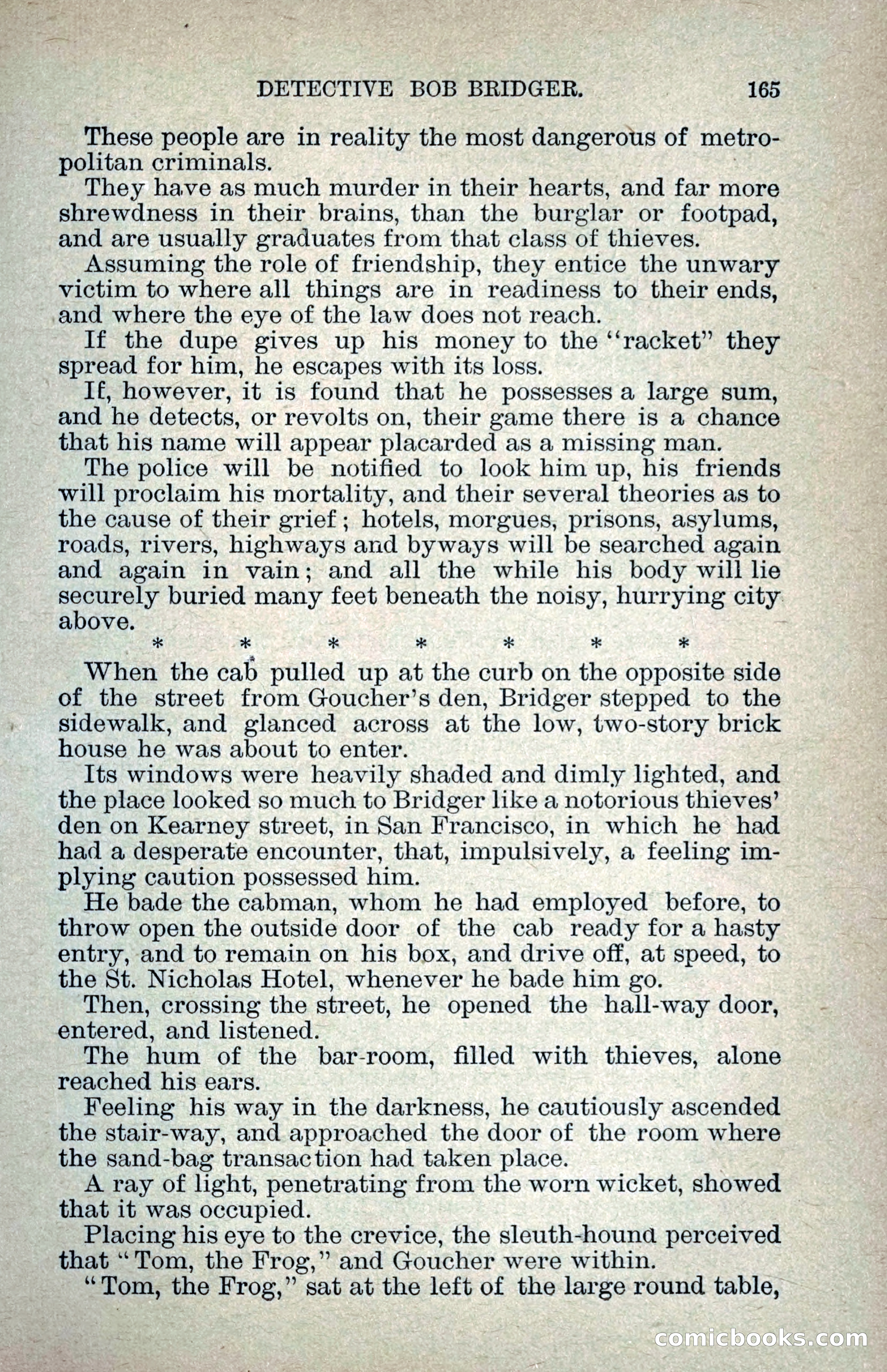
A restored page from Penny Dreadfuls, 1890. Page through the whole issue in the reader above.
📄 Transcribed text from this page (OCR, searchable)
Machine-transcribed from the original scan — historical spelling and the odd misread are preserved.
DETECTIVE BOB BRIDGER. | 165 These people are in reality the most dangerous of metro- politan criminals. They have as much murder in their hearts, and far more shrewdness in their brains, than the burglar or footpad, and are usually graduates from that class of thieves. Assuming the role of friendship, they entice the unwary victim to where all things are in readiness to their ends, and where the eye of the law does not reach. If the dupe gives up his money to the ‘‘racket” they spread for him, he escapes with its loss. If, however, it 1s found that he possesses a large sum, and he detects, or revolts on, their game there is a chance that his name will appear placarded as a missing man. The police will be notified to look him up, his friends will proclaim his mortality, and their several theories as to the cause of their grief; hotels, morgues, prisons, asylums, roads, rivers, highways and byways will be searched again and again in vain; and all the while his body will lie securely buried many feet beneath the noisy, hurrying city above. Ok * * ok * k ** When the cab pulled up at the curb on the opposite side of the street from Goucher’s den, Bridger stepped to the sidewalk, and glanced across at the low, two-story brick house he was about to enter. Its windows were heavily shaded and dimly lighted, and the place looked so much to Bridger like a notorious thieves’ den on Kearney street, in San Francisco, in which he had had a desperate encounter, that, impulsively, a feeling im- plying caution possessed him. He bade the cabman, whom he had employed before, to throw open the outside door of the cab ready for a hasty entry, and to remain on his box, and drive off, at speed, to the St. Nicholas Hotel, whenever he bade him go. Then, crossing the street, he opened the hall-way door, entered, and listened. The hum of the bar-room, filled with thieves, alone reached his ears. Feeling his way in the darkness, he cautiously ascended the stair-way, and approached the door of the room where the sand-bag transaction had taken place. A ray of light, penetrating from the worn wicket, showed — that it was occupied. Placing his eye to the crevice, the sleuth-houna perceived that “Tom, the Frog,” and Goucher were within. “Tom, the Frog,” sat at the left of the large round table, Gomicbhoo cS €o