
Penny Dreadfuls, 1856 · page 101 of 399
Ellen Percy; or, The Memoirs of an Actress — page 101: what you’re looking at
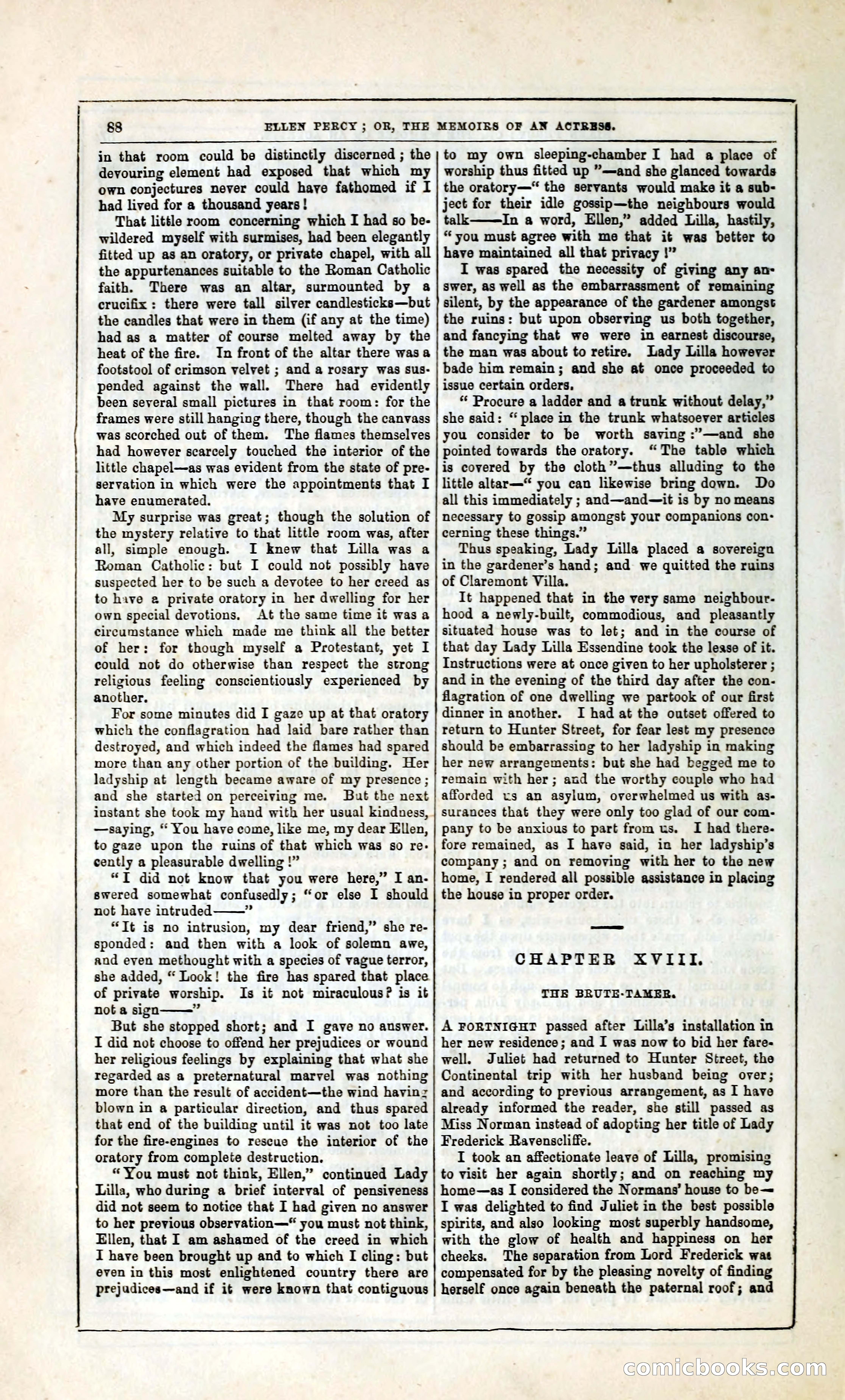
A restored page from Penny Dreadfuls, 1856. Page through the whole issue in the reader above.
📄 Transcribed text from this page (OCR, searchable)
Machine-transcribed from the original scan — historical spelling and the odd misread are preserved.
§8 ELLEN PERCY ; OR, THE MEMOIES OF AN ACTRESS. in that room could be distinctly discerned ; the devouring element had exposed that which my own conjectures never could have fathomed if I had lived for a thousand years! That little room concerning which I had so be- wildered myself with surmises, had been elegantly fitted up as an oratory, or private chapel, with all the appurtenances suitable to the Roman Catholic faith. There was an altar, surmounted by 4 crucifix : there were tall silver candlesticks—but the candles that were in them (if any at the time) had as a matter of course melted away by the heat of the fire. In front of the altar there wasa footstool of crimson velvet ; and a rosary was sus- pended against the wall. There had evidently been several small pictures in that room: for the frames were still hanging there, though the canvass was scorched out of them. The flames themselves had however scarcely touched the interior of the little chapel—as was evident from the state of pre- servation in which were the appointments that I have enumerated. My surprise was great; though the solution of the mystery relative to that little room was, after all, simple enough. I knew that Lilla was a Roman Catholic: but I could not possibly have suspected her to be such a devotee to her creed as to have a private oratory in her dwelling for her own special devotions. At the same time it was a circumstance which made me think all the better of her: for though myself a Protestant, yet I could not do otherwise than respect the strong religious feeling conscientiously experienced by another. For some minutes did I gaze up at that oratory which the conflagration had laid bare rather than destroyed, and which indeed the flames had spared more than any other portion of the building. Her ladyship at length became aware of my presence ; and she started on perceiving me. But the next instant she took my hand with her usual kindness, —saying, “ You have come, like me, my dear Ellen, to gaze upon the ruins of that which was so re- cently a pleasurable dwelling !” “T did not know that you were here,” I an- swered somewhat confusedly; “or else I should not have intruded 2 “Tt is no intrusion, my dear friend,” she re- sponded: and then with a look of solemn awe, aod even methought with a species of vague terror, she added, “ Look! the fire has spared that place of private worship. Is it not miraculous? is it not a sign ~ But she stopped short; and I gave no answer. I did not choose to offend her prejudices or wound her religious feelings by explaining that what she regarded as a preternatural marvel was nothing more than the result of accident—the wind havinz blown in a particular direction, and thus spared that end of the building until it was not too late for the fire-engines to rescue the interior of the oratory from complete destruction. “You must not think, Ellen,” continued Lady Lilla, who during a brief interval of pensiveness did not seem to notice that I had given no answer to her previous observation—*“ you must not think, Ellen, that I am ashamed of the creed in which I have been brought up and to which I cling: but even in this most enlightened country there are prejudices—and if it were known that contiguous to my own sleeping-chamber I had a place of worship thus fitted up ”—and she glanced towards the oratory—“ the servants would make it a sub- ject for their idle gossip—the neighbours would talk In a word, Ellen,” added Lilla, hastily, * you must agree with me that it was better to have maintained all that privacy !” I was spared the necessity of giving any an- swer, as well as the embarrassment of remaining silent, by the appearance of the gardener amongst the ruins: but upon observing us both together, and fancying that we were in earnest discourse, the man was about to retire. Lady Lilla however bade him remain; and she at once proceeded to issue certain orders, * Procure a ladder and a trunk without delay,” she said: “ place in the trunk whatsoever articles you consider to be worth saving :’—and she pointed towards the oratory. “The table which is covered by the cloth”—thus alluding to the little altar—“ you can likewise bring down. Do all this immediately ; and—~and—it is by no means necessary to gossip amongst your companions con- cerning these things.” Thus speaking, Lady Lilla placed a sovereign in the gardener’s hand; and we quitted the ruins of Claremont Villa. It happened that in the very same neighbour- hood a newly-built, commodious, and pleasantly situated house was to let; and in the course of that day Lady Lilla Essendine took the lease of it. Instructions were at once given to her upholsterer ; and in the evening of the third day after the con- flagration of one dwelling we partook of our first dinner in another. I had at the outset offered to return to Hunter Street, for fear lest my presence should be embarrassing to her ladyship in making her new arrangements: but she had begged me to remain with her; and the worthy couple who had afforded cs an asylum, overwhelmed us with as- surances that they were only too glad of our com- pany to be anxious to part from us. I had there- fore remained, as I have said, in her ladyship’s company; and on removing with her to the new home, I rendered all possible assistance in placing the house in proper order. CHAPTER XVIII. THE BRUTE-TAMER. A FORTNIGHT passed after Lilla’s installation in her new residence; and I was now to bid her fare- well. Juliet had returned to Hunter Street, the Continental trip with her husband being over; and according to previous arrangement, as I have already informed the reader, she still passed as Miss Norman instead of adopting her title of Lady Frederick Ravenscliffe. I took an affectionate leave of Lilla, promising to visit her again shortly; and on reaching my home—as I considered the Normans’ house to be— I was delighted to find Juliet in the best possible spirits, and also looking most superbly handsome, with the glow of health and happiness on her cheeks. The separation from Lord Frederick wae compensated for by the pleasing novelty of finding herself once again beneath the paternal roof; and <=) CORNIELAOO Com