
Penny Dreadfuls, 1856 · page 130 of 399
Ellen Percy; or, The Memoirs of an Actress — page 130: what you’re looking at
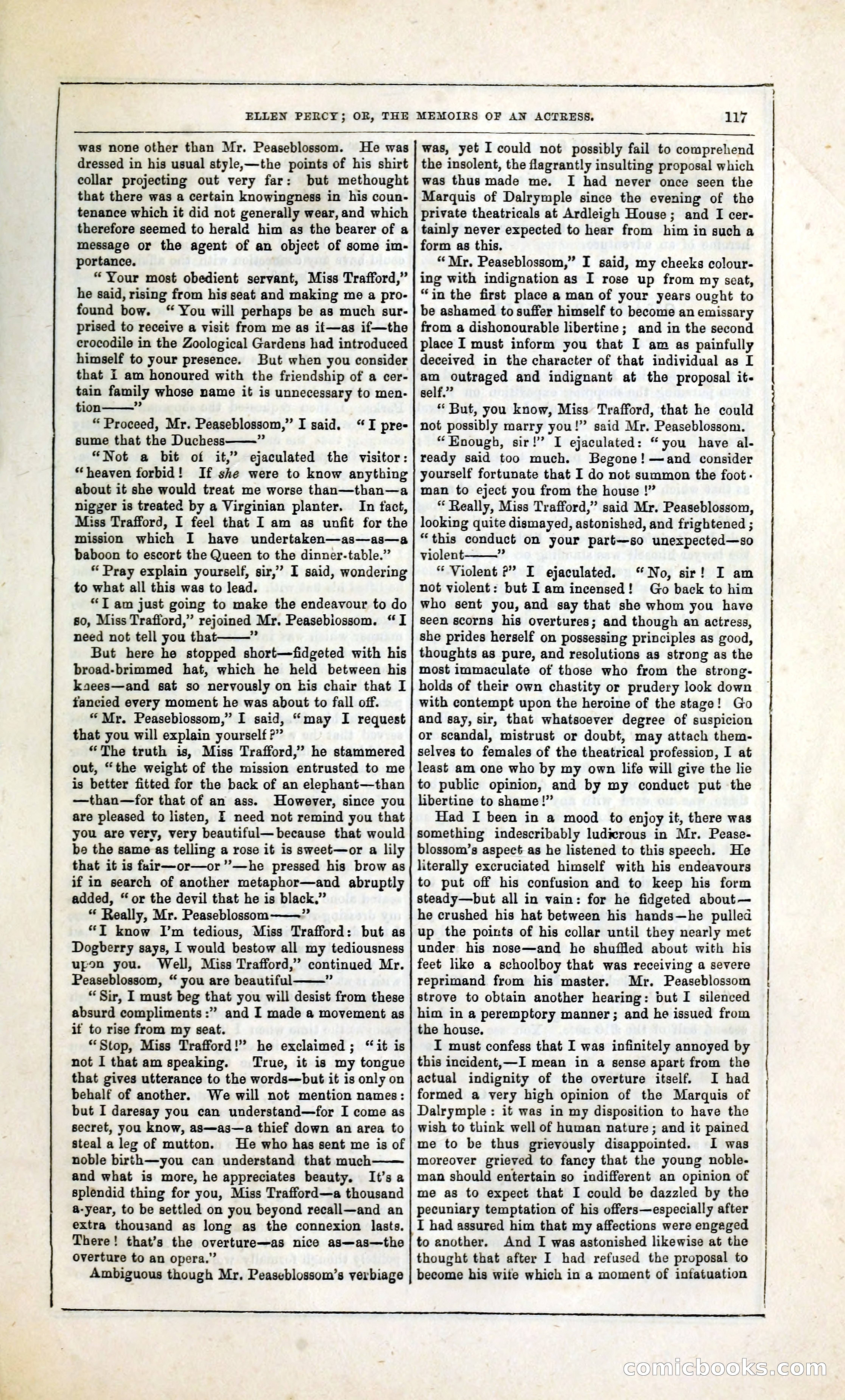
A restored page from Penny Dreadfuls, 1856. Page through the whole issue in the reader above.
📄 Transcribed text from this page (OCR, searchable)
Machine-transcribed from the original scan — historical spelling and the odd misread are preserved.
ELLEN PERCY; OR, THE was none other than Mr. Peaseblossom. He was dressed in his usual style,—the points of his shirt collar projecting out very far: but methought that there was a certain knowingness in his coun- tenance which it did not generally wear, and which therefore seemed to heralc him as the bearer of a message or the agent of an object of some im- portance. “Your most obedient servant, Miss Trafford,” he said, rising from his seat and making me a pro- found bow. “You will perhaps be as much sur- prised to receive a visit from me as ii—as if—the crocodile in the Zoological Gardens had introduced himself to your presence. But when you consider that I am honoured with the friendship of a cer- tain family whose name it is unnecessary to men- tion ” “Proceed, Mr. Peaseblossom,” I said. sume that the Duchess “Not a bit of it,” ejaculated the visitor: “heaven forbid! If she were to know anything about it she would treat me worse than—than—a nigger is treated by a Virginian planter. In fact, Miss Trafford, I feel that I am as unfit for the mission which I have undertaken—as—as—a baboon to escort the Queen to the dinner-table.” “ Pray explain yourself, sir,” I said, wondering to what all this was to lead. “T am just going to make the endeavour to do s0, Miss Trafford,” rejoined Mr. Peasebiossom. “I need not tell you that——” But here he stopped short—fidgeted with his broad-brimmed hat, which he held between his kaees—and sat so nervously on kis chair that I fancied every moment he was about to fall off. “ Mr. Peasebiossom,’ I said, “may I request that you will explain yourself?” “The truth is, Miss Trafford,’ he stammered out, “the weight of the mission entrusted to me is better fitted for the back of an elephant—than —than—for that of an ass. However, since you are pleased to listen, E need not remind you that you are very, very beautiful— because that would be the same as telling a rose it is sweet—or a lily that it is fair—or—or’’—he pressed his brow as if in search of another metaphor—and abruptly added, “ or the devil that he is black,” “ Really, Mr. Peaseblossom-——~” “I know I’m tedious, Miss Trafford: but as Dogberry says, I would bestow all my tediousness upon you. Well, Miss Trafford,” continued Mr. Peaseblossom, “ you are beautiful “Sir, I must beg that you will desist from these absurd compliments :” and I made a movement as it to rise from my seat. “Stop, Miss Trafford!” he exclaimed; “it is not I that am speaking. True, it is my tongue that gives utterance to the words—but it is only on behalf of another. We will not mention names: but I daresay you can understand—for I come as secret, you know, as—as—a thief down an area to steal a leg of mutton. He who has sent me is of noble birth—you can understand that much and what is more, he appreciates beauty. It’s a splendid thing for you, Miss Trafford—a thousand a-year, to be settled on you beyond recall—and an extra thousand as long as the connexion lasts. There! that’s the overture—as nice as—as—the overture to an opera.” Ambiguous though Mr, Peaseblossom’s verbiage “TI pre- MEMOIRS OF AN ACTRESS. 117 was, yet I could not possibly fail to comprehend the insolent, the flagrantly insulting proposal which was thus made me. I had never once seen the Marquis of Dalrymple since the evening of the private theatricals at Ardleigh House; and I cer- tainly never expected to hear from him in such a form as this. “Mr. Peaseblossom,” I said, my cheeks colour- ing with indignation as I rose up from my seat, “jn the first place a man of your years ought to be ashamed to suffer himself to become an emissary from a dishonourable libertine; and in the second place I must inform you that I am as painfully deceived in the character of that individual as I am outraged and indignant at the proposal it- self.” * But, you know, Miss Trafford, that he could not possibly marry you!” said Mr. “Peaseblossoni. “ Knough, sir!’ I ejaculated: “you have al- ready said too much. Begone! —and consider yourself fortunate that I do not summon the foot - man to eject you from the house !” “ Really, Miss Trafford,” said Mr. Peaseblossom, looking quite dismayed, astonished, and frightened ; “this conduct on your part—so unexpected—so violent——” “Violent ?” I ejaculated. “No, sir! I am not violent: but Iam incensed! Go back to him who sent you, and say that she whom you have seen scorns his overtures; and though an actress, she prides herself on possessing principles as good, thoughts as pure, and resolutions as strong as the most immaculate of those who from the strong- holds of their own chastity or prudery look down with contempt upon the heroine of the stage! Go and say, sir, that whatsoever degree of suspicion or scandal, mistrust or doubt, may attach them- selves to females of the theatrical profession, I at least am one who by my own life will give the lie to public opinion, and by my conduct put the libertine to shame!” Had I been in a mood to enjoy it, there was something indescribably ludwrous in Mr. Pease- blossom’s aspect as he listened to this speech. He literally excruciated himself with his endeavours to put off his confusion and to keep his form steady—but all in vain: for he fidgeted about— he crushed his hat between his hands—he pulled up the points of his collar until they nearly met under his nose—and he shuffled about with his feet like a schoolboy that was receiving a severe reprimand from his master. Mr. Peaseblossom strove to obtain another hearing: but I silenced him in a peremptory manner; and he issued from the house. I must confess that I was infinitely annoyed by this incident,—I mean in a sense apart from the actual indignity of the overture itself. I had formed a very high opinion of the Marquis of Dalrymple: it was in my disposition to have the wish to think well of human nature ; and it pained me to be thus grievously disappointed. I was moreover grieved to fancy that the young noble- man should entertain so indifferent an opinion of me as to expect that I could be dazzled by the pecuniary temptation of his offers—especially after I had assured him that my affections were engaged to another. And I was astonished likewise at the thought that after I had refused the proposal to become his wiie which in a moment of infatuation ee CORNICLO® SS Com