
Penny Dreadfuls, 1856 · page 152 of 399
Ellen Percy; or, The Memoirs of an Actress — page 152: what you’re looking at
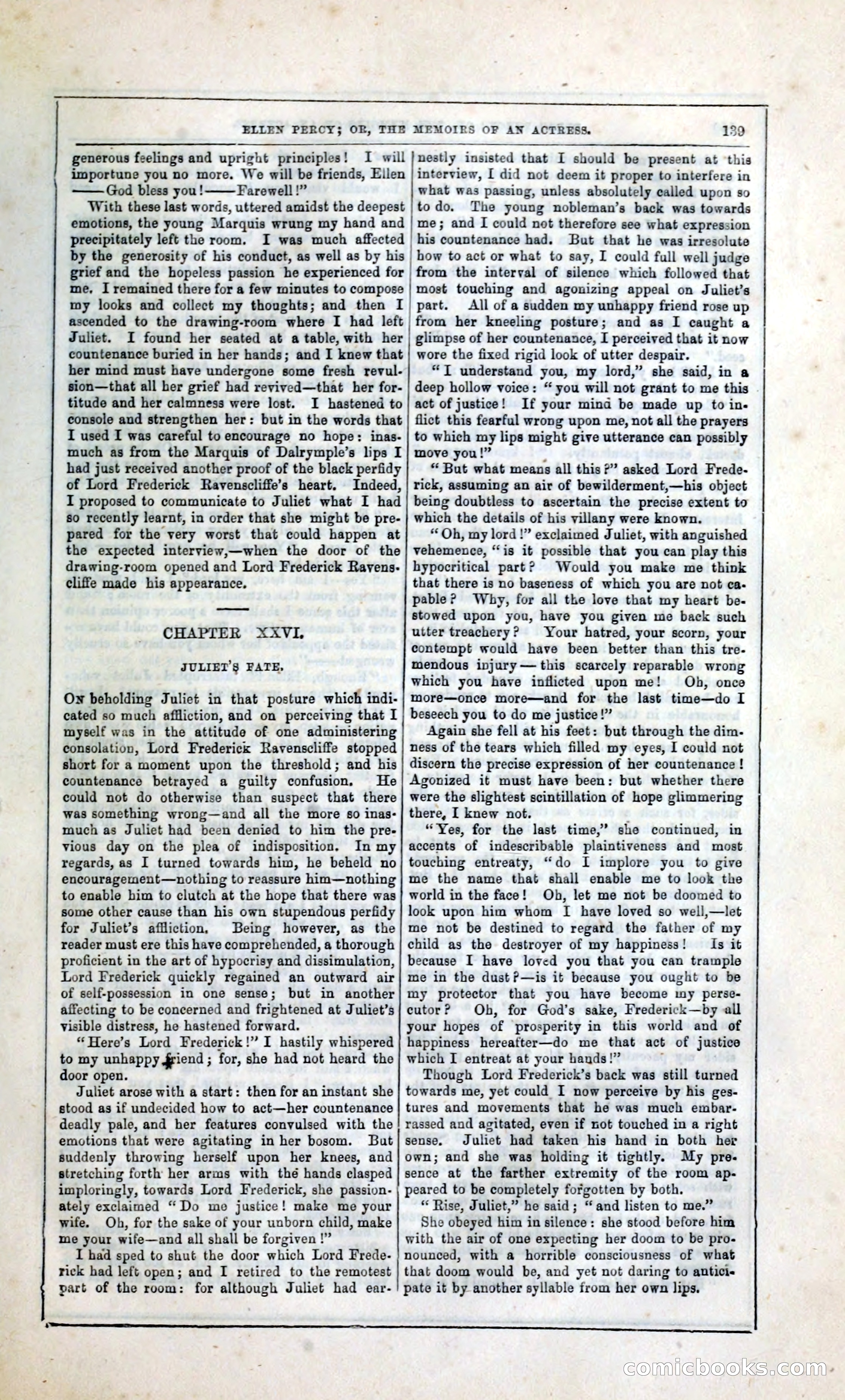
A restored page from Penny Dreadfuls, 1856. Page through the whole issue in the reader above.
📄 Transcribed text from this page (OCR, searchable)
Machine-transcribed from the original scan — historical spelling and the odd misread are preserved.
eres ee ee eee ELLEN PERCY; OR, THE MEMOIRS OF AN ACTRESS. 139 generous feelings and upright principles! I will importune you no more. We will be friends, Ellen — God bless you! Farewell !” With these last words, uttered amidst the deepest emotions, the young Marquis wrung my hand and precipitately left the room. I was much affected by the generosity of his conduct, as well as by his grief and the hopeless passion he experienced for me, I remained there for a few minutes to compose my looks and collect my thoughts; and then I ascended to the drawing-room where I had left Juliet. I found her seated at a table, with her countenance buried in her hands; and I knew that her mind must have undergone some fresh revul- sion—that all her grief had revived—that her for- titude and her calmness were lost. I hastened to console and strengthen her: but in the words that I used I was careful to encourage no hope: inas- much as from the Marquis of Dalrymple’s lips I had just received another proof of the black perfidy of Lord Frederick Ravenscliffe’s heart. Indeed, I proposed to communicate to Juliet what I had so recently learnt, in order that she might be pre- pared for the very worst that could happen at the expected interview,—when the door of the drawing-room opened and Lord Frederick Ravens- cliffe made his appearance. CHAPTER XXVI, JULIET’§ FATE, Ow beholding Juliet in that posture which indi- cated so much afiliction, and on perceiving that I myself was in the attitude of one administering consolation, Lord Frederick Ravenscliffe stopped short for a moment upon the threshold; and his countenance betrayed a guilty confusion. He could not do otherwise than suspect that there was something wrong—and all the more so inas- much as Juliet had been denied to him the pre- vious day on the plea of indisposition. In my regards, as I turned towards him, he beheld no encouragement—nothing to reassure him—nothing to enable him to clutch at the hope that there was some other cause than his own stupendous perfidy for Juliet’s affliction, Being however, as the reader must ere this have comprehended, a thorough proficient in the art of hypocrisy and dissimulation, Lord Frederick quickly regained an outward air of self-possession in one sense; but in another affecting to be concerned and frightened at Juliet’s visible distress, he hastened forward. * Here’s Lord Frederick!” I hastily whispered to my unhappy friend ; for, she had not heard the door open. Juliet arose with a start: then for an instant she stood as if undecided how to act—her countenance deadly pale, and her features convulsed with the emotions that were agitating in her bosom. But suddenly throwing herself upon her knees, and stretching forth her arms with thé hands clasped imploringly, towards Lord Frederick, she passion- ately exclaimed “Do me justice! make me your wife. Oh, for the sake of your unborn child, make me your wife—and all shall be forgiven !” I had sped to shut the door which Lord Frede- rick had left open; and I retired to the remotest part of the room: for although Juliet had ear- nestly insisted that I should be present at ‘this interview, I did not deem it proper to interfere in what was passing, unless absolutely called upon so todo. The young nobleman’s back was towards me; and I could not therefore see what expression his countenance had. But that he was irresolute how to act or what to say, I could full well judge from the interval of silence which followed that most touching and agonizing appeal on Juliet’s part. All of a sudden my unhappy friend rose up from her kneeling posture; and as I caught a glimpse of her countenance, I perceived that it now wore the fixed rigid look of utter despair. “I understand you, my lord,” she said, in a deep hollow voice: “ you will not grant to me this act of justice! If your mina be made up to in- flict this fearful wrong upon me, not all the prayers to which my lips might give utterance can possibly move you!” : * But what means all this?” asked Lord Frede- rick, assuming an air of bewilderment,—his object being doubtless to ascertain the precise extent to which the details of his villany were known. “Oh, my lord!” exclaimed Juliet, with anguished vehemence, “is it possible that you can play this hypocritical part? Would you make me think that there is no baseness of which you are not ca- pable? Why, for all the love that my heart be- stowed upon you, have you given me back such utter treachery? Your hatred, your scorn, your contempt would have been better than this tre- mendous injury— this scarcely reparable wrong which you have inflicted upon me! Oh, once more—once more—and for the last time—do I beseech you to do me justice!” Again she fell at his feet: but through the dim. ness of the tears which filled my eyes, I could not discern the precise expression of her countenance! Agonized it must have been: but whether there were the slightest scintillation of hope glimmering there, I knew not. “Yes, for the last time,” she continued, in accents of indescribable plaintiveness and most touching entreaty, “do I implore you to give me the name that shall enable me to look the world in the face! Oh, let me not be doomed to look upon him whom I have loved so well,—let me not be destined to regard the father of my child as the destroyer of my happiness! Is it because I have loved you that you can trample me in the dust?—is it because you ought to be my protector that you have become my perse- cutor? Oh, for God's sake, Frederick—by all your hopes of prosperity in this world and of happiness hereafter—do me that act of justice which I entreat at your hands!” Though Lord Frederick’s back was still turned towards me, yet could I now perceive by his ges- tures and movements that he was much embar- rassed and agitated, even if not touched in a right sense. Juliet had taken his hand in both her own; and she was holding it tightly. My pre. sence at the farther extremity of the room ap- peared to be completely forgotten by both. * Rise, Juliet,” he said; “and listen to me.” She obeyed him in silence: she stood before him with the air of one expecting her doom to be pro- nounced, with a horrible consciousness of what that doom would be, and yet not daring to autici- pate it by another syllable from her own lips. —_—_—_———— eS ws Ss _eee___ JOO COMMU COME