
Penny Dreadfuls, 1856 · page 173 of 399
Ellen Percy; or, The Memoirs of an Actress — page 173: what you’re looking at
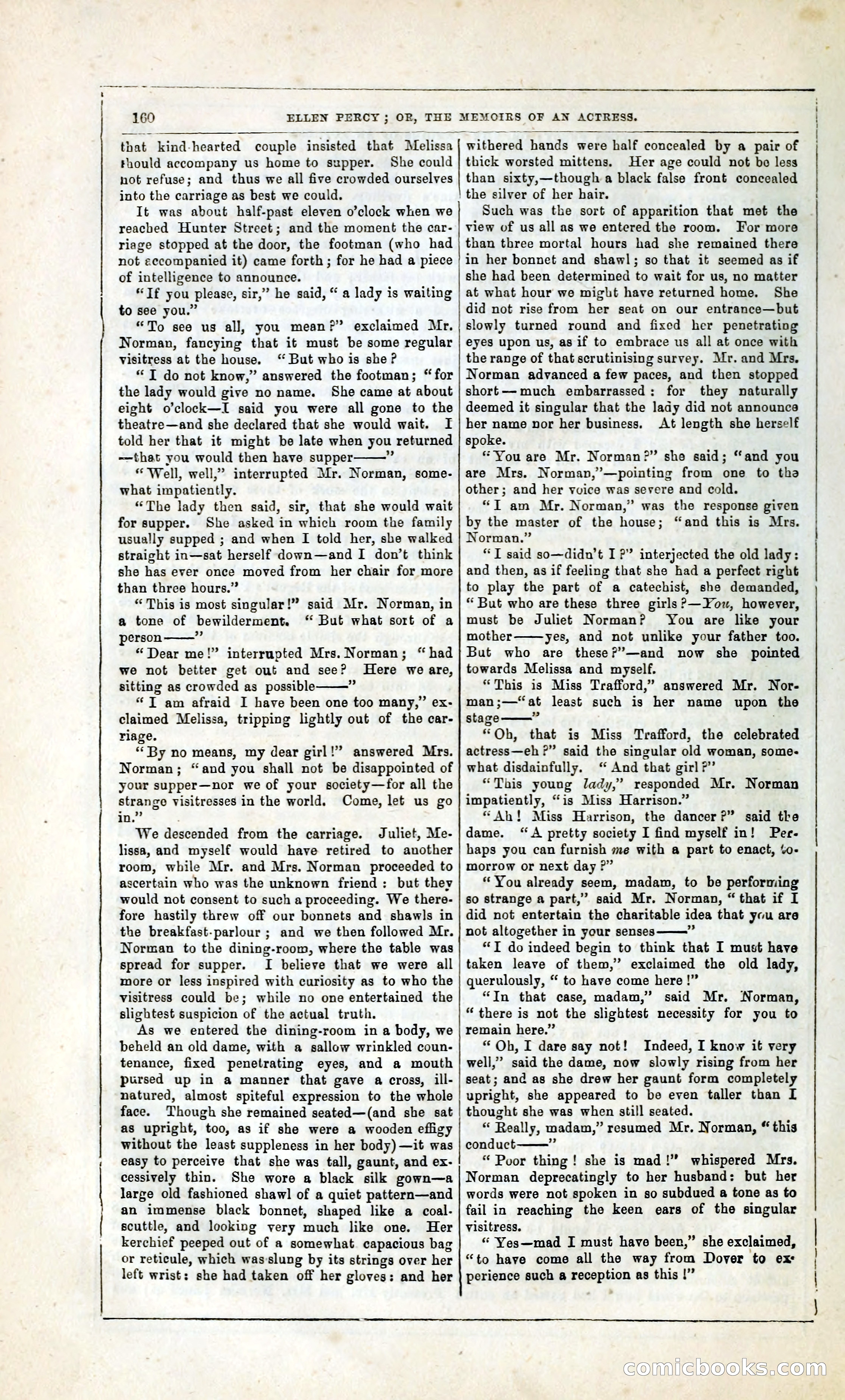
A restored page from Penny Dreadfuls, 1856. Page through the whole issue in the reader above.
📄 Transcribed text from this page (OCR, searchable)
Machine-transcribed from the original scan — historical spelling and the odd misread are preserved.
OO ——— — - —_—--—- —— 160 that kind-hearted couple insisted that Melissa thould accompany us home to supper. She could not refuse; and thus we all five crowded ourselves into the carriage as best we could. It was about half-past eleven o’clock when we reached Hunter Street; and the moment the car- riage stopped at the door, the footman (who had not eccompanied it) came forth; for he had a piece of intelligence to announce. “If you please, sir,” he said, “ a lady is waiting to see you.” “To see us all, you mean?” exclaimed Mr. Norman, fancying that it must be some regular visitress at the house. ‘“ But who is she? “I do not know,” answered the footman; “ for the lady would give no name. She came at about eight o’clock—I said you were all gone to the theatre—and she declared that she would wait. I told her that it might be late when you returned —that you would then have supper uf Well, well,’ interrupted Mr. Norman, some- what impatiently. “The lady then said, sir, that she would wait for supper. She asked in which room the family usually supped ; and when I told her, she walked straight in—sat herself down—and I don’t think she has ever once moved from her chair for more than three hours.” “This is most singular!” said Mr. Norman, in a tone of bewilderment. ‘ But what sort of a person Ks “Dear me!” interrupted Mrs. Norman; “had we not better get out and see? Here we are, sitting as crowded as possible 5. “ T am afraid I have been one too many,” ex- claimed Melissa, tripping lightly out of the car- riage. *‘ By no means, my dear girl!” answered Mrs. Norman; “and you shall not be disappointed of your supper—nor we of your society—for all the strange visitresses in the world. Come, let us go in.” We descended from the carriage. Juliet, Me- lissa, and myself would have retired to another room, while Mr. and Mrs. Norman proceeded to ascertain who was the unknown friend: but they would not consent to such a proceeding. We there- fore hastily threw off our bonnets and shawls in the breakfast-parlour ; and we then followed Mr. Norman to the dining-room, where the table was spread for supper. I believe that we were all more or less inspired with curiosity as to who the visitress could be; while no one entertained the slightest suspicion of the actual truth. As we entered the dining-room in a body, we beheld an old dame, with a sallow wrinkled coun- tenance, fixed penetrating eyes, and a mouth pursed up in a manner that gave a cross, ill- natured, almost spiteful expression to the whole face. Though she remained seated—(and she sat as upright, too, as if she were a wooden efligy without the least suppleness in her body)—it was easy to perceive that she was tall, gaunt, and ex- cessively thin. She wore a black silk gown—a large old fashioned shawl of a quiet pattern—and an immense black bonnet, shaped like a coal- scuttle, and looking very much like one. Her kerchief peeped out of a somewhat. capacious bag or reticule, which was:slung by its strings over her left wrist: she had taken off her gloves: and her ELLEN PERCY ; OR, THE MEMOIRS OF AN ACTRESS. withered hands were half concealed by a pair of thick worsted mittens. Her age could not be less than sixty,—though a black false front concealed ' the silver of her hair. Such was the sort of apparition that met the view of us all as we entered the room. For more than three mortal hours had she remained there in her bonnet and shawl; so that it seemed as if she had been determined to wait for us, no matter at what hour we might have returned home. She did not rise from her seat on our entrance—but slowly turned round and fixed her penetrating eyes upon us, as if to embrace us all at once with the range of that scrutinising survey. Mr. and Mrs, Norman advanced a few paces, and then stopped short—-much embarrassed: for they naturally deemed it singular that the lady did not announce her name nor her business. At length she herself spoke. “You are Mr. Norman?” she said; “and you are Mrs. Norman,’—pointing from one to the other; and her voice was severe and cold. “T am Mr. Norman,” was the response given by the master of the house; “and this is Mrs. Norman.” “T said so—didn’t I ?” interjected the old lady: and then, as if feeling that she had a perfect right to play the part of a catechist, she demanded, “ But who are these three girls ?—Yow, however, must be Juliet Norman? /You are like your mother yes, and not unlike your father too. But who are these?’—and now she pointed towards Melissa and myself. “This is Miss Trafford,” answered Mr. Nor- man;—‘at least such is her name upon the stage 24 “Oh, that is Miss Trafford, the celebrated actress—eh ?” said the singular old woman, some- what disdainfully. ‘“ And that girl?” “This young lady,’ responded Mr. Norman impatiently, “is Miss Harrison.” * Ah! Miss Harrison, the dancer?” said the dame. “A pretty society I find myself in! Per- haps you can furnish me with a part to enact, ‘o- morrow or next day ?” “You already seem, madam, to be performing so strange a part,” said Mr. Norman, “ that if I did not entertain the charitable idea that you are not altogether in your senses » “1 do indeed begin to think that I must have taken leave of them,” exclaimed the old lady, querulously, “ to have come here !” “In that case, madam,’ said Mr. Norman, “there is not the slightest necessity for you to remain here.” “ Oh, I dare say not! Indeed, I know it very well,” said the dame, now slowly rising from her seat; and as she drew her gaunt form completely upright, she appeared to be even taller than I thought she was when still seated. “ Really, madam,” resumed Mr. Norman, “ this conduct r “ Poor thing! she is mad!” whispered Mrs. Norman deprecatingly to her husband: but her words were not spoken in so subdued a tone as to fail in reaching the keen ears of the singular Visitress. “ Yes—mad I must have been,” she exclaimed, “to have come all the way from Dover to ex: perience such a reception as this !” b CONNIE DIOOKS eee meee Com