
Penny Dreadfuls, 1856 · page 18 of 399
Ellen Percy; or, The Memoirs of an Actress — page 18: what you’re looking at
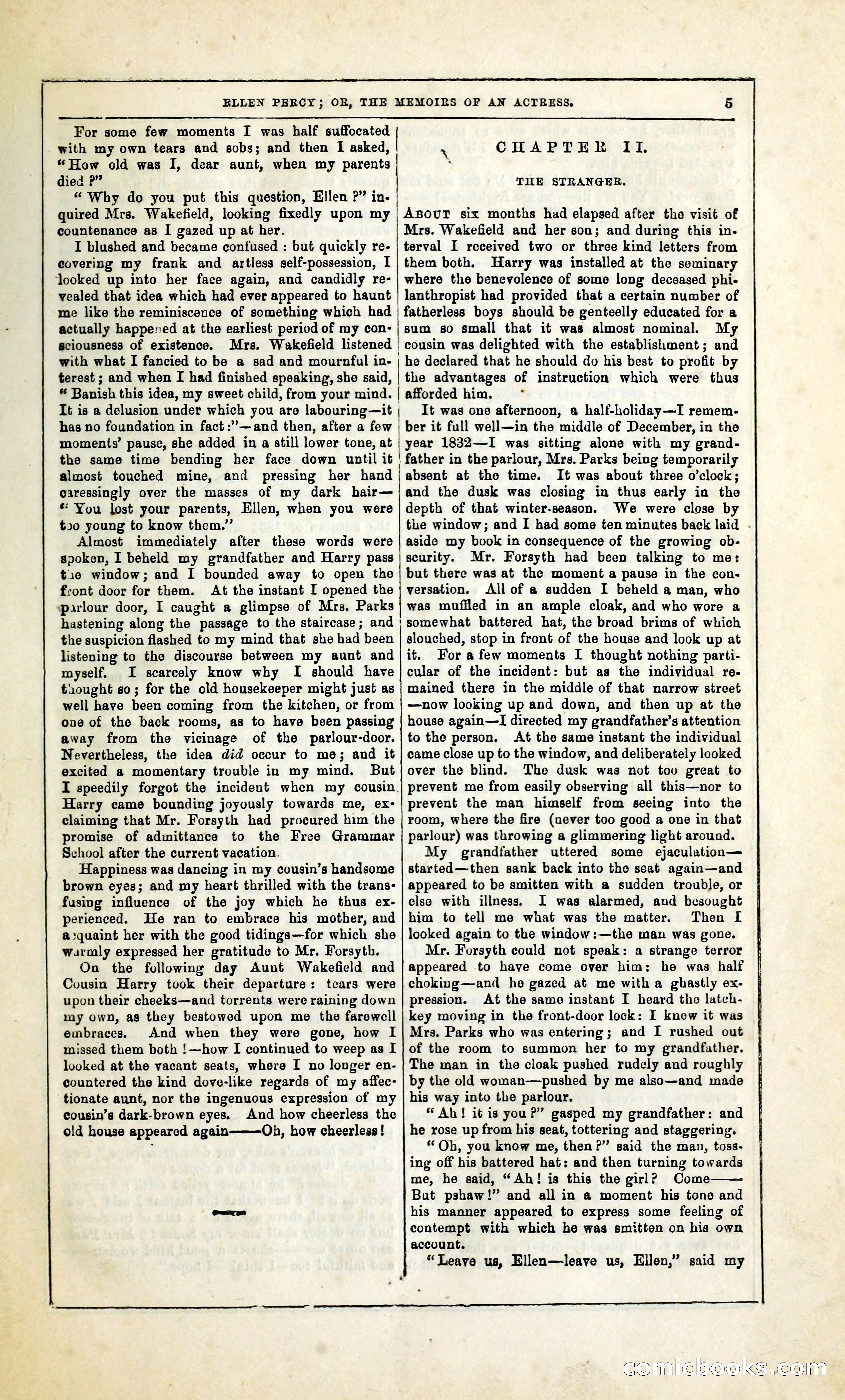
A restored page from Penny Dreadfuls, 1856. Page through the whole issue in the reader above.
📄 Transcribed text from this page (OCR, searchable)
Machine-transcribed from the original scan — historical spelling and the odd misread are preserved.
ELLEN PERCY; OR, THE MEMOIRS OF AN ACTRESS. For some few moments I was half suffocated with my own tears and sobs; and then I asked, “How old was I, dear aunt, when my parents died ?” “ Why do you put this question, Ellen ?” in- quired Mrs. Wakefield, looking fixedly upon my countenance as I gazed up at her. I blushed and became confused : but quickly re- covering my frank and artless self-possession, I looked up into her face again, and candidly re- vealed that idea which had ever appeared to haunt me like the reminiscence of something which had actually happened at the earliest period of my con- sciousness of existence. Mrs, Wakefield listened with what I fancied to be a sad and mournful in- terest ; and when I had finished speaking, she said, “ Banish this idea, my sweet child, from your mind. It is a delusion under which you are labouring—it has no foundation in fact:’’—and then, after a few moments’ pause, she added in a still lower tone, at the same time bending her face down until it almost touched mine, and pressing her hand caressingly over the masses of my dark hair— * You lost your parents, Ellen, when you were t.0 young to know them.” Almost immediately after these words were spoken, I beheld my grandfather and Harry pass tie window; and I bounded away to open the front door for them. At the instant I opened the parlour door, I caught a glimpse of Mrs. Parks hastening along the passage to the staircase; and the suspicion flashed to my mind that she had been listening to the discourse between my aunt and myself. I scarcely know why I should have tuought so; for the old housekeeper might just as well have been coming from the kitchen, or from one of the back rooms, as to have been passing away from the vicinage of the parlour-door. Nevertheless, the idea did occur to me; and it excited a momentary trouble in my mind. But I speedily forgot the incident when my cousin. Harry came bounding joyously towards me, ex- claiming that Mr. Forsyth had procured him the promise of admittance to the Free Grammar School after the current vacation. Happiness was dancing in my cousin’s handsome brown eyes; and my heart thrilled with the trans- fusing influence of the joy which he thus ex- perienced. He ran to embrace his mother, and a:quaint her with the good tidings—for which she warmly expressed her gratitude to Mr. Forsyth. On the following day Aunt Wakefield and Cousin Harry took their departure: tcars were upon their cheeks—and torrents were raining down my own, as they bestowed upon me the farewell embraces. And when they were gone, how I missed them both !—how I continued to weep as I looked at the vacant seats, where I no longer en- countered the kind dove-like regards of my affec- tionate aunt, nor the ingenuous expression of my cousin’s dark-brown eyes. And how cheerless the old house appeared again Oh, how cheerless! . CHAPTER II, THE STRANGER. ABOUT six months had elapsed after the visit of Mrs. Wakefield and her son; and during this in- terval I received two or three kind letters from them both. Harry was installed at the seminary where the benevolence of some long deceased phi- lanthropist had provided that a certain number of fatherless boys should be genteelly educated for a sum so small that it was almost nominal. My cousin was delighted with the establishment; and he declared that he should do his best to profit by the advantages of instruction which were thus afforded him. It was one afternoon, a half-holiday—I remem- ber it full well—in the middle of December, in the year 1832—I was sitting alone with my grand- father in the parlour, Mrs. Parks being temporarily absent at the time. It was about three o’clock; and the dusk was closing in thus early in the depth of that winter-season. We were close by aside my book in consequence of the growing ob- scurity. Mr. Forsyth had been talking to me: but there was at the moment a pause in the con- versation. All of a sudden I beheld a man, who was muffled in an ample cloak, and who wore a somewhat battered hat, the broad brims of which slouched, stop in front of the house and look up at it. For afew moments I thought nothing parti- cular of the incident: but as the individual re- mained there in the middle of that narrow street —now looking up and down, and then up at the house again—TI directed my grandfather’s attention to the person. At the same instant the individual came close up to the window, and deliberately looked over the blind. prevent me from easily observing all this—nor to prevent the man himself from seeing into the room, where the fire (never too good a one in that parlour) was throwing a glimmering light around. My grandfather uttered some ejaculation— started—then sank back into the seat again—and appeared to be smitten with a sudden trouble, or else with illness. I was alarmed, and besought him to tell me what was the matter. Then I looked again to the window :—the man was gone. Mr. Forsyth could not speak: a strange terror appeared to have come over him: he was half choking—and he gazed at me witha ghastly ex- pression. At the same instant I heard the latch- key moving in the front-door lock: I knew it was Mrs. Parks who was entering; and I rushed out of the room to summon her to my grandfather. The man in the cloak pushed rudely and roughly by the old woman—pushed by me also—and made his way into the parlour. “Ah! it is you?” gasped my grandfather: and he rose up from his seat, tottering and staggering. Oh, you know me, then?” said the man, toss- ing off his battered hat: and then turning towards me, he said, “Ah! is this the girl? Come But pshaw!” and all in a moment his tone and his manner appeared to express some feeling of contempt with which he was smitten on his own account. “Leave us, Ellen—leave us, Ellen,” said my et The dusk was not too great to the window; and I had some ten minutes back laid . ee ECORNIECLOO <S) Com