
Penny Dreadfuls, 1856 · page 186 of 399
Ellen Percy; or, The Memoirs of an Actress — page 186: what you’re looking at
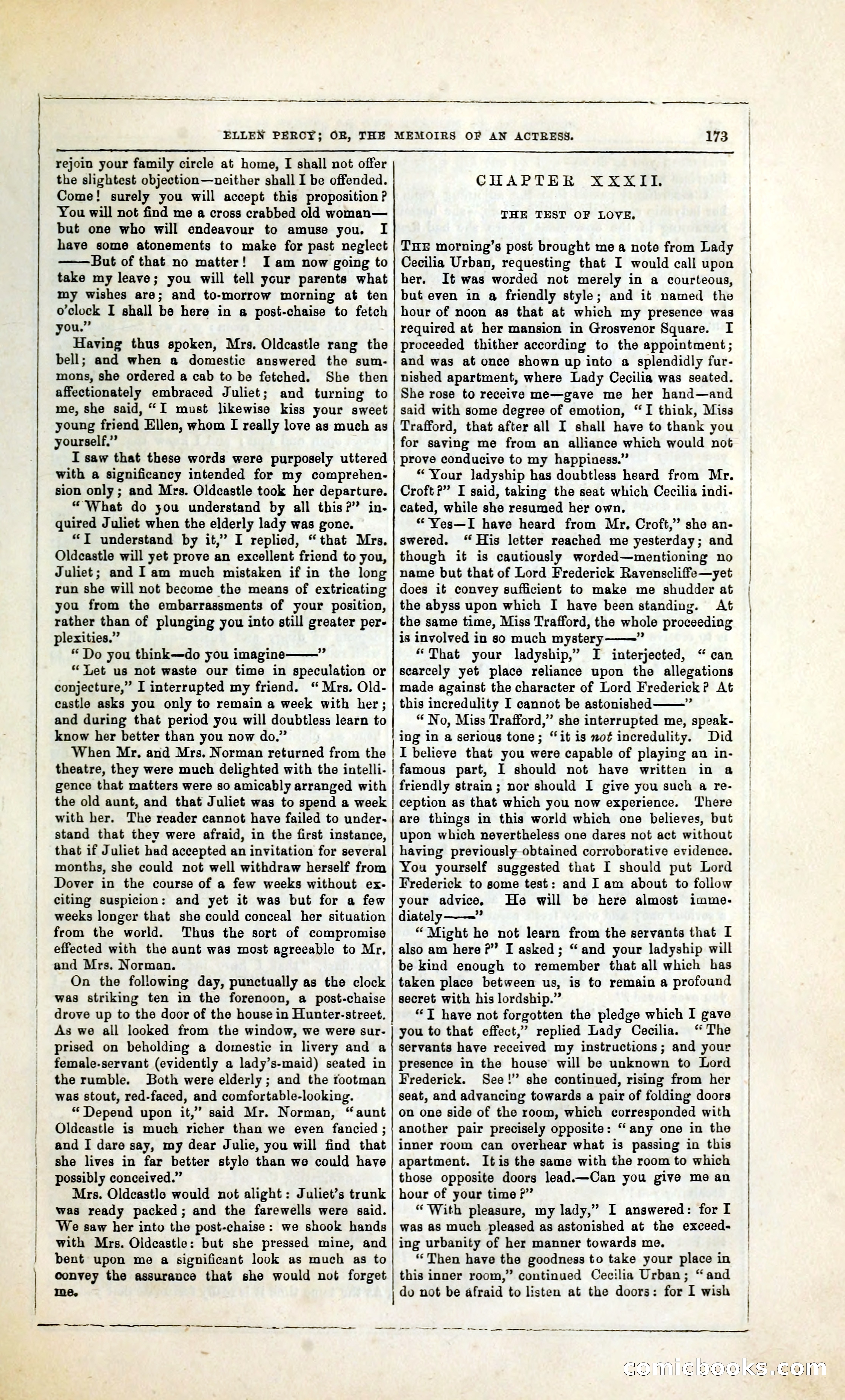
A restored page from Penny Dreadfuls, 1856. Page through the whole issue in the reader above.
📄 Transcribed text from this page (OCR, searchable)
Machine-transcribed from the original scan — historical spelling and the odd misread are preserved.
a ee ee on ~ ELLEN PERCY; OR, THE MEMOIRS OF AN ACTRESS. 173 rejoin your family circle at home, I shall not offer the slightest objection—neither shall I be offended. Come! surely you will accept this proposition? You will not find me a cross crabbed old woman— but one who will endeavour to amuse you. I have some atonements to make for past neglect But of that no matter! Iam now going to take my leave; you will tell your parents what my wishes are; and to-morrow morning at ten o’clock I shall be here in a post-chaise to fetch you.” Having thus spoken, Mrs. Oldcastle rang the bell; and when a domestic answered the sum- mons, she ordered a cab to be fetched. She then affectionately embraced Juliet; and turning to me, she said, “I must likewise kiss your sweet young friend Ellen, whom I really love as much as yourself,” I saw that these words were purposely uttered with a significancy intended for my comprehen- sion only ; and Mrs. Oldcastle took her departure. “What do you understand by all this?” in- quired Juliet when the elderly lady was gone. “IT understand by it,” I replied, “that Mrs. Oldcastle will yet prove an excellent friend to you, Juliet; and Iam much mistaken if in the long run she will not become the means of extricating you from the embarrassments of your position, rather than of plunging you into still greater per- plexities.”’ “ Do you think—do you imagine “Let us not waste our time in speculation or conjecture,” I interrupted my friend. “Mrs. Old- castle asks you only to remain a week with her; and during that period you will doubtless learn to know her better than you now do.” When Mr. and Mrs. Norman returned from the theatre, they were much delighted with the intelli- gence that matters were so amicably arranged with the old aunt, and that Juliet was to spend a week with her. The reader cannot have failed to under- stand that they were afraid, in the first instance, that if Juliet had accepted an invitation for several months, she could not well withdraw herself from Dover in the course of a few weeks without ex- citing suspicion: and yet it was but for a few weeks longer that she could conceal her situation from the world. Thus the sort of compromise effected with the aunt was most agreeable to Mr, and Mrs. Norman. On the following day, punctually as the clock was striking ten in the forenoon, a post-chaise drove up to the door of the house in Hunter-street. 33 As we all looked from the window, we were sur- | prised on beholding a domestic in livery and a female-servant (evidently a lady’s-maid) seated in the rumble. Both were elderly ; and the tootman was stout, red-faced, and comfortable-looking. “Depend upon it,” said Mr. Norman, “aunt Oldcastle is much richer than we even fancied ; and I dare say, my dear Julie, you will find that she lives in far better style than we could have possibly conceived.” Mrs. Oldcastle would not alight: Juliet’s trunk was ready packed; and the farewells were said. We saw her into the post-chaise: we shook hands with Mrs. Oldcastle: but she pressed mine, and bent upon me a significant look as much as to convey the assurance that she would not forget me. a ————— — eT. on CHAPTER XXXII. THE TEST OF LOVE. THE morning’s post brought me a note from Lady Cecilia Urban, requesting that I would call upon her. It was worded not merely in a courteous, but even in a friendly style; and it named the hour of noon as that at which my presence was required at her mansion in Grosvenor Square. I proceeded thither according to the appointment; and was at once shown up into a splendidly fur- nished apartment, where Lady Cecilia was seated. She rose to receive me—gave me her hand—and said with some degree of emotion, “I think, Miss Trafford, that after all I shall have to thank you for saving me from an alliance which would not prove conducive to my happiness.” “Your ladyship has doubtless heard from Mr. Croft?” I said, taking the seat which Cecilia indi- cated, while she resumed her own. “Yes—I have heard from Mr. Croft,’ she an- swered. “His letter reached me yesterday; and though it is cautiously worded—mentioning no name but that of Lord Frederick Ravenscliffe—yet does it convey sufficient to make me shudder at the abyss upon which I have been standing. At the same time, Miss Trafford, the whole proceeding is involved in so much mystery “i “That your ladyship,” I interjected, “can scarcely yet place reliance upon the allegations made against the character of Lord Frederick? At this incredulity I cannot be astonished a “ No, Miss Trafford,” she interrupted me, speak- ing in a serious tone; “it is wot incredulity. Did I believe that you were capable of playing an in- | famous part, I should not have written in a friendly strain; nor should I give you such a re- ception as that which you now experience. There are things in this world which one believes, but upon which nevertheless one dares not act without having previously obtained corroborative evidence. You yourself suggested that I should put Lord Frederick to some test: and I am about to follow your advice. He will be here almost imme- diately 2 “Might he not learn from the servants that I also am here ?” I asked; “and your ladyship will be kind enough to remember that all which has taken place between us, is to remain a profound secret with his lordship.” “T have not forgotten the pledge which I gave you to that effect,” replied Lady Cecilia. “The servants have received my instructions; and your presence in the house will be unknown to Lord Frederick. See!” she continued, rising from her seat, and advancing towards a pair of folding doors on one side of the room, which corresponded with another pair precisely opposite: “any one in the inner room can overhear what is passing in this apartment. Itis the same with the room to which those opposite doors lead.—Can you give me an hour of your time ?” “With pleasure, my lady,” I answered: for I was as much pleased as astonished at the exceed- ing urbanity of her manner towards me. “Then have the goodness to take your place in this inner room,” continued Cecilia Urban; “and do not be afraid to listen at the doors: for 1 wish Com ElOOO) cS) Com