
Penny Dreadfuls, 1856 · page 192 of 399
Ellen Percy; or, The Memoirs of an Actress — page 192: what you’re looking at
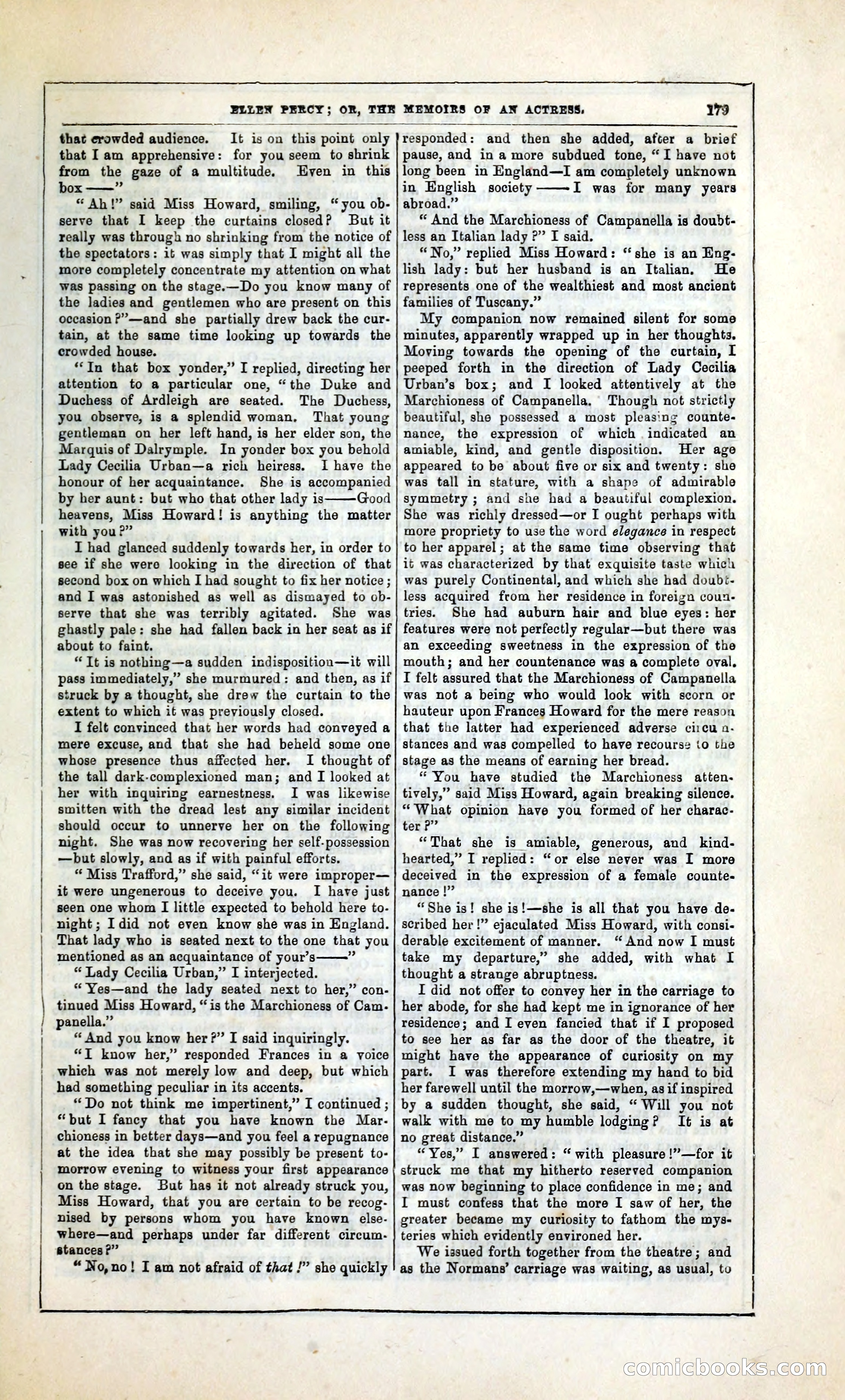
A restored page from Penny Dreadfuls, 1856. Page through the whole issue in the reader above.
📄 Transcribed text from this page (OCR, searchable)
Machine-transcribed from the original scan — historical spelling and the odd misread are preserved.
, that crowded audience. It is on this point only that Iam apprehensive: for you seem to shrink from the gaze of a multitude. Even in this box ——” * Ah!” said Miss Howard, smiling, “ you ob- serve that I keep the curtains closed? But it really was through no shrinking from the notice of the spectators: it was simply that I might all the more completely concentrate my attention on what was passing on the stage.—Do you know many of the ladies and gentlemen who are present on this occasion ?”—and she partially drew back the cur- tain, at the same time looking up towards the crowded house. *‘In that box yonder,” I replied, directing her attention to a particular one, “the Duke and Duchess of Ardleigh are seated. The Duchess, you observe, is a splendid woman, That young gentleman on her left hand, is her elder son, the Marquis of Dalrymple. In yonder box you behold Lady Cecilia Urban—a rich heiress. I have the honour of her acquaintance. She is accompanied by her aunt: but who that other lady is Good heavens, Miss Howard! is anything the matter with you?” I had glanced suddenly towards her, in order to see if she were looking in the direction of that second box on which I had sought to fix her notice ; and I was astonished as well as dismayed to ob- serve that she was terribly agitated. She was ghastly pale: she had fallen back in her seat as if about to faint. “Tt is nothing—a sudden indisposition—it will pass immediately,” she murmured: and then, as if struck by a thought, she drew the curtain to the extent to which it was previously closed. I felt convinced that her words had conveyed a mere excuse, and that she had beheld some one whose presence thus affected her. I thought of the tall dark-complexioned man; and I looked at her with inquiring earnestness. I was likewise smitten with the dread lest any similar incident should occur to unnerve her on the following night. She was now recovering her self-possession —but slowly, and as if with painful efforts. “ Miss Trafford,” she said, “it were improper— it were ungenerous to deceive you. I have just seen one whom [| little expected to behold here to- night; Idid not even know she was in England. That lady who is seated next to the one that you mentioned as an acquaintance of your’s ie “ Lady Cecilia Urban,” I interjected. “Yes—and the lady seated next to her,” con- tinued Miss Howard, “is the Marchioness of Cam- panella.” “ And you know her?” I said inquiringly. “1 know her,” responded Frances in a voice which was not merely low and deep, but which had something peculiar in its accents. Do not think me impertinent,” I continued ; “but I fancy that you have known the Mar- chioness in better days—and you feel a repugnance at the idea that she may possibly be present to- morrow evening to witness your first appearance on the stage. But has it not already struck you, Miss Howard, that you are certain to be recog- nised by persons whom you have known else- where—and perhaps under far different circum- stances ?” “No,no! I am not afraid of that !” she quickly FLULEN PERCY; OR, THE MEMOIRS OF AN ACTRESS, 179 responded: and then she added, after a brief pause, and in a more subdued tone, “I have not long been in England—I am completely unknown in English society I was for many years abroad.” “ And the Marchioness of Campanella is doubt- less an Italian lady ?” I said. “No,” replied Miss Howard: “she is an Eng- lish lady: but her husband is an Italian. He represents one of the wealthiest and most ancient families of Tuscany.” My companion now remained silent for some minutes, apparently wrapped up in her thoughts, Moving towards the opening of the curtain, I peeped forth in the direction of Lady Cecilia Urban’s box; and I looked attentively at the Marchioness of Campanella, Though not strictly beautiful, she possessed a most pleasing counte- nance, the expression of which indicated an amiable, kind, and gentle disposition. Her age appeared to be about five or six and twenty: she was tall in stature, with a shape of admirable symmetry ; and she had a beautiful complexion. She was richly dressed—or I ought perhaps with more propriety to use the word elegance in respect to her apparel; at the same time observing that it was characterized by that exquisite taste which was purely Continental, and which she had doubt- less acquired from her residence in foreign coun- tries. She had auburn hair and blue eyes: her features were not perfectly regular—but there was an exceeding sweetness in the expression of the mouth; and her countenance was a complete oval. I felt assured that the Marchioness of Campanella was not a being who would look with scorn or hauteur upon Frances Howard for the mere reason that the latter had experienced adverse ciicu a- stances and was compelled to have recourse ‘o the stage as the means of earning her bread. “You have studied the Marchioness atten- tively,” said Miss Howard, again breaking silence. “What opinion have you formed of her charac- ter ?” “That she is amiable, generous, and kind- hearted,” I replied: “or else never was I more deceived in the expression of a female counte- nance !” “She is! she is!—she is all that you have de- scribed her!” ejaculated Miss Howard, with consi- derable excitement of manner. “And now I must take my departure,” she added, with what I thought a strange abruptness. I did not offer to convey her in the carriage to her abode, for she had kept me in ignorance of her residence; and I even fancied that if I proposed to see her as far as the door of the theatre, it might have the appearance of curiosity on my part. I was therefore extending my hand to bid her farewell until the morrow,—when, as if inspired by a sudden thought, she said, “ Will you not walk with me to my humble lodging? It is at no great distance,” “Yes,” I answered: “with pleasure !”—for it struck me that my hitherto reserved companion was now beginning to place confidence in me; and I must confess that the more I saw of her, the greater became my curiosity to fathom the mys- teries which evidently environed her. We issued forth together from the theatre; and as the Normans’ carriage was waiting, as usual, to ECORNICLO@ Com