
Penny Dreadfuls, 1856 · page 197 of 399
Ellen Percy; or, The Memoirs of an Actress — page 197: what you’re looking at
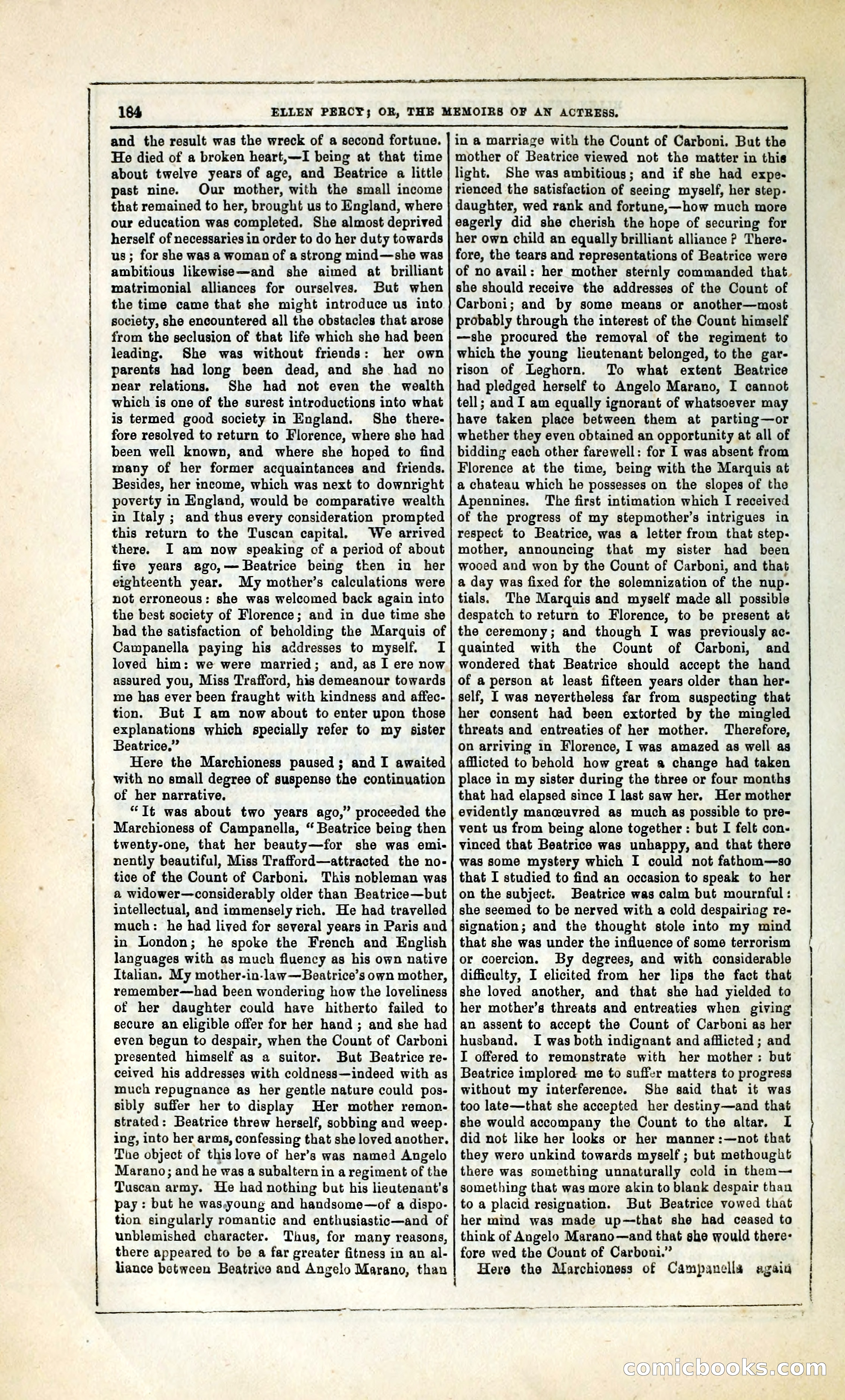
A restored page from Penny Dreadfuls, 1856. Page through the whole issue in the reader above.
📄 Transcribed text from this page (OCR, searchable)
Machine-transcribed from the original scan — historical spelling and the odd misread are preserved.
184 ELLEN PERCY; OR, THE MEMOIRS OF AN ACTRESS. and the result was the wreck of a second fortune. He died of a broken heart,—I being at that time about twelve years of age, and Beatrice a little past nine. Our mother, with the small income that remained to her, brought us to England, where our education was completed. She almost deprived herself of necessaries in order to do her duty towards us ; for she was a woman of a strong mind—she was ambitious likewise—and she aimed at brilliant matrimonial alliances for ourselves. But when the time came that she might introduce us into society, she encountered all the obstacles that arose from the seclusion of that life which she had been leading. She was without friends: her own parents had long been dead, and she had no near relations. She had not even the wealth which is one of the surest introductions into what is termed good society in England. She there- fore resolved to return to Florence, where she had been well known, and where she hoped to find many of her former acquaintances and friends. Besides, her tncome, which was next to downright poverty in England, would be comparative wealth in Italy ; and thus every consideration prompted this return to the Tuscan capital. We arrived there. I am now speaking of a period of about five years ago,— Beatrice being then in her eighteenth year. My mother’s calculations were not erroneous: she was welcomed back again into the best society of Florence; and in due time she had the satisfaction of beholding the Marquis of Campanella paying his addresses to myself. I loved him: we were married; and, as I ere now assured you, Miss Trafford, his demeanour towards me has ever been fraught with kindness and affec- tion. But I am now about to enter upon those explanations which specially refer to my sister Beatrice,” Here the Marchioness paused; and I awaited with no small degree of suspense the continuation of her narrative. “It was about two years ago,” proceeded the Marchioness of Campanella, “ Beatrice being then twenty-one, that her beauty—for she was emi- nently beautiful, Miss Trafford—attracted the no- tice of the Count of Carboni. This nobleman was a widower—considerably older than Beatrice—but intellectual, and immensely rich. He had travelled much: he had lived for several years in Paris and in London; he spoke the French and English languages with as much fluency as his own native Italian. My mother-in-law—Beatrice’s own mother, remember—had been wondering how the loveliness of her daughter could have hitherto failed to secure an eligible offer for her hand ; and she had even begun to despair, when the Count of Carboni presented himself as a suitor. But Beatrice re- ceived his addresses with coldness—indeed with as much repugnance as her gentle nature could pos- sibly suffer her to display Her mother remon- strated: Beatrice threw herself, sobbing aud weep- ing, into her arms, confessing that she loved another. The object of this love of her’s was named Angelo Marano; and he was a subaltern in a regiment of the Tuscan army. He had nothing but his lieutenant’s pay: but he was,young and handsome—of a dispo- tion singularly romantic and enthusiastic—and of unblemished character. Thus, for many reasons, there appeared to be a far greater fitness in an al- liance between Beatrive and Anzelo Marano, than et in a marriage with the Count of Carboni. But the mother of Beatrice viewed not the matter in this light. She was ambitious; and if she had expe- rienced the satisfaction of seeing myself, her step- daughter, wed rank and fortune,—how much more eagerly did she cherish the hope of securing for her own child an equally brilliant alliance ? There- fore, the tears and representations of Beatrice were of no avail: her mother sternly commanded that. she should receive the addresses of the Count of Carboni; and by some means or another—most probably through the interest of the Count himself —she procured the removal of the regiment to which the young lieutenant belonged, to the gar- rison of Leghorn. To what extent Beatrice had pledged herself to Angelo Marano, I cannot tell; and I am equally ignorant of whatsoever may have taken place between them at parting—or whether they even obtained an opportunity at all of bidding each other farewell: for I was absent from Florence at the time, being with the Marquis at a chateau which he possesses on the slopes of the Apennines. The first intimation which I received of the progress of my stepmother’s intrigues in respect to Beatrice, was a letter from that step- mother, announcing that my sister had been wooed and won by the Count of Carboni, and that a day was fixed for the solemnization of the nup- tials. The Marquis and myself made all possible despatch to return to Florence, to be present at the ceremony; and though I was previously ac- quainted with the Count of Carboni, and wondered that Beatrice should accept the hand of a person at least fifteen years older than her- self, I was nevertheless far from suspecting that her consent had been extorted by the mingled threats and entreaties of her mother. Therefore, on arriving in Florence, I was amazed as well as afflicted to behold how great a change had taken place in my sister during the three or four months that had elapsed since I last saw her. Her mother evidently manceuvred as much as possible to pre= vent us from being alone together : but I felt con- vinced that Beatrice was unhappy, and that there was some mystery which I could not fathom—so that I studied to find an occasion to speak to her on the subject. Beatrice was calm but mournful : she seemed to be nerved with a cold despairing re- signation; and the thought stole into my mind that she was under the influence of some terrorism or coercion. By degrees, and with considerable difficulty, I elicited from her lips the fact that she loved another, and that she had yielded to her mother’s threats and entreaties when giving an assent to accept the Count of Carboni as her husband. I was both indignant and afflicted; and I offered to remonstrate with her mother: but Beatrice implored me to suffer matters to progress without my interference. She said that it was too late—that she accepted her destiny—and that she would accompany the Count to the altar. IL did not like her looks or her manner :—not that they were unkind towards myself ; but methought there was something unnaturally cold in them— something that was more akin to blank despair than to a placid resignation. But Beatrice vowed that her mind was made up—that she had ceased to think of Angelo Marano—and that she would there- fore wed the Count of Carboni.” Here the Marchioness of Campanella agai CONNIE IOOKS eS " C€om