
Penny Dreadfuls, 1856 · page 217 of 399
Ellen Percy; or, The Memoirs of an Actress — page 217: what you’re looking at
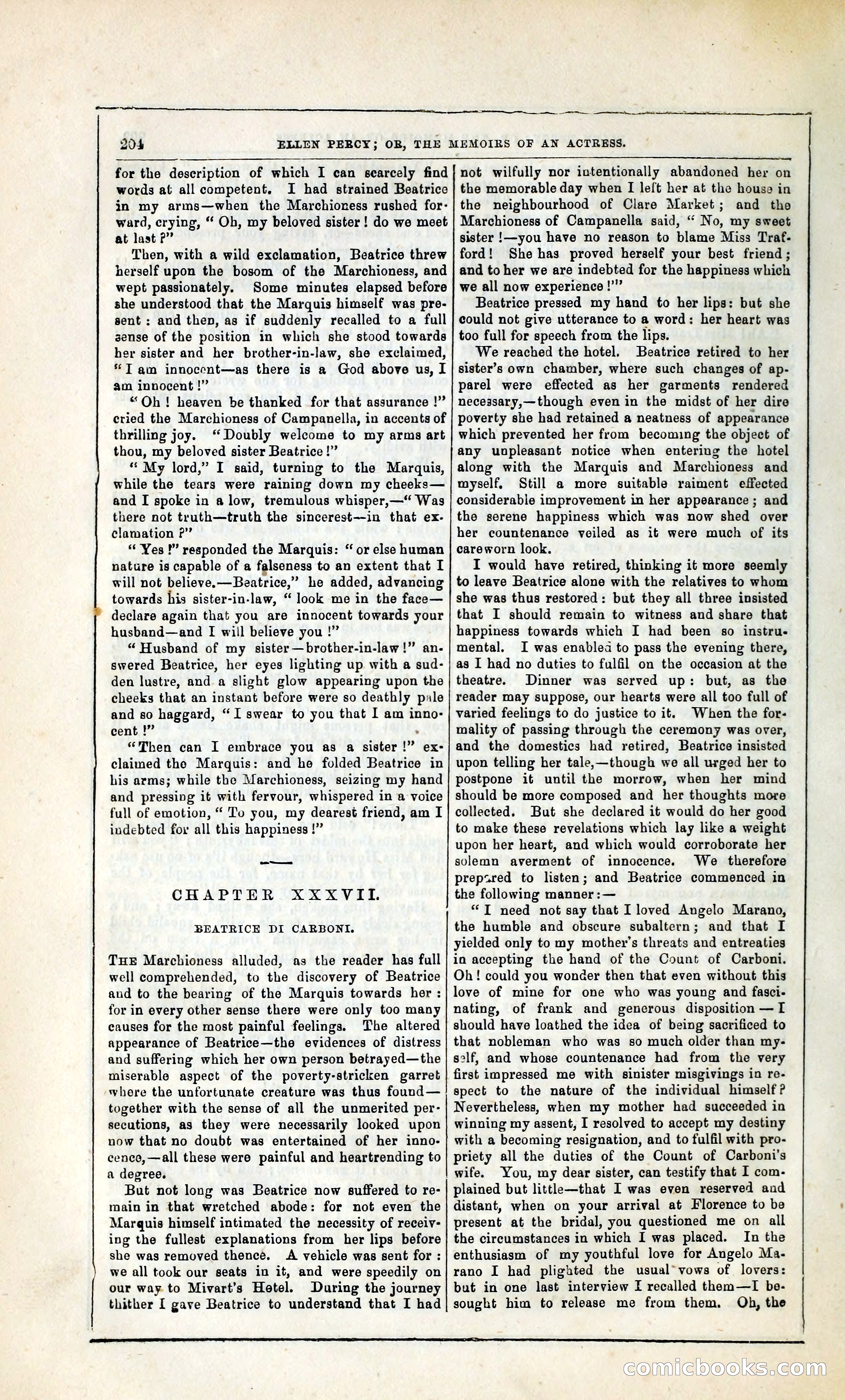
A restored page from Penny Dreadfuls, 1856. Page through the whole issue in the reader above.
📄 Transcribed text from this page (OCR, searchable)
Machine-transcribed from the original scan — historical spelling and the odd misread are preserved.
204 ELLEN PERCY; OR, THE MEMOIRS OF AN ACTRESS. ee for the description of which I can searcely find words at all competent. I had strained Beatrice in my arms—when the Marchioness rushed for: ward, crying, “ Oh, my beloved sister! do we meet at last?” Then, with a wild exclamation, Beatrice threw herself upon the bosom of the Marchioness, and wept passionately. Some minutes elapsed before she understood that the Marquis himself was pre- sent : and then, as if suddenly recalled to a full sense of the position in which she stood towards her sister and her brother-in-law, she exclaimed, *T am innocent—as there is a God above us, I am innocent !” * Qh! heaven be thanked for that assurance !” cried the Marchioness of Campanella, in accents of thrilling joy. ‘Doubly welcome to my arms art thou, my beloved sister Beatrice !” ** My lord,” I said, turning to the Marquis, while the tears were raining down my cheeks— and I spoke in a low, tremulous whisper,—“ Was there not truth—truth the sincerest—in that ex- clamation ?”’ “Yes !’ responded the Marquis: “ or else human nature is capable of a falseness to an extent that I will not believe.—Beatrice,” he added, advancing towards his sister-in-law, “ look me in the face— declare again that you are innocent towards your husband—and I will believe you !” “ Husband of my sister—brother-in-law!” an- swered Beatrice, her eyes lighting up with a sud- den lustre, and a slight glow appearing upon the cheeks that an instant before were so deathly pale and so haggard, “I swear to you that I am inno- cent !” , “Then can I embrace you as a sister!” ex- claimed the Marquis: and he folded Beatrice in his arms; while the Marchioness, seizing my hand and pressing it with fervour, whispered in a voice full of emotion, “ To you, my dearest friend, am I indebted for all this happiness !” i See CHAPTER XXXVII. BEATRICE DI CARBONI. THE Marchioness alluded, as the reader has full well comprehended, to the discovery of Beatrice and to the bearing of the Marquis towards her : for in every other sense there were only too many causes for the most painful feelings. The altered appearance of Beatrice—the evidences of distress and suffering which her own person betrayed—the miserable aspect of the poverty-stricken garret where the unfortunate creature was thus found— together with the sense of all the unmerited per- secutions, as they were necessarily looked upon now that no doubt was entertained of her inno- cence,—all these were painful and heartrending to a depree. But not long was Beatrice now suffered to re- main in that wretched abode: for not even the Marquis himself intimated the necessity of receiv- ing the fullest explanations from her lips before she was removed thence. A vehicle was sent for : we all took our seats in it, and were speedily on our way to Mivart’s Hotel. During the journey thither I gave Beatrice to understand that I had not wilfully nor intentionally abandoned her on the memorable day when I left her at the house in the neighbourhood of Clare Market; and tho Marchioness of Campanella said, “ No, my sweet sister !—you have no reason to blame Miss Traf:- ford! She has proved herself your best friend ; and to her we are indebted for the happiness which we all now experience !’” Beatrice pressed my hand to her lips: but she could not give utterance to a word: her heart was too full for speech from the lips. We reached the hotel. Beatrice retired to her sister’s own chamber, where such changes of ap- parel were effected as her garments rendered necessary,—though even in the midst of her dire poverty she had retained a neatness of appearance which prevented her from becoming the object of any uupleasant notice when entering the hotel along with the Marquis and Marchioness and myself, Still a more suitable raiment effected considerable improvement in her appearance ; and the serene happiness which was now shed over her countenance veiled as it were much of its careworn look. I would have retired, thinking it more seemly to leave Beatrice alone with the relatives to whom she was thus restored: but they all three insisted that I should remain to witness and share that happiness towards which I had been so instru. mental. I was enabled to pass the evening there, as I had no duties to fulfil on the occasion at the theatre. Dinner was served up: but, as the reader may suppose, our hearts were all too full of varied feelings to do justice to it. When the for- mality of passing through the ceremony was over, and the domestics had retired, Beatrice insisted upon telling her tale,—though we all urged her to postpone it until the morrow, when her mind should be more composed and her thoughts more collected. But she declared it would do her good to make these revelations which lay like a weight upon her heart, and which would corroborate her solemn averment of innocence. We therefore prepared to listen; and Beatrice commenced in the following manner :— “TIT need not say that I loved Angelo Marano, the humble and obscure subaltern; and that I yielded only to my mother’s threats and entreaties in accepting the hand of the Count of Carboni. Oh! could you woncer then that even without this love of mine for one who was young and fasci- nating, of frank and gencrous disposition — I should have loathed the idea of being sacrificed to that nobleman who was so much older than my- self, and whose countenance had from the very first impressed me with sinister misgivings in re- spect to the nature of the individual himself? Nevertheless, when my mother had succeeded in winning my assent, I resolved to accept my destiny with a becoming resignation, and to fulfil with pro- priety all the duties of the Count of Carboni’s wife. You, my dear sister, can testify that I com- plained but littlk—that I was even reserved and distant, when on your arrival at Florence to be present at the bridal, you questioned me on all the circumstances in which I was placed. In the enthusiasm of my youthful love for Angelo Ma- rano I had plighted the usual’ vows of lovers: but in one last interview I recalled them—TI be- sought him to release me from them. Qh, the CONNIEIOOKS Com