
Penny Dreadfuls, 1856 · page 248 of 399
Ellen Percy; or, The Memoirs of an Actress — page 248: what you’re looking at
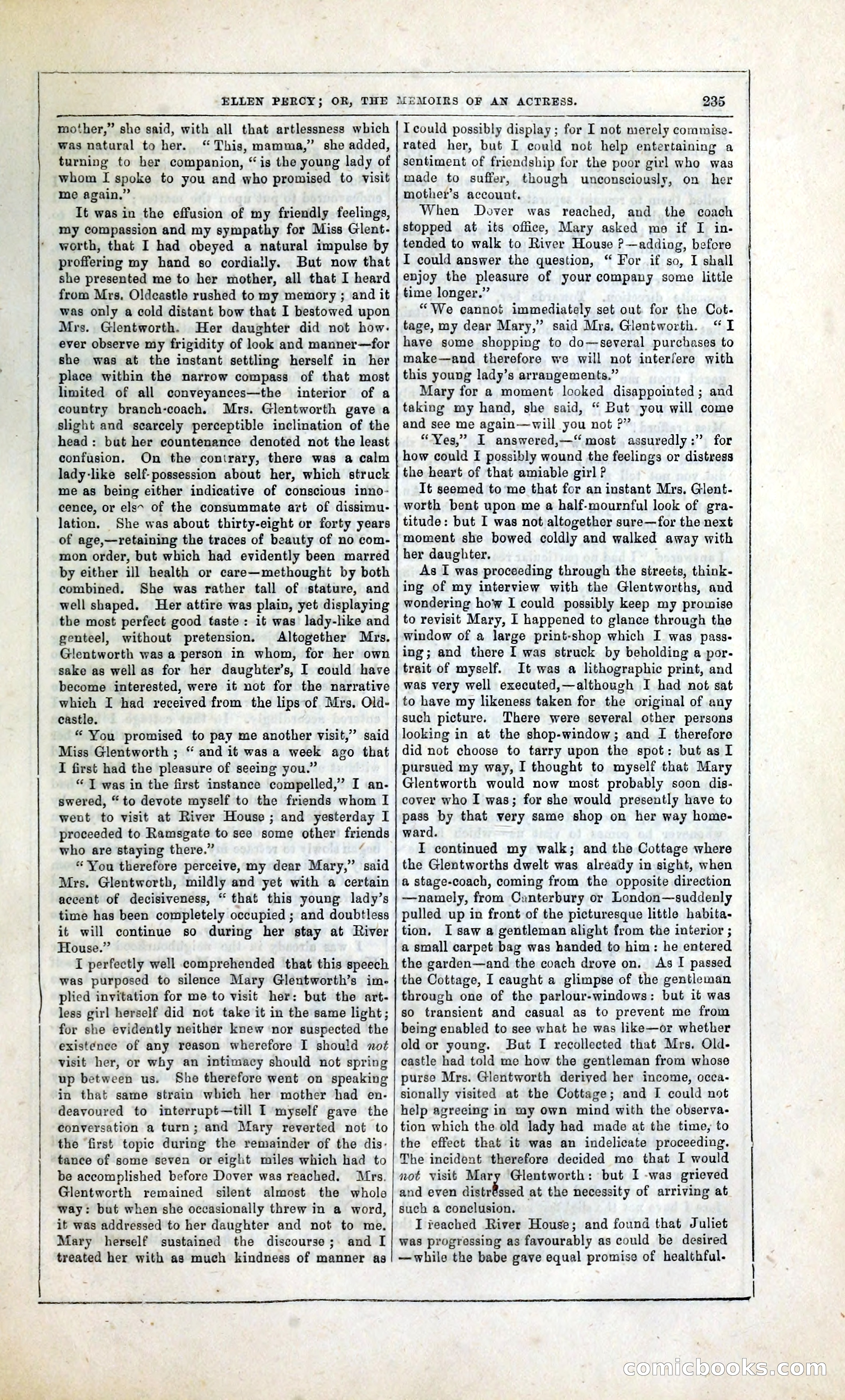
A restored page from Penny Dreadfuls, 1856. Page through the whole issue in the reader above.
📄 Transcribed text from this page (OCR, searchable)
Machine-transcribed from the original scan — historical spelling and the odd misread are preserved.
——- -—-_ —_——- Oh + Or eae ee eee mother,” she said, with all that artlessness which was natural to her. “This, mamma,” she added, turning to her companion, “is the young lady of whom I spoke to you and who promised to visit me again,” It was in the effusion of my friendly feelings, my compassion and my sympathy for Miss Glent- worth, that I had obeyed a natural impulse by proffering my hand so cordiaily. But now that she presented me to her mother, all that I heard from Mrs. Oldcastle rushed to my memory ; and it was only a cold distant bow that I bestowed upon Mrs. Glentworth. Her daughter did not how. ever observe my frigidity of look and manner—for she was at the instant settling herself in her place within the narrow compass of that most limited of all conveyances—the interior of a country branch-coach. Mrs. Glentworth gave a slight and scarcely perceptible inclination of the head: but her countenance denoted not the least confusion. On the contrary, there was a calm lady-like self-possession about her, which struck me as being either indicative of conscious inno- cence, or els* of the consummate art of dissimu- lation. She was about thirty-eight or forty years of age,—retaining the traces of beauty of no com- mon order, but which had evidently been marred by either ill health or care—methought by both combined. She was rather tall of stature, and well shaped. Her attire was plain, yet displaying the most perfect good taste: it was lady-like and genteel, without pretension. Altogether Mrs. Glentworth was a person in whom, for her own sake as well as for her daughter’s, I could have become interested, were it not for the narrative which I had received from the lips of Mrs, Old- castle. “ You promised to pay me another visit,” said Miss Glentworth ; “ and it wasa week ago that I first had the pleasure of seeing you.” “ T was in the first instance compelled,’ I an- swered, “to devote myself to the friends whom I went to visit at River House ; and yesterday I proceeded to Ramsgate to see some other friends who are staying there.” : “You therefore perceive, my dear Mary,” said Mrs. Glentworth, mildly and yet with a certain accent of decisiveness, “ that this young lady’s time has been completely occupied ; and doubtless it will continue so during her stay at River House.” I perfectly well comprehended that this speech was purposed to silence Mary Glentworth’s im- plied invitation for me to visit her: but the art- less girl herself did not take it in the same light; for she evidently neither knew nor suspected the existence of any reason wherefore I shou!d not visit her, or why an intimacy should not spring up between us. She therefore went on speaking in that same strain which her mother had en- deavyoured to interrupt—till I myself gave the conversation a turn; and Mary reverted not to the ‘first topic during the remainder of the dis- tance of some seven or eight miles which had to be accomplished before Dover was reached. Mrs. Glentworth remained silent almost the wholo way: but when she occasionally threw in a word, it was addressed to her daughter and not to me. Mary herself sustained the discourse; and I treated her with as much kindness of manner as ELLEN PERCY; OR, THE MEMOIRS OF AN ACTRESS. Se a 235 I could possibly display ; for I not merely commise- rated her, but I could not help entertaining a sentiment of friendship for the poor girl who was made to suffer, though unconsciously, on her mother’s account. When Dover was reached, and the coach stopped at its office, Mary asked mo if I in- tended to walk to River House ?—adding, before I could answer the question, “ For if so, I shall enjoy the pleasure of your company some little time longer.” “We cannot immediately set out for the Cot- tage, my dear Mary,” said Mrs. Glentworth. “I have some shopping to do—several purchases to make—and therefore we will not interfere with this young lady’s arrangements.” Mary for a moment looked disappointed ; and taking my hand, she said, “ But you will come and see me again—will you not ?” “Yes,” I answered,—“ most assuredly:” for how could I possibly wound the feelings or distress the heart of that amiable girl P It seemed to me that for an instant Mrs, Glent- worth bent upon me a half-mournful look of gra- titude: but I was not altogether sure—for the next moment she bowed coldly and walked away with her daughter. As I was proceeding through the streets, think- ing of my interview with the Glentworths, and wondering how I could possibly keep my prowise to revisit Mary, I happened to glance through the window of a large print-shop which I was pass- ing; and there I was struck by beholding a por- trait of myself. It was a lithographic print, and was very well executed,—although I had not sat to have my likeness taken for the original of any such picture. There were several other persons looking in at the shop-window; and I therefore did not choose to tarry upon the spot: but as I pursued my way, I thought to myself that Mary Glentworth would now most probably soon dis- cover who I was; for she would presently have to pass by that very same shop on her way home- ward. I continued my walk; and the Cottage where the Glentworths dwelt was already in sight, when a stage-coach, coming from the opposite direction —namely, from Ounterbury or London—suddenly pulled up in front of the picturesque little habita- tion. I saw a gentleman alight from the interior ; a small carpet bag was handed to him: he entered the garden—and the coach drove on. As I passed the Cottage, I caught a glimpse of the gentleman through one of the parlour-windows: but it was so transient and casual as to prevent me from being enabled to see what he was like—or whether old or young. But I recollected that Mrs, Old- castle had told me how the gentleman from whose purse Mrs. Glentworth deriyed her income, occa- sionally visited at the Cottage; and I could not help agreeing in my Own mind with the observa- tion which the old lady had made at the time, to the effect that it was an indelicate proceeding. The incident ‘therefore decided mo that I would not visit Mary Glentworth: but I -was grieved and even aistréssed at the necessity of arriving at such a conclusion. I reached River House; and found that Juliet was progressing as favourably as could be desired —while the babe gave equal promise of healthful. COMMUC oO); (COUN