
Penny Dreadfuls, 1856 · page 253 of 399
Ellen Percy; or, The Memoirs of an Actress — page 253: what you’re looking at
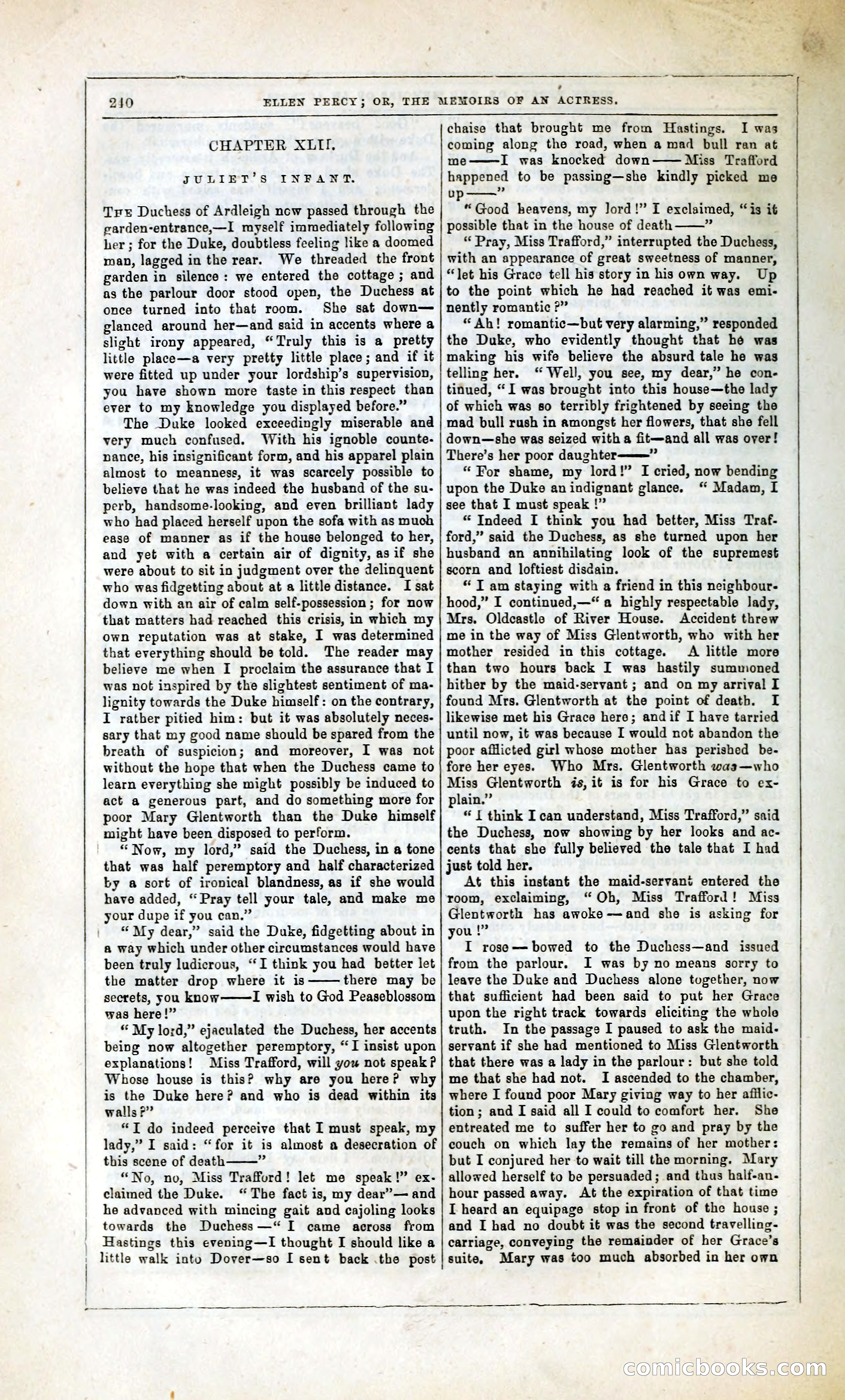
A restored page from Penny Dreadfuls, 1856. Page through the whole issue in the reader above.
📄 Transcribed text from this page (OCR, searchable)
Machine-transcribed from the original scan — historical spelling and the odd misread are preserved.
| 240 ; ELLEN PERCY; OR, THE MEMOIRS OF AN ACTRESS, eect a a ee CHAPTER XLII. JULIET’S INFANT. Tre Duchess of Ardleigh now passed through the earden-entrance,—I myself immediately following her ; for the Duke, doubtless feeling like a doomed man, lagged in the rear. We threaded the front garden in silence: we entered the cottage ; and as the parlour door stood open, the Duchess at once turned into that room. She sat down— glanced around her—and said in accents where a slight irony appeared, “Truly this is a pretty little place—a very pretty little place; and if it were fitted up under your lordship’s supervision, you have shown more taste in this respect than ever to my knowledge you displayed before.” The Duke looked exceedingly miserable and very much confused. With his ignoble counte- nance, his insignificant form, and his apparel plain almost to meanness, it was scarcely possible to believe that he was indeed the husband of the su- perb, handsome-looking, and even brilliant lady who had placed herself upon the sofa with as much ease of manner as if the house belonged to her, and yet with a certain air of dignity, asif she were about to sit in judgment over the delinquent who was fidgetting about at a little distance. Isat down with an air of calm self-possession ; for now that matters had reached this crisis, in which my own reputation was at stake, I was determined that everything should be told. The reader may believe me when I proclaim the assurance that I was not inspired by the slightest sentiment of ma- lignity towards the Duke himself: on the contrary, I rather pitied him: but it was absolutely neces- sary that my good name should be spared from the breath of suspicion; and moreover, I was not without the hope that when the Duchess came to learn everything she might possibly be induced to act a generous part, and do something more for poor Mary Glentworth than the Duke himself might have been disposed to perform. * Now, my lord,” said the Duchess, in a tone that was half peremptory and half characterized by a sort of ironical blandness, as if she would have added, “Pray tell your tale, and make me your dupe if you can.” “ My dear,” said the Duke, fidgetting about in & way which under other circumstances would have been truly ludicrous, “I think you had better let the matter drop where it is there may be secrets, you know——I wish to God Peaseblossom was here!” “ My lord,” ejaculated the Duchess, her accents being now altogether peremptory, “I insist upon explanations! Miss Trafford, will you not speak? Whose house is this? why are you here? why is the Duke here? and who is dead within its walls P” “TI do indeed perceive that I must speak, my lady,” I said: “for it is almost a desecration of this scene of death “No, no, Miss Trafford! let me speak!” ex- claimed the Duke. “The fact is, my dear”’— and he advanced with mincing gait and cajoling looks towards the Duchess—‘“ I came across from Hastings this evening—I thought I should like a little walk into Dover—so I sent back .the post chaise that brought me from Hastings. I was coming along the road, when a mad bull ran at me I was knocked down Miss Trafford happened to be passing—she kindly picked me up »? “Good heavens, my Jord!” I exclaimed, “is it possible that in the house of death a “Pray, Miss Trafford,” interrupted the Duchess, with an appearance of great sweetness of manner, “let his Grace tell his story in his own way. Up to the point which he had reached it was emi- nently romantic ?” “Ah! romantic—but very alarming,” responded the Duke, who evidently thought that hé was making his wife believe the absurd tale he was telling her. “ Well, you see, my dear,” he con- tinued, “I was brought into this house—the lady of which was so terribly frightened by seeing the mad bull rush in amongst her flowers, that she fell down—she was seized with a fit—and all was over! There’s her poor daughter———” “ For shame, my lord!” I cried, now bending upon the Duke anindignant glance. “ Madam, I see that I must speak !” * Indeed I think you had better, Miss Traf- ford,” said the Duchess, as she turned upon her husband an annihilating look of the supremest scorn and loftiest disdain. “ T am staying with a friend in this neighbour- hood,” I continued,—“ a highly respectable lady, Mrs. Oldcastle of River House. Accident threw me in the way of Miss Glentworth, who with her mother resided in this cottage. A little more than two hours back I was hastily summoned hither by the maid-servant ; and on my arrival I found Mrs. Glentworth at the point of death. I likewise met his Grace here; andif I have tarried until now, it was because I would not abandon the poor afflicted girl whose mother has perished be- fore her eyes. Who Mrs. Glentworth was—who Miss Glentworth is, it is for his Grace to ex- plain.” “ | think I can understand, Miss Trafford,” said the Duchess, now showing by her looks and ac- cents that she fully believed the tale that I had just told her. At this instant the maid-servant entered the room, exclaiming, “Ob, Miss Trafford! Miss Glentworth has awoke-—and she is asking for you !” I rose—— bowed to the Duchess—and issued from the parlour. I was by no means sorry to leave the Duke and Duchess alone together, now that sufficient had been said to put her Grace upon the right track towards eliciting the whole truth. In the passage I paused to ask the maid- servant if she had mentioned to Miss Glentworth that there was a lady in the parlour: but she told me that she had not. I ascended to the chamber, where I found poor Mary giving way to her afilic- tion; and I said all I could to comfort her. She entreated me to suffer her to go and pray by the couch on which lay the remains of her mother: but I conjured her to wait till the morning. Mary allowed herself to be persuaded; and thus half-an- hour passed away. At the expiration of that time I heard an equipage stop in front of the house ; and I had no doubt it was the second travelling- carriage, conveying the remainder of her Grace’s suite, Mary was too much absorbed in her own i CONnNEDOOKS com