
Penny Dreadfuls, 1856 · page 268 of 399
Ellen Percy; or, The Memoirs of an Actress — page 268: what you’re looking at
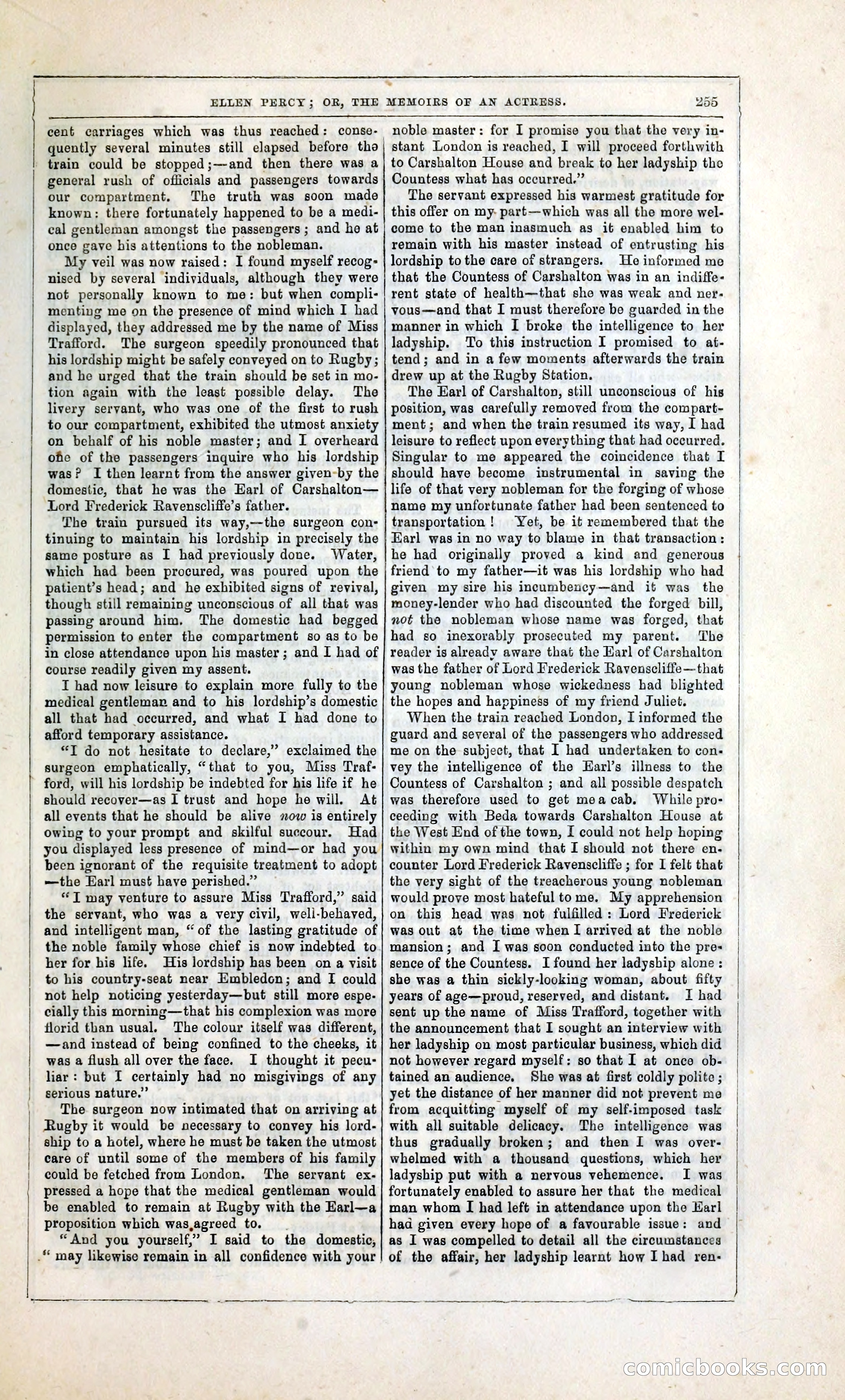
A restored page from Penny Dreadfuls, 1856. Page through the whole issue in the reader above.
📄 Transcribed text from this page (OCR, searchable)
Machine-transcribed from the original scan — historical spelling and the odd misread are preserved.
a —— = soeetnsnettiieelienetcceliniiial NR ne et — LL LL LL LL CL tig . ELLEN PERCY; OR, THE MEMOIRS OF AN ACTRESS. 205 cent carriages which was thus reached: conse- quently several minutes still elapsed before tho train could be stopped;~-and then there was a general rush of officials and passengers towards our compartment. The truth was soon made known: there fortunately happened to be a medi- cal gentleman amongst the passengers; and he at once gave his attentions to the nobleman. My veil was now raised: I found myself recog- nised by several individuals, although they were not personally known to me: but when compli- menting me on the presence of mind which I had displayed, they addressed me by the name of Miss Trafford. The surgeon speedily pronounced that his lordship might be safely conveyed on to Rugby; and he urged that the train should be set in mo- tion again with the least possible delay. The livery seryant, who was one of the first to rush to our compartment, exhibited the utmost anxiety on behalf of his noble master; and I overheard ofie of the passengers inquire who his lordship was? I then learnt from the answer given-by the domestic, that he was the Earl of Carshalton— Lord Frederick Ravenscliffe’s father. The train pursued its way,—the surgeon con- tinuing to maintain his lordship in precisely the same posture as I had previously done. Water, which had been procured, was poured upon the patient’s head; and he exhibited signs of revival, though still remaining unconscious of all that was passing around him, The domestic had begged permission to enter the compartment so as to be in close attendance upon his master; and I had of course readily given my assent. T had now leisure to explain more fully to the medical gentleman and to his lordship’s domestic all that had occurred, and what I had done to afford temporary assistance. “T do not hesitate to declare,” exclaimed the surgeon emphatically, “that to you, Miss Traf:- ford, will his lordship be indebted for his life if he should recover—as I trust and hope he will. At all events that he should be alive mow is entirely owing to your prompt and skilful succour. Had you displayed less presence of mind—or had you been ignorant of the requisite treatment to adopt —the Earl must have perished.” *T may venture to assure Miss Trafford,” said the servant, who was a very civil, well-behaved, and intelligent man, “of the lasting gratitude of the noble family whose chief is now indebted to her for his life. His lordship has been on a visit to his country-seat near Embledon; and I could not help noticing yesterday—but still more espe- cially this morning—that his complexion was more florid than usual. The colour itself was different, —and instead of being confined to the cheeks, it was a flush all over the face. I thought it pecu- liar: but I certainly had no misgivings of any serious nature.” The surgeon now intimated that on arriving at Rugby it would be necessary to convey his lord- ship to a hotel, where he must be taken the utmost care of until some of the members of his family could be fetched from London. ‘The servant ex- pressed a hope that the medical gentleman would be enabled to remain at Rugby with the Earl—a proposition which was,agreed to. “And you yourself,’ I said to the domestic, . may likewise remain in all confidence with your -_——_—_—---———- es OS == noble master: for I promise you that the very in- stant London is reached, I will proceed forthwith to Carshalton House and break to her ladyship tho Countess what has occurred.” The servant expressed his warmest gratitude for this offer on my- part—which was all the more wel- come to the man inasmuch as it enabled him to remain with his master instead of entrusting his lordship to the care of strangers. He informed me that the Countess of Carshalton was in an indiffe- rent state of health—that she was weak and ner. vous—and that I must therefore be guarded in the manner in which I broke the intelligence to her ladyship. To this instruction I promised to at- tend; and in a few moments afterwards the train drew up at the Rugby Station. The Earl of Carshalton, still unconscious of his position, was carefully removed from the compart- ment; and when the train resumed its way, I had leisure to reflect upon everything that had occurred. Singular to me appeared the coincidence that I should have become instrumental in saving the life of that very nobleman for the forging of whose name my unfortunate father had been sentenced to transportation! Yet, be it remembered that the Earl was in no way to blame in that transaction : he had originally proved a kind and generous friend to my father—it was his lordship who had given my sire his incumbency—and it was the money-lender who had discounted the forged bill, not the nobleman whose name was forged, that had so inexorably prosecuted my parent. The reader is already aware that the Earl of Carshalton was the father of Lord Frederick Ravenscliffe—that young nobleman whose wickedness had blighted the hopes and happiness of my friend Juliet. When the train reached London, I informed the guard and several of the passengers who addressed me on the subject, that I had undertaken to con: vey the intelligence of the Harl’s illness to the Countess of Carshalton ; and all possible despatch was therefore used to get meacab. While pro- ceeding with Beda towards Carshalton House at the West End of the town, [ could not help hoping within my own mind that I should not there en- counter Lord Frederick Ravenscliffe ; for I felt that the very sight of the treacherous young nobleman would prove most hateful tome. My apprehension on this head was not fulfilled: Lord Frederick was out af the time when I arrived at the noble mansion; and I was soon conducted into the pre« sence of the Countess. I found her ladysbip alone: she was a thin sickly-looking woman, about fifty years of age—proud, reserved, and distant. I had sent up the name of Miss Trafford, together with the announcement that I sought an interview with her ladyship on most particular business, which did not however regard myself: so that I at once ob- tained an audience. She was at first coldly polite; yet the distance of her manner did not prevent me from acquitting myself of my self-imposed taslx with all suitable delicacy. The intelligence was thus gradually broken; and then I was over- whelmed with a thousand questions, which her ladyship put with a nervous vehemence. I was fortunately enabled to assure her that the medical man whom [I had left in attendance upon the Harl had given every hope of a favourable issue: and as I was compelled to detail all the circumstances of the affair, her ladyship learnt how I had ren- a ee a eee COME <S (COI