
Penny Dreadfuls, 1856 · page 27 of 399
Ellen Percy; or, The Memoirs of an Actress — page 27: what you’re looking at
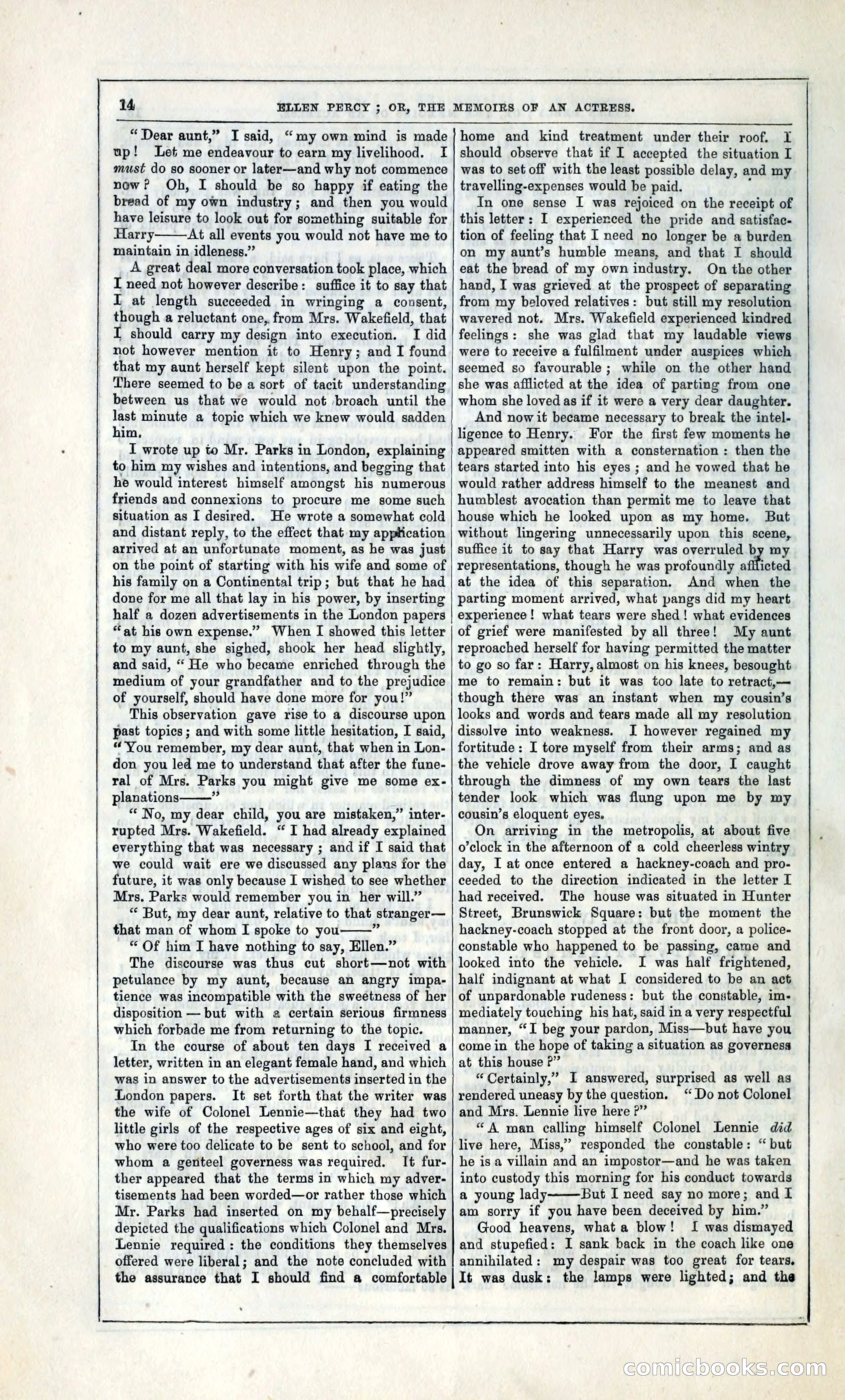
A restored page from Penny Dreadfuls, 1856. Page through the whole issue in the reader above.
📄 Transcribed text from this page (OCR, searchable)
Machine-transcribed from the original scan — historical spelling and the odd misread are preserved.
14 ELLEN PERCY ; OR, THE MEMOIRS OF AN ACTRESS. er “ Dear aunt,” I said, “my own mind is made up! Let me endeavour to earn my livelihood. I must do so sooner or later—and why not commence now? Oh, I should be so happy if eating the bread of my own industry; and then you would have leisure to look out for something suitable for Harry At all events you would not have me to maintain in idleness.” A great deal more conversation took place, which I need not however describe: suffice it to say that I at length succeeded in wringing a consent, though a reluctant one,. from Mrs. Wakefield, that I should carry my design into execution. I did not however mention it to Henry; and I found that my aunt herself kept silent upon the point. There seemed to be a sort of tacit understanding between us that we would not broach until the last minute a topic which we knew would sadden him, I wrote up to Mr. Parks in London, explaining to him my wishes and intentions, and begging that he would interest himself amongst his numerous friends and connexions to procure me some such situation as I desired. He wrote a somewhat cold and distant reply, to the effect that my application arrived at an unfortunate moment, as he was just on the point of starting with his wife and some of his family on a Continental trip; but that he had done for me all that lay in his power, by inserting half a dozen advertisements in the London papers “at his own expense.” When I showed this letter to my aunt, she sighed, shook her head slightly, and said, “ He who became enriched through the medium of your grandfather and to the prejudice of yourself, should have done more for you!” This observation gave rise to a discourse upon past topics ; and with some little hesitation, I said, “You remember, my dear aunt, that when in Lon- don you led me to understand that after the fune- ral of Mrs. Parks you might give me some ex- planations 4 ** No, my dear child, you are mistaken,” inter- rupted Mrs. Wakefield. “ I had already explained everything that was necessary ; and if I said that we could wait ere we discussed any plans for the future, it was only because I wished to see whether Mrs. Parks would remember you in her will.” ** But, my dear aunt, relative to that stranger— that man of whom I spoke to you a * Of him I have nothing to say, Ellen.” The discourse was thus cut short—not with petulance by my aunt, because an angry impa- tience was incompatible with the sweetness of her disposition — but with 2 certain serious firmness which forbade me from returning to the topic. In the course of about ten days I received a letter, written in an elegant female hand, and which was in answer to the advertisements inserted in the London papers. It set forth that the writer was the wife of Colonel Lennie—that they had two little girls of the respective ages of six and eight, who were too delicate to be sent to school, and for whom a geriteel governess was required. It fur- ther appeared that the terms in which my adver- tisements had been worded—or rather those which Mr. Parks had inserted on my behalf—precisely depicted the qualifications which Colonel and Mrs. Lennie required: the conditions they themselves offered were liberal; and the note concluded with the assurance that I should find a comfortable | It was dusk: home and kind treatment under their roof. I should observe that if I accepted the situation I was to set off with the least possible delay, and my travelling-expenses would be paid. In one sense I was rejoiced on the receipt of this letter: I experienced the pride and satisfac- tion of feeling that I need no longer be a burden on my aunt’s humble means, and that I should eat the bread of my own industry. On the other hand, I was grieved at the prospect of separating from my beloved relatives: but still my resolution wavered not. Mrs. Wakefield experienced kindred feelings: she was glad that my laudable views were to receive a fulfilment under auspices which seemed so favourable; while on the other hand she was afflicted at the idea of parting from one whom she loved as if it were a very dear daughter. And now it became necessary to break the intel- ligence to Henry. For the first few moments he appeared smitten with a consternation : then the tears started into his eyes ; and he vowed that he would rather address himself to the meanest and humblest avocation than permit me to leave that house which he looked upon as my home, But without lingering unnecessarily upon this scene, suffice it to say that Harry was overruled by my representations, though he was profoundly afificted at the idea of this separation. And when the parting moment arrived, what pangs did my heart experience! what tears were shed! what evidences of grief were manifested by all three! My aunt reproached herself for having permitted the matter to go so far: Harry, almost on his knees, besought me to remain: but it was too late to retract,— though there was an instant when my cousin’s looks and words and tears made all my resolution dissulve into weakness. J however regained my fortitude: I tore myself from their arms; and as the vehicle drove away from the door, I caught through the dimness of my own tears the last tender look which was flung upon me by my cousin’s eloquent. eyes. On arriving in the metropolis, at about five o’clock in the afternoon of a cold cheerless wintry day, I at once entered a hackney-coach and pro- ceeded to the direction indicated in the letter I had received. The house was situated in Hunter Street, Brunswick Square: but the moment the hackney-coach stopped at the front door, a police- constable who happened to be passing, came and looked into the vehicle. I was half frightened, half indignant at what I considered to be an act of unpardonable rudeness: but the constable, im- mediately touching his hat, said in a very respectful manner, “I beg your pardon, Miss—but have you come in the hope of taking a situation as governess at this house P” “ Certainly,’ I answered, surprised as well as rendered uneasy by the question. “Do not Colonel and Mrs. Lennie live here ?” “A man calling himself Colonel Lennie did live here, Miss,” responded the constable: “ but he is a villain and an impostor—and he was taken into custody this morning for his conduct towards a young lady But I need say no more; and I am sorry if you have been deceived by him.” Good heavens, what a blow! I was dismayed and stupefied: I sank back in the coach like one annihilated: my despair was too great for tears. the lamps were lighted; and the GomiGaooks Coim