
Penny Dreadfuls, 1856 · page 297 of 399
Ellen Percy; or, The Memoirs of an Actress — page 297: what you’re looking at
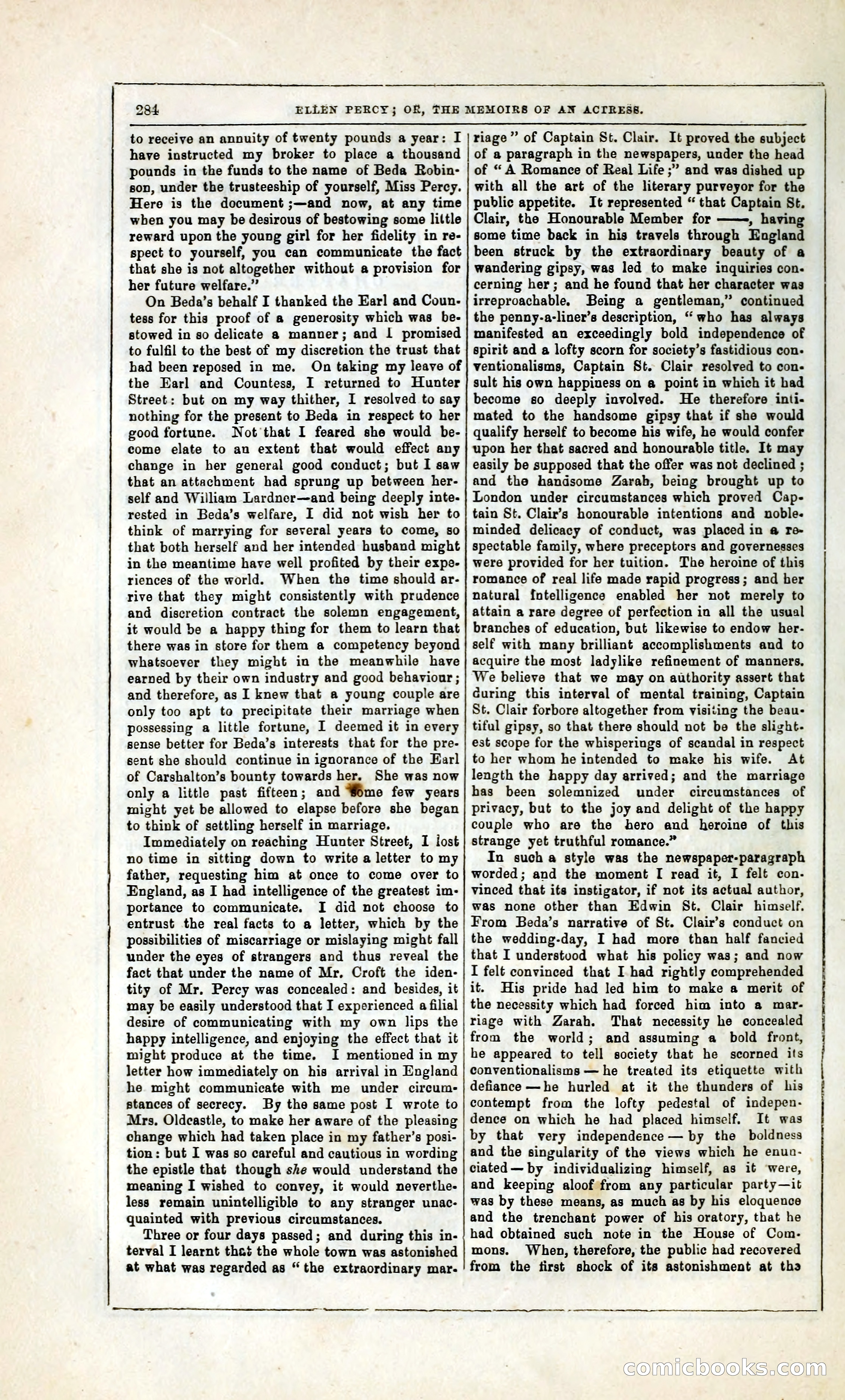
A restored page from Penny Dreadfuls, 1856. Page through the whole issue in the reader above.
📄 Transcribed text from this page (OCR, searchable)
Machine-transcribed from the original scan — historical spelling and the odd misread are preserved.
284 ELLEN PERCY; OR, THE MEMOIRS OF AN ACTRESS. to receive an annuity of twenty pounds a year: I | riage” of Captain St. Clair. It proved the subject have instructed my broker to place a thousand | of a paragraph in the newspapers, under the head pounds in the funds to the name of Beda Robin- son, under the trusteeship of yourself, Miss Percy. Here is the document ;—and now, at any time when you may be desirous of bestowing some little reward upon the young girl for her fidelity in re- spect to yourself, you can communicate the fact that she is not altogether without a provision for her future welfare.” On Beda’s behalf I thanked the Earl and Coun- tess for this proof of a generosity which was be- stowed in so delicate a manner; and I promised to fulfil to the best of my discretion the trust that had been reposed in me. On taking my leave of the Earl and Countess, I returned to Hunter Street: but on my way thither, I resolved to say nothing for the present to Beda in respect to her good fortune. Not’ that I feared she would be- come elate to an extent that would effect any change in her general good conduct; but I saw that an attachment had sprung up between her- self and William Lardner~and being deeply inte- rested in Beda’s welfare, I did not wish her to think of marrying for several years to come, 580 that both herself and her intended husband might in the meantime have well profited by their expe- riences of the world. When the time should ar- rive that they might consistently with prudence and discretion contract the solemn engagement, it would be a happy thing for them to learn that there was in store for them a competency beyond whatsoever they might in the meanwhile have earned by their own industry and good behaviour; and therefore, as I knew that a young couple are only too apt to precipitate their marriage when possessing a little fortune, I deemed it in every sense better for Beda’s interests that for the pre- sent she should continue in ignorance of the Earl of Carshalton’s bounty towards her. She was now only a little past fifteen; and e few years might yet be allowed to elapse before she began to think of settling herself in marriage. Immediately on reaching Hunter Street, I fost no time in sitting down to write a letter to my father, requesting him at once to come over to England, as I had intelligence of the greatest im- portance to communicate. I did not choose to entrust the real facts to a letter, which by the possibilities of miscarriage or mislaying might fall under the eyes of strangers and thus reveal the fact that under the name of Mr. Croft the iden- tity of Mr. Percy was concealed: and besides, it may be easily understood that I experienced a filial desire of communicating with my own lips the happy intelligence, and enjoying the effect that it might produce at the time. I mentioned in my letter how immediately on his arrival in England he might communicate with me under circum- stances of secrecy. By the same post I wrote to Mrs. Oldcastle, to make her aware of the pleasing change which had taken place in my father’s posi- tion: but I was so careful and cautious in wording the epistle that though she would understand the meaning I wished to convey, it would neverthe- less remain unintelligible to any stranger unac- quainted with previous circumstances. Three or four days passed; and during this in- terval I learnt that the whole town was astonished at what was regarded as “the extraordinary mar- of “ A Romance of Real Life ;” and was dished up with all the art of the literary purveyor for the public appetite. It represented “ that Captain St. Clair, the Honourable Member for ——, having some time back in his travels through England been struck by the extraordinary beauty of a wandering gipsy, was led to make inquiries con. cerning her; and he found that her character was irreproachable. Being a gentleman,” continued the penny-a-liner’s description, “who has always manifested an exceedingly bold independence of spirit and a lofty scorn for society’s fastidious con- ventionalisms, Captain St. Clair resolved to con- sult his own happiness on a point in which it had become so deeply involved. He therefore inti- mated to the handsome gipsy that if she would qualify herself to become his wife, he would confer upon her that sacred and honourable title. It may easily be supposed that the offer was not declined ; and the handsome Zarah, being brought up to London under circumstances which proved Cap- tain St. Clair’s honourable intentions and noble- minded delicacy of conduct, was placed in @ re- spectable family, where preceptors and governesses were provided for her tuition. The heroine of this romance of real life made rapid progress; and her natural {ntelligence enabled her not merely to attain a rare degree of perfection in all the usual branches of education, but likewise to endow her- self with many brilliant accomplishments and to acquire the most ladylike refinement of manners. We believe that we may on authority assert that Guring this interval of mental training, Captain St. Clair forbore altogether from visiting the beau- tiful gipsy, so that there should not be the slizht- est scope for the whisperiugs of scandal in respect to her whom he intended to make his wife. At length the happy day arrived; and the marriage has been solemnized under circumstances of privacy, but to the joy and delight of the happy couple who are the hero and heroine of this strange yet truthful romance.” In such a style was the newspaper-paragraph worded; and the moment [ read it, I felt con- vinced that ifs instigator, if not its actual author, was none other than Edwin St. Clair himself. From Beda’s narrative of St. Clair’s conduct on the wedding-day, I had more than half fancied that I understuod what his policy was; and now I felt convinced that I had rightly comprehended it. His pride had led him to make a merit of the necessity which had forced him into a mar- riage with Zarah. That necessity he concealed from the world; and assuming a bold front, he appeared to tell society that he scorned its conventionalisms — he treated its etiquette with defiance —he hurled at it the thunders of his contempt from the lofty pedestal of indepen- dence on which he had placed himself. It was by that very independence — by the boldness and the singularity of the views which he enun- ciated — by individualizing himself, as it were, and keeping aloof from any particular party—it was by these means, as much as by his eloquence and the trenchant power of his oratory, that he had obtained such note in the House of Com- mons. When, therefore, the public had recovered from the first shock of its astonishment at tha GoOmiGaooks Com