
Penny Dreadfuls, 1856 · page 365 of 399
Ellen Percy; or, The Memoirs of an Actress — page 365: what you’re looking at
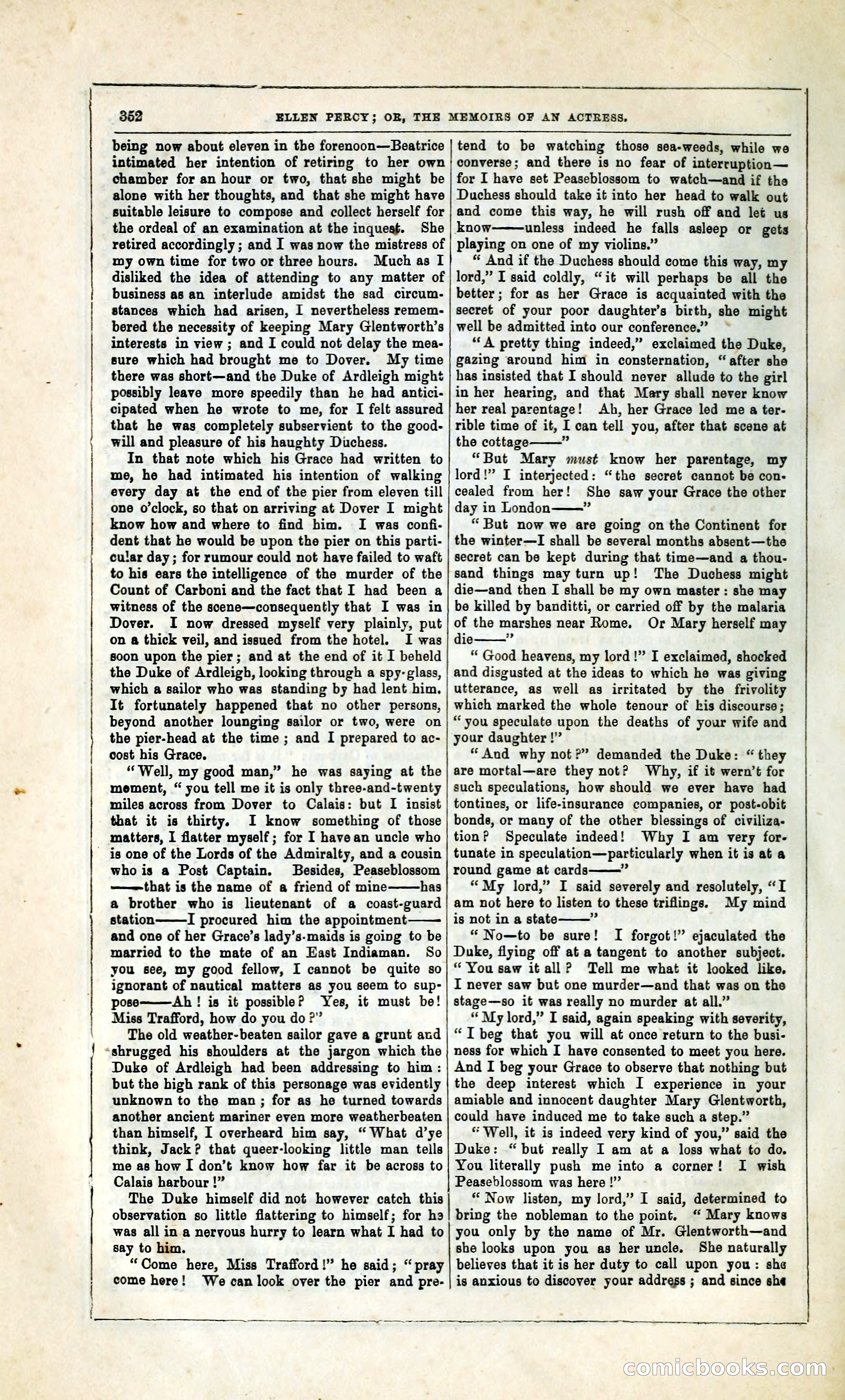
A restored page from Penny Dreadfuls, 1856. Page through the whole issue in the reader above.
📄 Transcribed text from this page (OCR, searchable)
Machine-transcribed from the original scan — historical spelling and the odd misread are preserved.
362 am ELLEN PERCY; OR, THE MEMOIRS OF AN ACTRESS, being now about eleven in the forenoon—Beatrice intimated her intention of retiring to her own chamber for an hour or two, that she might be alone with her thoughts, and that she might have suitable leisure to compose and collect herself for the ordeal of an examination at the inques$. She tend to be watching those sea-weeds, while we converse; and there is no fear of interruption— for I have set Peaseblossom to watch—and if the Duchess should take it into her head to walk out and come this way, he will rush off and let us know unless indeed he falls asleep or gets retired accordingly ; and I was now the mistress of | playing on one of my violins.” my own time for two or three hours. Much as I disliked the idea of attending to any matter of business as an interlude amidst the sad circum- stances which had arisen, I nevertheless remem- bered the necessity of keeping Mary Glentworth’s interests in view ; and I could not delay the mea- sure which had brought me to Dover. My time there was short—and the Duke of Ardleigh might possibly leave more speedily than he had antici- cipated when he wrote to me, for I felt assured that he was completely subservient to the good- will and pleasure of his haughty Duchess. In that note which his Grace had written to me, he had intimated his intention of walking every day at the end of the pier from eleven till one o'clock, so that on arriving at Dover I might know how and where to find him. I was confi- dent that he would be upon the pier on this parti- cular day; for rumour could not have failed to waft to his ears the intelligence of the murder of the Count of Carboni and the fact that I had been a witness of the scene—consequently that I was in Dover. I now dressed myself very plainly, put on a thick veil, and issued from the hotel. I was soon upon the pier; and at the end of it I beheld the Duke of Ardleigh, looking through a spy-glass, which a sailor who was standing by had lent him, It fortunately happened that no other persons, beyond another lounging sailor or two, were on the pier-head at the time ; and I prepared to ac- cost his Grace. “Well, my good man,” he was saying at the mement, “ you tell me it is only three-and-twenty miles across from Dover to Calais: but I insist that it is thirty, I know something of those matters, I flatter myself; for I havean uncie who is one of the Lords of the Admiralty, and a cousin who is a Post Captain. Besides, Peaseblossom ——that is the name of a friend of mine has a brother who is lieutenant of a coast-guard station I procured him the appointment and one of her Grace’s lady’s-maids is going to be married to the mate of an East Indiaman. So you see, my good fellow, I cannot be quite so ignorant of nautical matters as you seem to sup- pose———Ah ! is it possible? Yes, it must be! Mies Trafford, how do you do ?” The old weather-beaten sailor gave a grunt and “shrugged his shoulders at the jargon which the Duke of Ardleigh had been addressing to him: but the high rank of this personage was evidently unknown to the man; for as he turned towards another ancient mariner even more weatherbeaten than himself, I overheard him say, “ What d’ye think, Jack? that queer-looking little man tells me a8 how I don’t know how far it be across to} You literally push me into a corner! Calais harbour !” The Duke himself did not however catch this “ And if the Duchess should come this way, my lord,” I said coldly, “it will perhaps be all the better; for as her Grace is acquainted with the secret of your poor daughter’s birth, she might well be admitted into our conference.” “A pretty thing indeed,” exclaimed the Duke, gazing around him in consternation, “after she has insisted that I should never allude to the girl in her hearing, and that Mary shall never know her real parentage! Ah, her Grace led me a ter- rible time of it, I can tell you, after that scene at the cottage # “But Mary must know her parentage, my lord!” I interjected: “the secret cannot be con- cealed from her! She saw your Grace the other day in London g “But now we are going on the Continent for the winter—I shall be several months absent—the secret can be kept during that time—and a thou- sand things may turn up! The Duchess might die—and then I shall be my own master : she may be killed by banditti, or carried off by the malaria of the marshes near Rome. Or Mary herself may die “* “ Good heavens, my lord!” I exclaimed, shocked and disgusted at the ideas to which he was giving utterance, as well as irritated by the frivolity which marked the whole tenour of kis discourse; “ you speculate upon the deaths of your wife and your daughter !” “And why not?” demanded the Duke: “ they are mortal—are they not? Why, if it wern’t for such speculations, how should we ever have had tontines, or life-insurance companies, or post-obit bonds, or many of the other blessings of civiliza- tion? Speculate indeed! Why I am very for- tunate in speculation—particularly when it is at a round game at cards Z “My lord,” I said severely and resolutely, “I am not here to listen to these triflings. My mind is not in a state > “ No—to be sure! I forgot!” ejaculated the Duke, flying off at a tangent to another subject. “You saw it all? Tell me what it looked like, I never saw but one murder—and that was on the stage—so it was really no murder at all.” “My lord,” I said, again speaking with severity, “T beg that you will at once return to the busi- ness for which I have consented to meet you here. And I beg your Grace to observe that nothing but the deep interest which I experience in your amiable and innocent daughter Mary Glentworth, could have induced me to take such a step.” “Well, it is indeed very kind of you,” said the Duke: “but really I am at a loss what to do. I wish Peaseblossom was here !” “ Now listen, my lord,’ I said, determined to observation so little flattering to himself; for ha! bring the nobleman to the point, “ Mary knows was all in a nervous hurry to learn what I had to| you only by the name of Mr. Glentworth—and say to him. she looks upon you as her uncle. She naturally “Come here, Miss Trafford!” he said; “pray | believes that it is her duty to call upon you: she come here! We can look over the pier and pre- | is anxious to discover your address ; and since she eee ee OOOO eee CONNEDIOOKS €oim,