
Penny Dreadfuls, 1856 · page 37 of 399
Ellen Percy; or, The Memoirs of an Actress — page 37: what you’re looking at
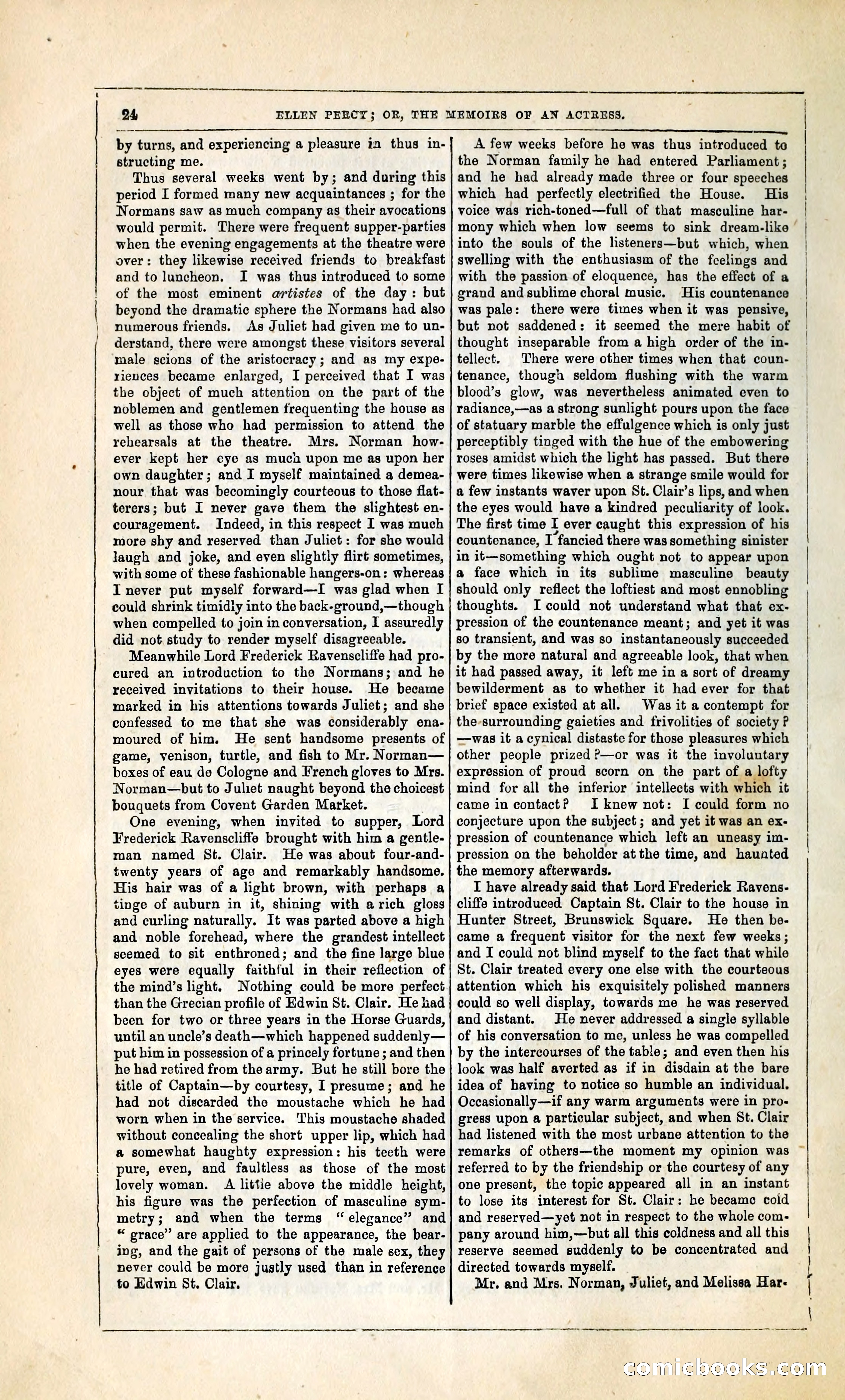
A restored page from Penny Dreadfuls, 1856. Page through the whole issue in the reader above.
📄 Transcribed text from this page (OCR, searchable)
Machine-transcribed from the original scan — historical spelling and the odd misread are preserved.
ee ee 24 by turns, and experiencing a pleasure in thus in- structing me. Thus several weeks went by; and during this period I formed many new acquaintances ; for the Normans saw as much company as their avocations would permit. There were frequent supper-parties when the evening engagements at the theatre were over: they likewise received friends to breakfast and to luncheon. I was thus introduced to some of the most eminent artistes of the day: but beyond the dramatic sphere the Normans had also numerous friends. As Juliet had given me to un- derstand, there were amongst these visitors several male scions of the aristocracy; and as my expe- riences became enlarged, I perceived that I was the object of much attention on the part of the noblemen and gentlemen frequenting the house as well as those who had permission to attend the rehearsals at the theatre. Mrs. Norman how- ever kept her eye as much upon me as upon her own daughter; and I myself maintained a demea- nour that was becomingly courteous to those flat- terers; but I never gave them the slightest en- couragement. Indeed, in this respect I was much more shy and reserved than Juliet: for she would laugh and joke, and even slightly flirt sometimes, with some of these fashionable hangers-on: whereas I never put myself forward—I was glad when I could shrink timidly into the back-ground,—though when compelled to join in conversation, I assuredly did not study to render myself disagreeable. Meanwhile Lord Frederick Ravenscliffe had pro- cured an introduction to the Normans; and ho received invitations to their house. He became marked in his attentions towards Juliet; and she confessed to me that she was considerably ena- moured of him. He sent handsome presents of game, venison, turtle, and fish to Mr. Norman— boxes of eau de Cologne and French gloves to Mrs. Norman—but to Juliet naught beyond the choicest bouquets from Covent Garden Market. One evening, when invited to supper, Lord Frederick Ravenscliffe brought with him a gentle- man named St. Clair. He was about four-and- twenty years of age and remarkably handsome. His hair was of a light brown, with perhaps a tinge of auburn in it, shining with a rich gloss and curling naturally. It was parted above a high and noble forehead, where the grandest intellect seemed to sit enthroned; and the fine large blue eyes were equally faithful in their reflection of the mind’s light. Nothing could be more perfect than the Grecian profile of Edwin St. Clair. He had been for two or three years in the Horse Guards, until an uncle’s death—which happened suddenly— put him in possession of a princely fortune ; and then he had retired from the army. But he still bore the title of Captain—by courtesy, I presume; and he had not discarded the moustache which he had worn when in the service. This moustache shaded without concealing the short upper lip, which had a somewhat haughty expression: his teeth were pure, even, and faultless as those of the most lovely woman. A littie above the middle height, his figure was the perfection of masculine sym- metry; and when the terms “elegance” and “ race” are applied to the appearance, the bear- ing, and the gait of persons of the male sex, they never could be more justly used than in reference to Edwin St. Clair. en er ea ee ELLEN PERCT; OR, THE MEMOIRS OF AN ACTRESS. —, A few weeks before he was thus introduced te the Norman family he had entered Parliament ; and he had already made three or four speeches which had perfectly electrified the House. His voice was rich-toned—full of that masculine har- mony which when low seems to sink dream-like into the souls of the listeners—but which, when swelling with the enthusiasm of the feelings and with the passion of eloquence, has the effect of a grand and sublime choral music. His countenance was pale: there were times when it was pensive, but not saddened: it seemed the mere habit of thought inseparable from a high order of the in- tellect. There were other times when that coun- tenance, though seldom flushing with the warm blood’s glow, was nevertheless animated even to radiance,—as a strong sunlight pours upon the face of statuary marble the effulgence which is only just perceptibly tinged with the hue of the embowering roses amidst which the light has passed. But there were times likewise when a strange smile would for a few instants waver upon St. Clair’s lips, and when the eyes would have a kindred peculiarity of look. The first time I ever caught this expression of his countenance, I fancied there was something sinister in it—something which ought not to appear upon a face which in its sublime masculine beauty should only reflect the loftiest and most ennobling thoughts. I could not understand what that ex- pression of the countenance meant; and yet it was so transient, and was so instantaneously succeeded by the more natural and agreeable look, that when it had passed away, it left me in a sort of dreamy bewilderment as to whether it had ever for that brief space existed at all. Was it a contempt for the-surrounding gaieties and frivolities of society P —was it acynical distaste for those pleasures which other people prized ?—or was it the involuntary expression of proud scorn on the part of a lofty mind for all the inferior intellects with 4 it came in contact? I knew not: I could form no conjecture upon the subject; and yet it was an ex- pression of countenance which left an uneasy im- pression on the beholder at the time, and haunted the memory afterwards. I have already said that Lord Frederick Ravens- cliffe introduced Captain St. Clair to the house in Hunter Street, Brunswick Square. He then be- came a frequent visitor for the next few weeks; and I could not blind myself to the fact that while St. Clair treated every one else with the courteous attention which his exquisitely polished manners could so well display, towards me he was reserved and distant. He never addressed a single syllable of his conversation to me, unless he was compelled by the intercourses of the table; and even then his look was half averted as if in disdain at the bare idea of having to notice so humble an individual. Occasionally—if any warm arguments were in pro- gress upon a particular subject, and when St. Clair had listened with the most urbane attention to the remarks of others—the moment my opinion was referred to by the friendship or the courtesy of any one present, the topic appeared all in an instant to lose its interest for St. Clair: he became cold and reserved—yet not in respect to the whole com- pany around him,—but all this coldness and all this reserve seemed suddenly to be concentrated and directed towards myself. Mr, and Mrs. Norman, Juliet, and Melissa Har- we ree ee (EONMIE DIO KS ¢om