
Penny Dreadfuls, 1856 · page 380 of 399
Ellen Percy; or, The Memoirs of an Actress — page 380: what you’re looking at
A restored page from Penny Dreadfuls, 1856. Page through the whole issue in the reader above.
📄 Transcribed text from this page (OCR, searchable)
Machine-transcribed from the original scan — historical spelling and the odd misread are preserved.
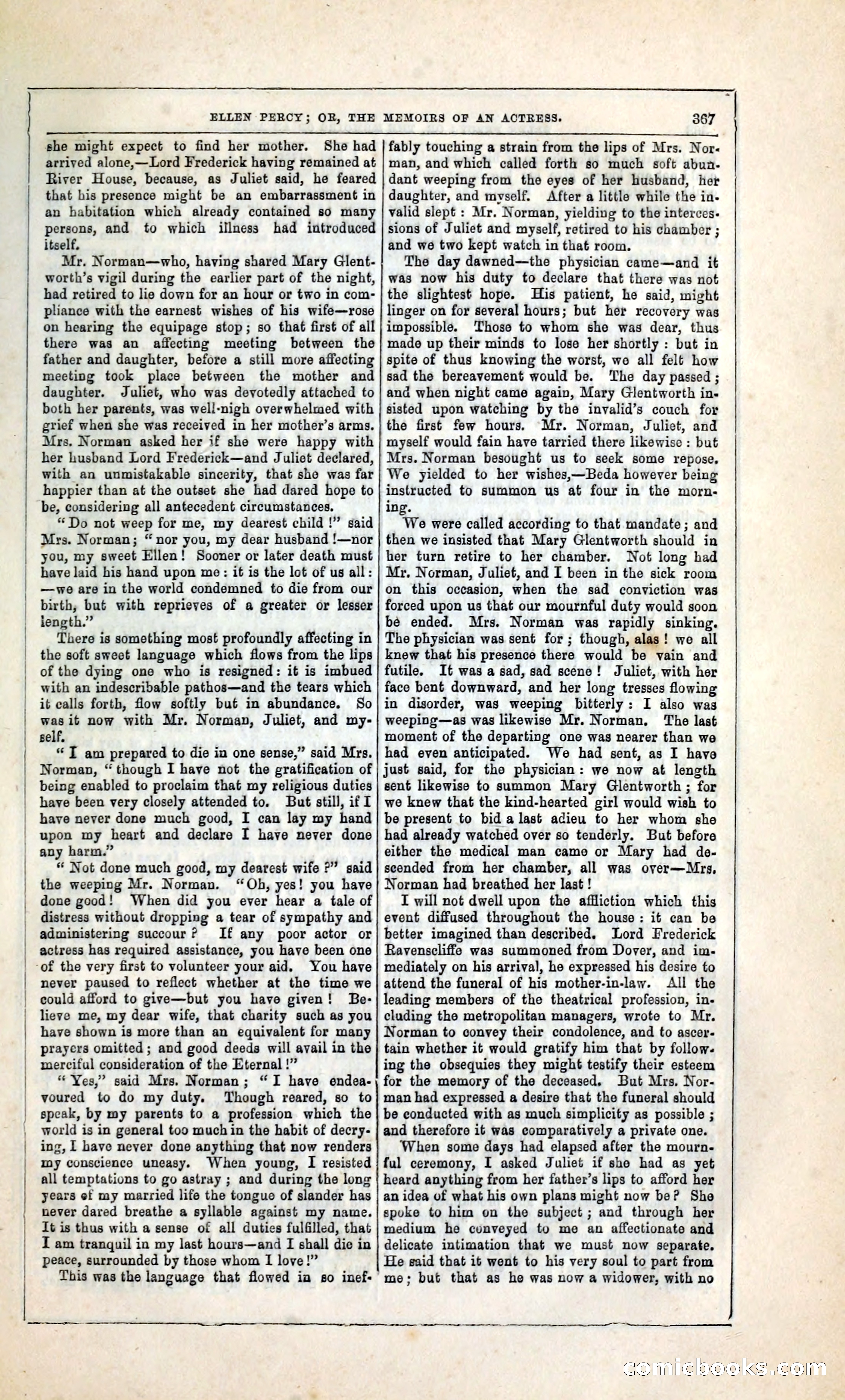
ELLEN PERCY; OR, THE MEMOIRS OF AN ACTRESS. she might expect to find her mother. She had arrived alone,—Lord Frederick having remained at River House, because, as Juliet said, he feared that bis presence might be an embarrassment in an habitation which already contained so many persons, and to which illness had introduced itself. Mr. Norman—who, having shared Mary Glent- worth’s vigil during the earlier part of the night, had retired to lie down for an hour or two in com- pliance with the earnest wishes of his wife—rose on hearing the equipage stop; so thaé first of all there was an affecting meeting between the father and daughter, before a still more affecting meeting took place between the mother and daughter. Juliet, who was devotedly attached to both her parents, was well-nigh overwhelmed with grief when she was received in her mother’s arms. Mrs. Norman asked her if she were happy with her husband Lord Frederick—and Juliet declared, with an uumistakable sincerity, that she was far happier than at the outset she had dared hope to be, considering all antecedent circumstances. * Do not weep for me, my dearest child !” said Mrs. Norman; “nor you, my dear husband !—nor you, my sweet Ellen! Sooner or later death must have laid his hand upon me: if is the lot of us all: —we are in the world condemned to die from our birth, but with reprieyes of a greater or lesser length.” There is something most profoundly affecting in the soft sweet language which flows from the lips of the dying one who is resigned: if is imbued with an indescribable pathos—and the tears which it calls forth, flow softly but in abundance. So wasit now with Mr. Norman, Juliet, and my- self. “IT am prepared to die in one sense,” said Mrs. Norman, “ though I have not the gratification of being enabled to proclaim that my religious duties have been very closely attended to. But still, if I have never done much good, I can lay my hand upon my heart and declare I have never done any harm.” “ Not done much good, my dearest wife ” said the weeping Mr. Norman. “Oh, yes! you have done good! When did you ever hear a tale of distress without dropping a tear of sympathy and administering succour? If any poor actor or actress has required assistance, you have been one ‘of the very first to volunteer your aid. You have never paused to reflect whether at the time we could afford to give—but you have given! Be: lieye me, my dear wife, that charity such as you have shown is more than an equivalent for many prayers omitted; and good deeds will avail in the merciful consideration of the Eternal !” * Yes,” said Mrs. Norman; “I have endea- voured to do my duty. Though reared, so to speak, by my parents to a profession which the world is in general too much in the habit of decry- ing, | have never done anything that now renders my conscience uneasy. When young, I resisted all temptations to go astray ; and during the long years ef my married life the tonguo of slander has never dared breathe a syllable against my name. it is thus with a sense of all duties fulfilled, that I am tranquil in my last hours—and I shall die in peace, surrounded by those whom I love!” This was the language that flowed ia so inef- 367 fably touching a strain from the lips of Mrs. Nor. man, and which called forth so much soft abun. dant weeping from the eyes of her husband, her daughter, and myself. After a little while the in- valid slept : Mr. Norman, yielding to the interces. sions of Juliet and myself, retired to his chamber ; and we two kept watch in that room. The day dawned—the physician came—and it was now his duty to declare that there was not the slightest hope. His patient, he said, might linger on for several hours; but her recovery was impossible. ‘Those to whom she was dear, thus made up their minds to lose her shortly : but in spite of thus knowing the worst, we all felt how sad the bereavement would be. The day passed ; and when night came again, Mary Glentworth in- sisted upon watching by the invalid’s couch for the first few hours. Mr. Norman, Juliet, and myself would fain have tarried there likewise : but Mrs. Norman besought us to seek some repose, We yielded to her wishes,—Beda however being instructed to summon us at four in the morn- ing. We were called according to that mandate; and then we insisted that Mary Glentworth should in her turn retire to her chamber. Not long had Mr. Norman, Juliet, and I been in the sick room on this occasion, when the sad conviction was forced upon us that our mournful duty would soon be ended. Mrs. Norman was rapidly sinking. The physician was sent for ; though, alas! we all knew that his presence there would be vain and futile. It was asad, sad scene! Juliet, with her face bent downward, and her long tresses flowing in disorder, was weeping bitterly: I also was weeping—as was likewise Mr. Norman, The last moment of the departing one was nearer than we had even anticipated. We had sent, as I have just said, for the physician: we now at length sent likewise to summon Mary Glentworth ; for we knew that the kind-hearted girl would wish to be present to bid a last adieu to her whom she had already watched over so tenderly. But before either the medical man came or Mary had de- seended from her chamber, all was over—Mrs, Norman had breathed her last ! I will not dwell upon the affliction which this event diffused throughout the house: it can be better imagined than described. Lord Frederick Ravenscliffe was summoned from Dover, and im- mediately on his arrival, he expressed his desire to attend the funeral of his mother-in-law. All the leading members of the theatrical profession, in- cluding the metropolitan managers, wrote to Mr. Norman to convey their condolence, and to ascer- tain whether it would gratify him that by follow. ing the obsequies they might testify their esteem for the memory of the deceased. But Mrs. Nor- man had expressed a desire that the funeral should be conducted with as much simplicity as possible ; and therefore it was comparatively a private one. ‘When some days had elapsed after the mourn- ful ceremony, I asked Juliet if she had as yet heard anything from her father’s lips to afford her an idea of what his own plans might now be? She spoke to him on the subject ; and through her medium he conveyed to me an affectionate and delicate intimation that we must now separate. He gaid that it went to his very soul to part from me; but that as he was now a widower, with no COMMUC 0)(0(0) S com