
Penny Dreadfuls, 1856 · page 53 of 399
Ellen Percy; or, The Memoirs of an Actress — page 53: what you’re looking at
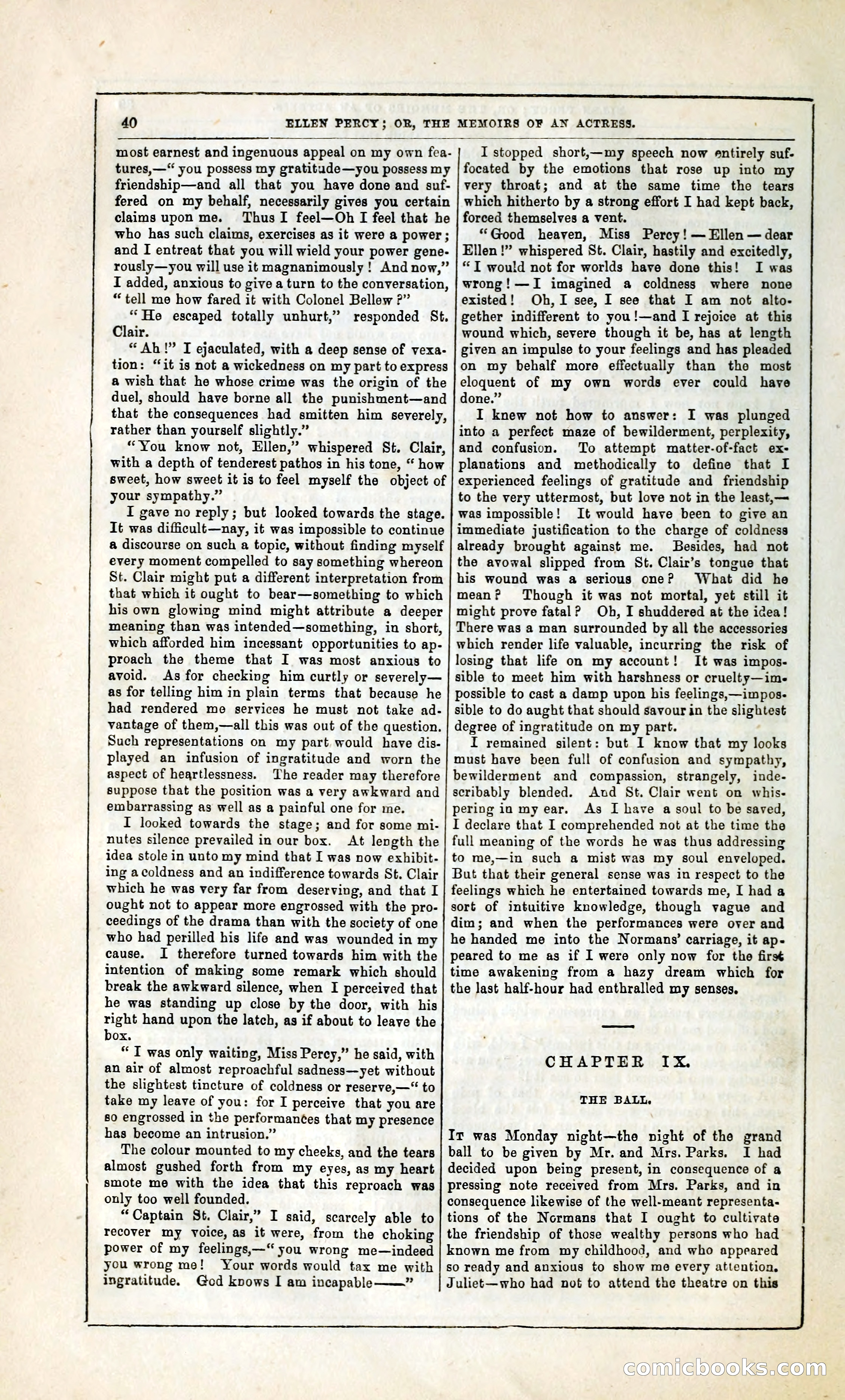
A restored page from Penny Dreadfuls, 1856. Page through the whole issue in the reader above.
📄 Transcribed text from this page (OCR, searchable)
Machine-transcribed from the original scan — historical spelling and the odd misread are preserved.
ee eee Sse 40 ELLEN PERCY; OB, THE MEMOIRS OF AN ACTRESS. most earnest and ingenuous appeal on my own fea- tures,—‘“ you possess my gratitude—you possess my friendship—and all that you have done and suf- fered on my behalf, necessarily gives you certain Thus I feel—Oh I feel that he who has such claims, exercises as it were a power; and I entreat that you will wield your power gene- rously—you will use it magnanimously! And now,” I added, anxious to give a turn to the conversation, claims upon me. “tell me how fared it with Colonel Bellew ?” ““He escaped totally unhurt,” responded St. Clair. “ Ah!” I ejaculated, with a deep sense of vexa- tion: “it is not a wickedness on my part to express a wish that he whose crime was the origin of the duel, should have borne all the punishment—and that the consequences had smitten him severely, rather than yourself slightly.” “You know not, Ellen,” whispered St. Clair, with a depth of tenderest pathos in his tone, “ how sweet, how sweet it is to feel myself the object of your sympathy.” I gave no reply; but looked towards the stage. It was difficult—nay, it was impossible to continue a discourse on such a topic, without finding myself every moment compelled to say something whereon St. Clair might put a different interpretation from that which it ought to bear—something to which his own glowing mind might attribute a deeper meaning than was intended—something, in short, which afforded him incessant opportunities to ap- proach the theme that I was most anxious to avoid. As for checking him curtly or severely— as for telling him in plain terms that because he had rendered me services he must not take ad- vantage of them,—all this was out of the question. Such representations on my part would have Gis- played an infusion of ingratitude and worn the The reader may therefore aspect of heartlessness. suppose that the position was a very awkward and embarrassing as well as a painful one for me. I looked towards the stage; and for some mi- nutes silence prevailed in our box. At length the idea stole in unto my mind that I was now exhibit- ing a coldness and an indifference towards St. Clair which he was very far from deserving, and that I ought not to appear more engrossed with the pro- ceedings of the drama than with the society of one who had perilled his life and was wounded in my cause. I therefore turned towards him with the intention of making some remark which should break the awkward silence, when I perceived that he was standing up close by the door, with his right hand upon the latch, as if about to leave the box. “I was only waiting, Miss Percy,” he said, with an air of almost reproachful sadness—yet without the slightest tincture of coldness or reserve,—“ to take my leave of you: for I perceive that you are 80 engrossed in the performantes that my presence has become an intrusion.” The colour mounted to my cheeks, and the tears almost gushed forth from my eyes, as my heart smote me with the idea that this reproach was only too well founded. “Captain St. Clair,” I said, scarcely able to recover my voice, as it were, from the choking power of my feelings,—“ you wrong me—indeed you wrong me! Your words would tax me with ingratitude. God knows I am incapable——” focated by the emotions that rose up into my very throat; and at the same time the tears which hitherto by a strong effort I had kept back, forced themselves a vent. “Good heaven, Miss Perey! — Ellen — dear Ellen!” whispered St. Clair, hastily and excitedly, “TI would not for worlds have done this! I was wrong!—I imagined a coldness where none existed! Oh, I see, I see that I am not alto- gether indifferent to you!—and I rejoice at this wound which, severe though it be, has at length given an impulse to your feelings and has pleaded on my behalf more effectually than the most eloquent of my own words ever could have done.” I knew not how to answer: I was plunged into a perfect maze of bewilderment, perplexity, and confusion. To attempt matter-of-fact ex- planations and methodically to define that I experienced feelings of gratitude and friendship to the very uttermost, but love not in the least,— was impossible! It would have been to give an immediate justification to the charge of coldness already brought against me. Besides, had not the avowal slipped from St. Clair’s tongue that his wound was a serious one? What did he mean? Though it was not mortal, yet still it might prove fatal? Ob, I shuddered at the idea! There was a man surrounded by all the accessories which render life valuable, incurring the risk of losing that life on my account! It was impos- sible to meet him with harshness or cruelty—im- possible to cast a damp upon his feelings,—impos- sible to do aught that should savour in the slightest degree of ingratitude on my part. I remained silent: but I know that my looks must have been full of confusion and sympathy, bewilderment and compassion, strangely, inde- scribably blended. And St. Clair went on whis- pering in my ear. As I have a soul to be saved, I declare that I comprehended not at the time the full meaning of the words he was thus addressing to me,—in such a mist was my soul enveloped. But that their general sense was in respect to the feelings which he entertained towards me, I had a sort of intuitive knowledge, though vague and dim; and when the performances were over and he handed me into the Normans’ carriage, it ap- peared to me as if I were only now for the firsé time awakening from a hazy dream which for the last half-hour had enthralled my senses, CHAPTER IX. THE BALL. It was Monday night—the night of the grand ball to be given by Mr. and Mrs. Parks. I had decided upon being present, in consequence of a pressing note received from Mrs. Parks, and in consequence likewise of the well-meant representa- tions of the Normans that I ought to cultivate the friendship of those wealthy persons who had known me from my childhood, and who appeared so ready and anxious to show me every attention. Juliet—who had not to attend the theatre on this I stopped short,—my speech now entirely suf- CORNICE OOKS.COm