
Penny Dreadfuls, 1856 · page 56 of 399
Ellen Percy; or, The Memoirs of an Actress — page 56: what you’re looking at
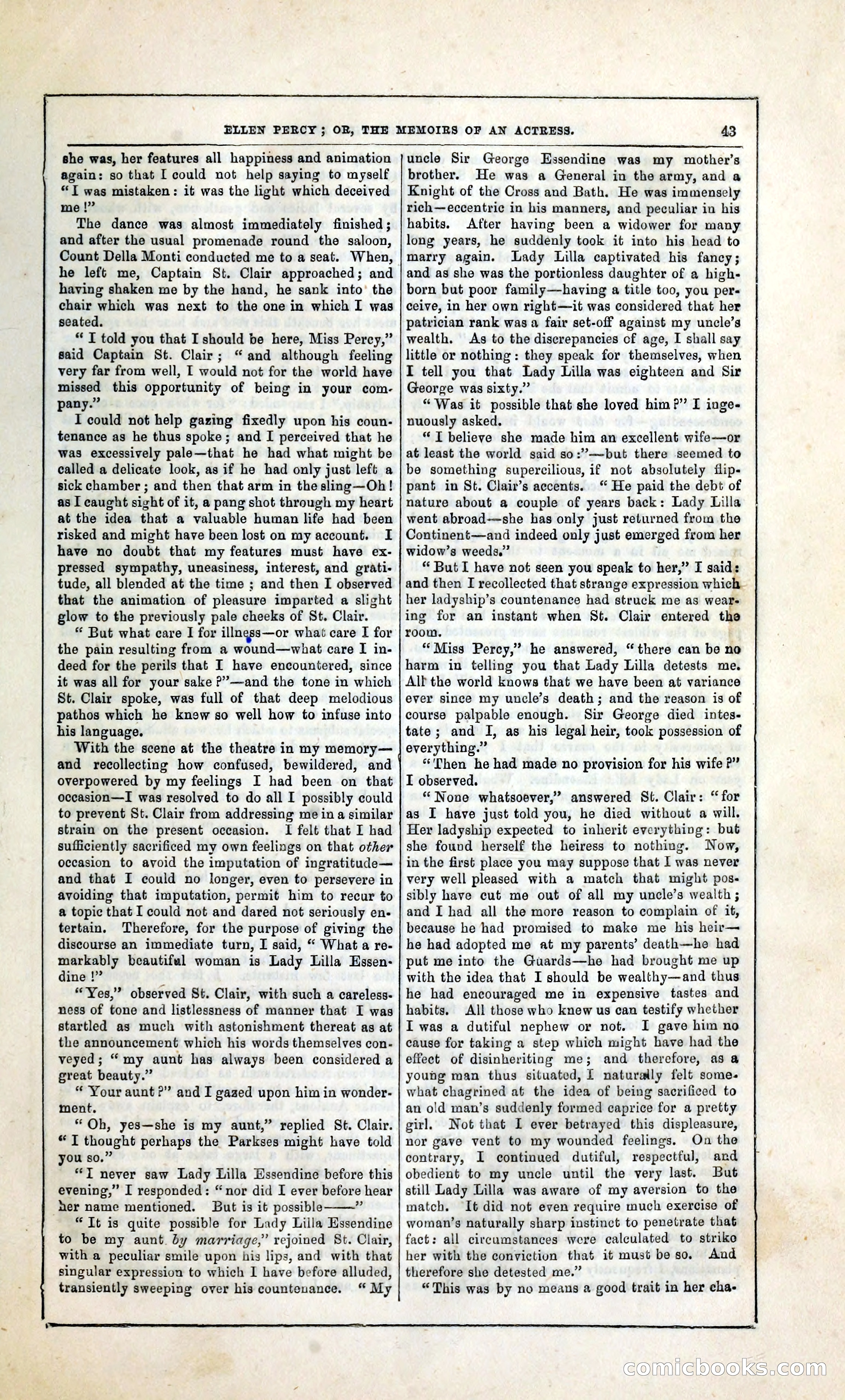
A restored page from Penny Dreadfuls, 1856. Page through the whole issue in the reader above.
📄 Transcribed text from this page (OCR, searchable)
Machine-transcribed from the original scan — historical spelling and the odd misread are preserved.
ELLEN PERCY ; OR, THE MEMOIRS OF AN ACTRESS. she was, her features all happiness and animation again: so that [ could not help saying to myself “T was mistaken: it was the light which deceived me! 1? The dance was almost immediately finished ; and after the usual promenade round the saloon, Count Della Monti conducted me to a seat. When, he left me, Captain St. Clair approached; and having shaken me by the hand, he sank into’ the chair which was next to the one in which I was seated. “I told you that I should be here, Miss Percy,” said Captain St. Clair; “ and although feeling very far from well, I would not for the world haye missed this opportunity of being in your com- pany. I could not help gazing fixedly upon his coun- tenance as he thus spoke; and I perceived that he was excessively pale—that he had what might be called a delicate look, as if he had only just ‘left a sick chamber ; and then that arm in the sling—Oh! as I caught sight of it, a pang shot through my heart at the idea that a valuable human life had been risked and might have been lost on my account. I have no doubt that my features must have ex- pressed sympathy, uneasiness, interest, and grati- tude, all blended at the time ; and then I observed that the animation of pleasure imparted a slight glow to the previously pale cheeks of St. Clair. “ But what care I for illness—or what care I for the pain resulting from a wound—what care I in- deed for the perils that I have encountered, since it was all for your sake P’—and the tone in which St. Clair spoke, was full of that deep melodious pathos which he know so well how to infuse into his language. With the scene at the theatre in my memory— and recollecting how confused, bewildered, and overpowered by my feelings I had been on that occasion—I was resolved to do all I possibly could to prevent St. Clair from addressing me in a similar strain on the present occasion. I felt that I had sufficiently sacrificed my own feelings on that other occasion to avoid the imputation of ingratitude— and that I could no longer, even to persevere in avoiding that imputation, permit him to recur to a topic that I could not and dared not seriously en- tertain. Therefore, for the purpose of giving the discourse an immediate turn, I said, “ What a re- markably beautiful woman is Lady Lilla Essen- dine !” “Yes,” observed St. Clair, with such a careless- ness of tone and listlessness of manner that I was startled as much with astonishment thereat as at the announcement which his words themselves con- veyed; “my aunt has always been considered a great beauty.” “ Your aunt ?” and I gazed upon him in wonder- ment. * Oh, yes—she is my aunt,” replied St. Clair. OF thought perhaps the Parkses might have told you so.” sat never saw Lady Lilla Hssendine before this evening,” I responded: “nor did I ever before hear her name mentioned. But is it possible af “It is quite possible for Lady Lilla Essendine to be my aunt. by marriage,’ rejoined St. Clair, with a peculiar smile upon his lips, and with that singular expression to which I have before alluded, transiently sweeping over his counteuance. “ My 43 uncle Sir George Essendine was my mother’s brother. He was a General in the army, and a Knight of the Cross and Bath. He was immensely rich—eccentric in his manners, and peculiar in his habits. After having been a widower for many long years, he suddenly took it into his head to marry again. Lady Lilla captivated his fancy; and as she was the portionless daughter of a high- born but poor family—having a title too, you pers ceive, in her own right—it was considered that her patrician rank was a fair set-off against my uncle’s wealth. As to the discrepancies cf age, I shall say little or nothing : they speak for themselves, when I tell you that Lady Lilla was eighteen and Sir George was sixty.” “Was it possible that she loved him?” I inge- nuously asked. “TI believe she made him an excellent wife—or at least the world said so:”’——but there seemed to be something supercilious, if not absolutely flip- pant in St. Clair’s accents. “ He paid the debt of nature about a couple of years back: Lady Lilla went abroad--she has only just returned from the Continent—and indeed only just emerged from her widow’s weeds.” “ But I have not seen you speak to her,” I said: and then I recollected that strange expression which her ladyship’s countenance had struck me as wears ing for an instant when St. Clair entered the room. “Miss Percy,” he answered, “there can be no harm in telling you that Lady Lilla detests me. Alf the world knows that we have been at variance ever since my uncle’s death; and the reason is of course palpable enough. Sir George died intes- tate; and I, as his legal heir, took possession of everything.” “Then he had made no provision for his wife P” I observed. “None whatsoever,’ answered St. Clair: “for as I have just told you, he died without a will. Her ladyship expected to inherit everything: but she found herself the heiress to nothing. Now, in the first place you may suppose that 1 was never very well pleased with a match that might pos- sibly have cut me out of all my uncle’s wealth ; and I had all the more reason to complain of it, because he had promised to make me his heir— he had adopted me at my parents’ death—he had put me into the Guards—he had brought me up with the idea that I should be wealthy—and thus he had encouraged me in expensive tastes and habits. All those who knew us can testify whether I was a dutiful nephew or not. I gave him no cause for taking a step which might have had the effect of disinheriting me; and therefore, as a young man thus situated, I naturally felt some- what chagrined at the idea of being sacrificed to an old man’s suddenly formed caprice for a pretty girl, Not that I ever betrayed this displeasure, nor gave vent to my wounded feelings. On the contrary, I continued dutiful, respectful, and obedient to my uncle until the very last. But still Lady Lilla was aware of my aversion to the match. It did not even require much exercise of woman’s naturally sharp instinct to penetrate that fact: all circumstances were calculated to striko her with the conviction that it must be so. And therefore she detested me.’ “This was by no means a good trait in her cha- CORNIELA@QO 6S Colm