
Penny Dreadfuls, 1856 · page 69 of 399
Ellen Percy; or, The Memoirs of an Actress — page 69: what you’re looking at
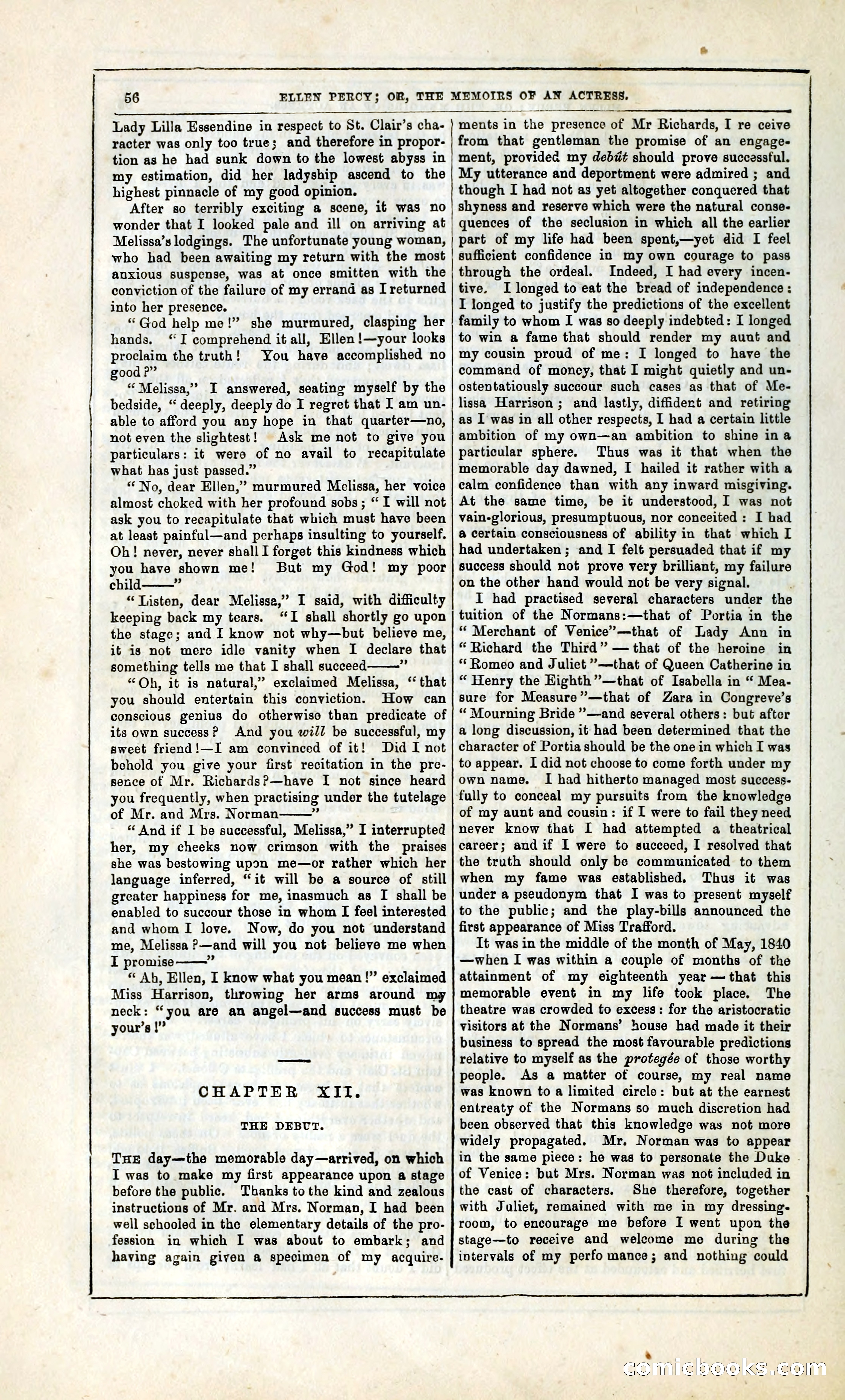
A restored page from Penny Dreadfuls, 1856. Page through the whole issue in the reader above.
📄 Transcribed text from this page (OCR, searchable)
Machine-transcribed from the original scan — historical spelling and the odd misread are preserved.
a a rr rc SR A Sse I 56 Lady Lilla Essendine in respect to St. Clair’s cha- racter was only too true; and therefore in propor- tion as he had sunk down to the lowest abyss in my estimation, did her ladyship ascend to the highest pinnacle of my good opinion. After so terribly exciting a scene, if was no wonder that I looked pale and ill on arriving at Melissa’s lodgings. The unfortunate young woman, who had been awaiting my return with the most anxious suspense, was at once smitten with the conviction of the failure of my errand as I returned into her presence. “God help me!” she murmured, clasping her hands. “JI comprehend it all, Ellen!—your looks proclaim the truth! You have accomplished no good ?” “ Melissa,” I answered, seating myself by the bedside, “‘ deeply, deeply do I regret that I am un- able to afford you any hope in that quarter—no, not even the slightest! Ask me not to give you particulars: it were of no avail to recapitulate what has just passed.” “No, dear Ellen,’ murmured Melissa, her voice almost choked with her profound sobs; “I will not ask you to recapitulate that which must have been at least painful—and perhaps insulting to yourself. Oh! never, never shall I forget this kindness which you have shown me! But my God! my poor child 5 “‘Tiisten, dear Melissa,” I said, with difficulty keeping back my tears. “I shall shortly go upon the stage; and I know not why—but believe me, it is not mere idle vanity when I declare that something tells me that I shall succeed $ “Oh, it is natural,’ exclaimed Melissa, ‘that you should entertain this conviction. How can conscious genius do otherwise than predicate of its own success? And you will be successful, my sweet friend!—I am convinced of it! Did 1 not behold you give your first recitation in the pre- sence of Mr. Richards?—have I not since heard you frequently, when practising under the tutelage of Mr. and Mrs. Norman ¥ “ And if I be successful, Melissa,” I interrupted her, my cheeks now crimson with the praises she was bestowing upon me—or rather which her language inferred, “it will be a source of still greater happiness for me, inasmuch as I shall be enabled to succour those in whom I feel interested and whom I love. Now, do you not understand me, Melissa P—and will you not believe me when I promise 4 “ Ah, Ellen, I know what you mean!” exclaimed Miss Harrison, throwing her arms around my neck: “you are an angel—and success must be your’s |” CHAPTER XII. THE DEBUT. THE day—the memorable day—arrived, on which I was to make my first appearance upon a stage before the public. Thanks to the kind and zealous instructions of Mr. and Mrs. Norman, I had been well schooled in the elementary details of the pro- fession in which I was about to embark; and having again given @ specimen of my acquire- ELLEN PERCY; OR, THE MEMOIRS OF AN ACTRESS, ——_—_— ments in the presence of Mr Richards, I re ceive from that gentleman the promise of an engage- ment, provided my debét should prove successful. My utterance and deportment were admired ; and though I had not as yet altogether conquered that shyness and reserve which were the natural conse- quences of the seclusion in which all the earlier part of my life had been spent,—yet did I feel sufficient confidence in my own courage to pass through the ordeal. Indeed, I had every incen- tive. I longed to eat the bread of independence : I longed to justify the predictions of the excellent family to whom I was so deeply indebted: I longed to win a fame that should render my aunt and my cousin proud of me: I longed to have the commard of money, that I might quietly and un- ostentatiously succour such cases as that of Me- lissa Harrison ; and lastly, difident and retiring as I was in all other respects, I had a certain little ambition of my own—an ambition to shine ina particular sphere. Thus was it that when the memorable day dawned, I hailed it rather witha calm confidence than with any inward misgiving. At the same time, be it understood, I was not vain-glorious, presumptuous, nor conceited: I had @ certain consciousness of ability in that which I had undertaken ; and I felt persuaded that if my success should not prove very brilliant, my failure on the other hand would not be very signal. I had practised several characters under the tuition of the Normans:—that of Portia in the “ Merchant of Venice’—that of Lady Ann in “Richard the Third” — that of the heroine in * Romeo and Juliet ”—that of Queen Catherine in “ Henry the Eighth ”—that of Isabella in “ Mea. sure for Measure”—that of Zara in Congreve’s “ Mourning Bride ”—and several others: but after a long discussion, it had been determined that the character of Portia should be the one in which I was to appear. I did not choose to come forth under my own name. I had hitherto managed most success- fully to conceal my pursuits from the knowledge of my aunt and cousin: if I were to fail they need never know that I had attempted a theatrical career; and if I were to succeed, I resolved that the truth should only be communicated to them when my fame was established. Thus it was under a pseudonym that I was to present myself to the public; and the play-bills announced the first appearance of Miss Trafford. It was in the middle of the month of May, 1840 —when I was within a couple of months of the attainment of my eighteenth year —that this memorable event in my life took place. The theatre was crowded to excess: for the aristocratic visitors at the Normans’ house had made it their business to spread the most favourable predictions relative to myself as the protegée of those worthy people. As a matter of course, my real name was known to a limited circle: but at the earnest entreaty of the Normans so much discretion had been observed that this knowledge was not more widely propagated. Mr. Norman was to appear in the same piece: he was to personate the Duke - of Venice: but Mrs. Norman was not included in the cast of characters. She therefore, together with Juliet, remained with me in my dressing- room, to encourage me before I went upon the stage—to receive and welcome me during the intervals of my perfo mance; and nothing could . CONME DOO KS Com