
Penny Dreadfuls, 1856 · page 71 of 399
Ellen Percy; or, The Memoirs of an Actress — page 71: what you’re looking at
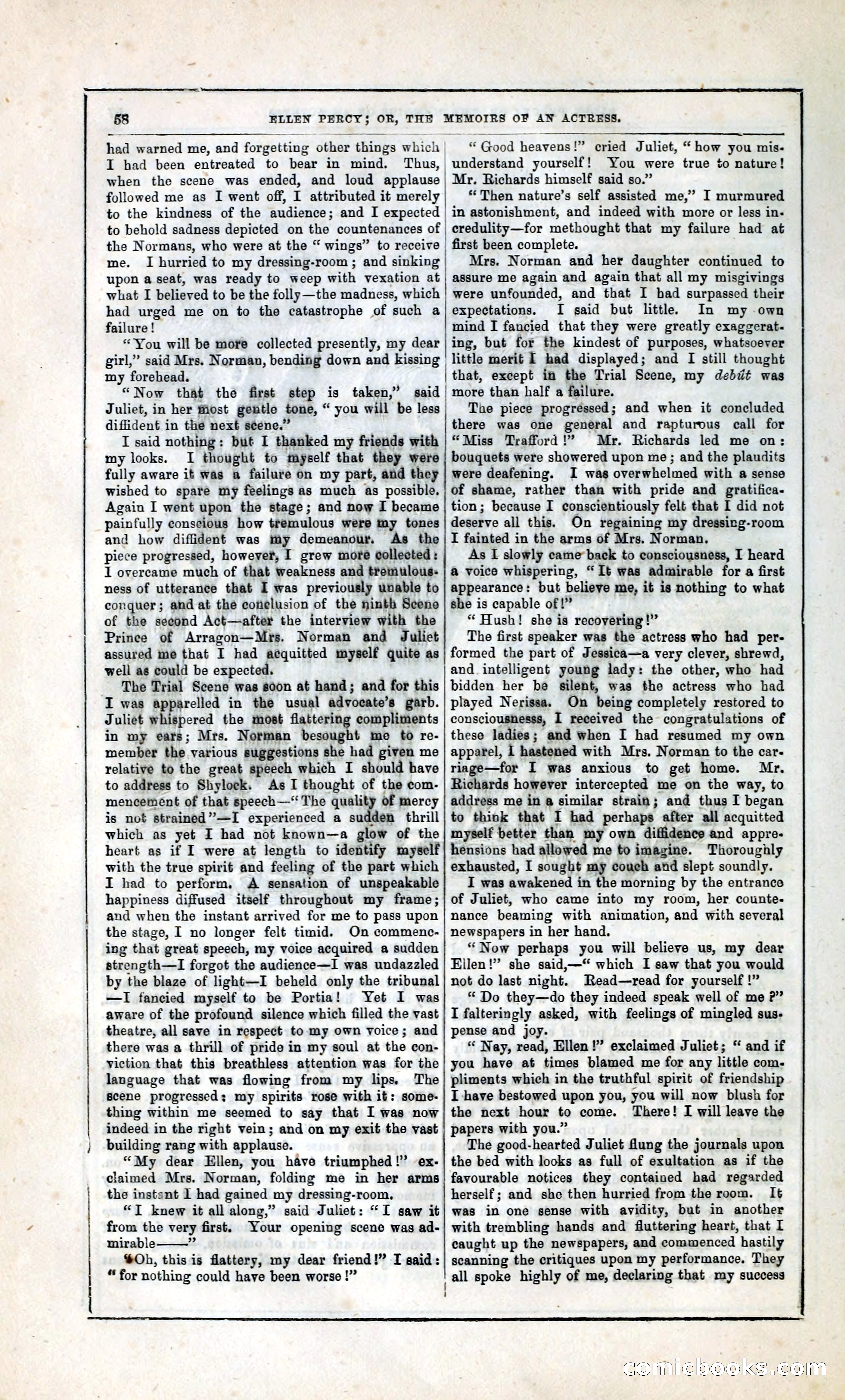
A restored page from Penny Dreadfuls, 1856. Page through the whole issue in the reader above.
📄 Transcribed text from this page (OCR, searchable)
Machine-transcribed from the original scan — historical spelling and the odd misread are preserved.
. LT ~_ LL ems + oe ae ee 58 ELLEN PERCY; OR, THE MEMOIRS OF AN ACTRESS. had warned me, and forgetting other things which I had been entreated to bear in mind. Thus, when the scene was ended, and loud applause followed me as I went off, I attributed it merely to the kindness of the audience; and I expected to behold sadness depicted on the countenances of the Normans, who were at the “ wings” to receive me. I hurried to my dressing-room ; and sinking upon a seat, was ready to weep with vexation at what I believed to be the folly—the madness, which had urged me on to the catastrophe of such a failure ! “You will be more collected presently, my dear girl,” said Mrs. Norman, bending down and kissing my forehead. “Now that the first step is taken,” said Juliet, in her fost gentle tone, “ you will be less diffident in the next s¢ene.” I said nothing: but I thanked my friends with my looks. I thought to myself that they were fully aware it was a failure on my part, and they wished to spare my feelings as much as possible. Again I went upon the stage; and now I became painfully conscious how tremulous were my tones and how diffident was my demeanour. As the piece progressed, however, I grew more collected: I overcame much of that weakness and tremulous- ness of utterance that I was previously unable to conquer; and at the cofielusion of the ninth Seene of the second Act—after the interview with the Prinee of Arragon—Mrs. Norman and Juliet assured me that I had acquitted myself quite as well as could be expected. The Trial Scene was soon at hand; and for this I was apparelled in the usual advocate’s garb. Juliet whispered the most flattering compliments in my eats; Mrs. Norman besought me to re- member the various suggestions she had given me relative to the great speech which I should have to address to Shylock. As I thought of the com- mencemeént of that speech—‘‘ The quality of mercy is not strained” —I experienced a sudden thrill which as yet I had not known—a glow of the heart as if I were at length to identify myself with the true spirit and feeling of the part which I had to perform. A sensation of unspeakable happiness diffused itself throughout my frame; and when the instant arrived for me to pass upon the stage, I no longer felt timid. On commenc- ing that great speech, my voice acquired a sudden strength—I forgot the audience—I was undazzled by the blaze of light—I beheld only the tribunal —I fancied myself to be Portia! Yet I was aware of the profound silence which filled the vast theatre, all save in respect to my own voice; and there was a thrill of pride in my soul at the con- viction that this breathless attention was for the language that was flowing from my lips. The scene progressed; my spirits rose with 16: some- thing within me seemed to say that I was now indeed in the right vein; and on my exit the vast building rang with applause. “My dear Ellen, you have triumphed!” ex- claimed Mrs. Norman, folding me in her arms the instant I had gained my dressing-room. “TI knew it all along,” said Juliet: “I saw it from the very first. Your opening scene was ad- mirable 2 $Oh, this is flattery, my dear friend!” I said: “ for nothing could have been worse !” “ Good heavens!” cried Juliet, “ how you mis- understand yourself! You were true to nature! Mr. Richards himself said so.” ** Then nature’s self assisted me,” I murmured in astonishment, and indeed with more or less in- credulity—for methought that my failure had at first been complete. Mrs. Norman and her daughter continued to assure me again and again that all my misgivings were unfounded, and that I had surpassed their expectations. I said but littl. In my -own mind I fancied that they were greatly exaggerat- ing, but for the kindest of purposes, whatsoever little merit I had displayed; and I still thought that, except im the Trial Scene, my debit was more than half a failure. The piece progressed; and when it concluded there was one general and rapturous call for “Miss Trafford!’ Mr. Richards led me on: bouquets were showered upon me; and the plaudits were deafening. I was overwhelmed with a sense of shame, rather than with pride and gratifica- tion; because I conscientiously felt that I did not deserve all this. On regaining my dressirg-room I fainted in the arms of Mrs. Norman. As I slowly came back to consciousness, I heard a voice whispering, “It was admirable for a first appearance: but believe me, it is nothing to what she is capable of!” “ Hush! she is recovering!” The first speaker was the actress who had per- formed the part of Jessica—a very clever, shrewd, and intelligent young lady: the other, who had bidden her be silent, was the actress who had played Nerissa. On being completely restored to consciousnesss, I received the congratulations of these ladies; and when I had resumed my own apparel, I hastened with Mrs. Norman to the car- riage—for I was anxious to get home. Mr. Richards however intercepted me on the way, to address me in a similar strain; and thus I began to think that I had perhaps after all acquitted myself better than my own diffidence and appre- hensions had allowed me to imagine. Thoroughly exhausted, I sought my couch and slept soundly. I was awakened in the morning by the entrance of Juliet, who came into my room, her counte- nance beaming with animation, and with several newspapers in her hand. ‘Now perhaps you will believe us, my dear Ellen!” she said,—“ which I saw that you would not do last night. Read—read for yourself !” * Do they—do they indeed speak well of me ?” I falteringly asked, with feelings of mingled sus- pense and joy. * Nay, read, Ellen!” exclaimed Juliet; “ and if you have at times blamed me for any little com- pliments which in the truthful spirit of friendship I have bestowed upon you, you will now blush for the next hour to come. There! I will leave the papers with you.” The good-hearted Juliet flung the journals upon the bed with looks as full of exultation as if the favourable notices they contained had regarded herself; and she then hurried from the room. It was in one sense with avidity, but in another with trembling hands and fluttering heart, that I caught up the newspapers, and commenced hastily scanning the critiques upon my performance. They all spoke highly of me, declaring that my success CONNIE OOKS com