
Penny Dreadfuls, 1856 · page 73 of 399
Ellen Percy; or, The Memoirs of an Actress — page 73: what you’re looking at
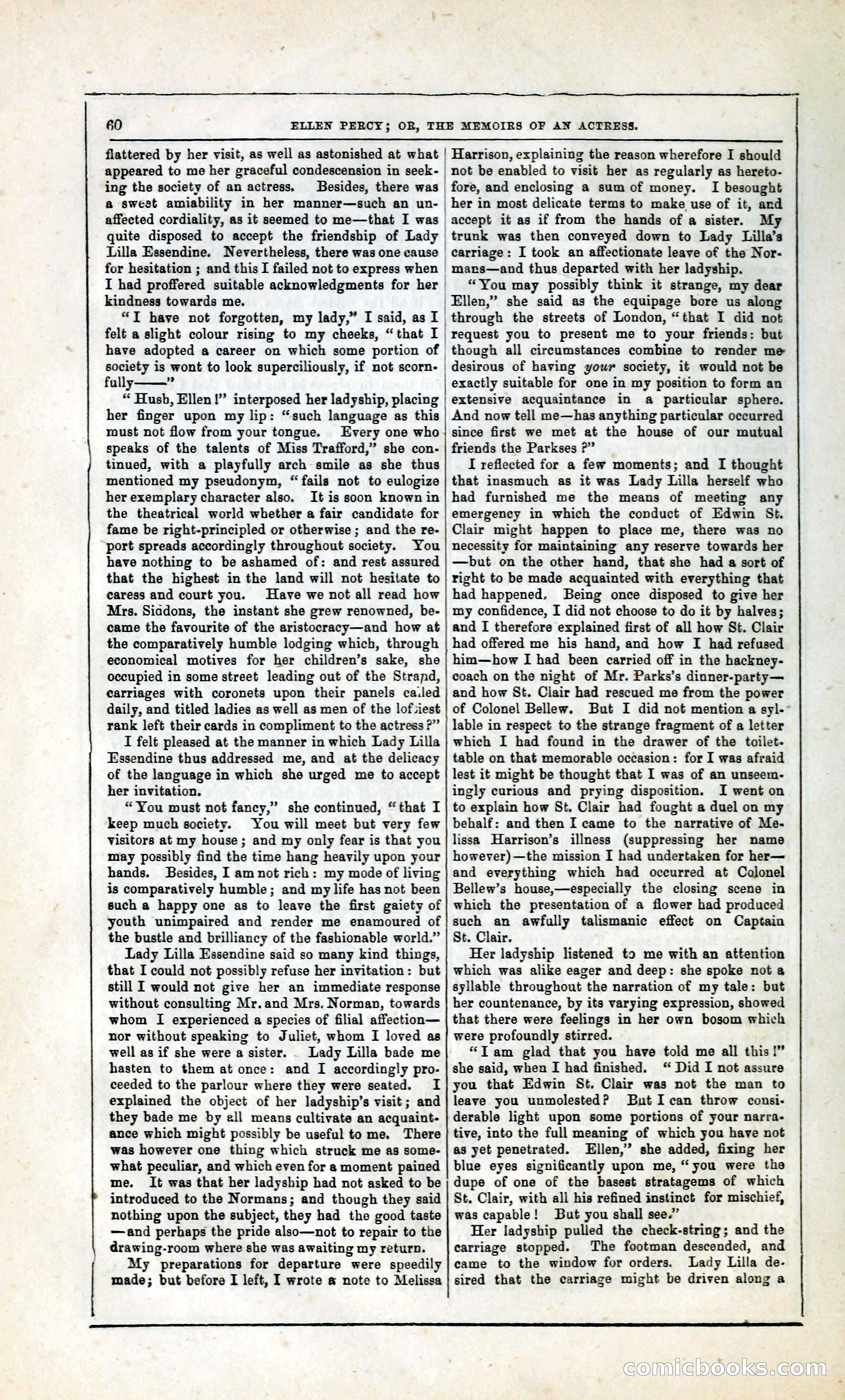
A restored page from Penny Dreadfuls, 1856. Page through the whole issue in the reader above.
📄 Transcribed text from this page (OCR, searchable)
Machine-transcribed from the original scan — historical spelling and the odd misread are preserved.
60 ELLEN PERCY; OR, THE MEMOIRS OF AN ACTRESS. flattered by her visit, as well as astonished at what appeared to me her graceful condescension in seek- ing the society of an actress. Besides, there was a swest amiability in her manner—such an un- affected cordiality, as it seemed to me—that I was quite disposed to accept the friendship of Lady Lilla Essendine. Nevertheless, there was one cause for hesitation ; and this I failed not to express when I had proffered suitable acknowledgments for her | kindness towards me. “T have not forgotten, my lady,” I said, as I felt a slight colour rising to my cheeks, “that I have adopted a career on which some portion of society is wont to look superciliously, if not scorn- fully 1 | Harrison, explaining the reason wherefore I should not be enabled to visit her as regularly as hereto- fore, and enclosing a sum of money. I besought _her in most delicate terms to make use of it, and accept it as if from the hands of a sister. My trunk was then conveyed down to Lady Lilla’s carriage: I took an affectionate leave of the Nor- -mars—and thus departed with her ladyship. | “You may possibly think it strange, my dear Ellen,” she said as the equipage bore us along through the streets of London, “that I did not request you to present me to your friends: but though all circumstances combine to render me desirous of having your society, it would not be exactly suitable for one in my position to form an “ Hush, Ellen!’ interposed her ladyship, placing | extensive acquaintance in a particular sphere. her finger upon my lip: “such language as this must not flow from your tongue. Every one who speaks of the talents of Miss Trafford,” she con- tinued, with a playfully arch smile as she thus mentioned my pseudonym, “fails not to eulogize her exemplary character also. It is soon known in the theatrical world whether a fair candidate for fame be right-principled or otherwise ; and the re- ‘port spreads accordingly throughout society. You have nothing to be ashamed of: and rest assured that the highest in the land will not hesitate to caress and court you. Have we not all read how Mrs. Siadons, the instant she grew renowned, be- came the favourite of the aristocracy—and how at the comparatively humble lodging which, through economical motives for her children’s sake, she occupied in some street leading out of the Strand, carriages with coronets upon their panels ca.led daily, and titled ladies as well as men of the lof:iest rank left their cards in compliment to the actress ?” I felt pleased at the manner in which Lady Lilla Essendine thus addressed me, and at the delicacy of the language in which she urged me to accept her invitation. “You must not fancy,” she continued, “that I keep much society. You will meet but very few visitors at my house; and my only fear is that you may possibly find the time hang heavily upon your hands. Besides, I am not rich: my mode of living is comparatively humble; and my life has not been such a happy one as to leave the first gaiety of youth unimpaired and render me enamoured of the bustle and brilliancy of the fashionable world.” Lady Lilla Essendine said so many kind things, that I could not possibly refuse her invitation: but still I would not give her an immediate response without consulting Mr.and Mrs. Norman, towards whom I experienced a species of filial affection— nor without speaking to Juliet, whom I loved as well as if she were a sister. _ Lady Lilla bade me hasten to them at once: and I accordingly pro- ceeded to the parlour where they were seated. I explained the object of her ladyship’s visit; and they bade me by ell means cultivate an acquaint- ance which might possibly be useful to me. There was however one thing which struck me as some- what peculiar, and which even for a moment pained me. It was that her ladysbip had not asked to be introduced to the Normans; and though they said nothing upon the subject, they had the good taste —and perhaps the pride also—not to repair to the drawing-room where she was awaiting my return. My preparations for departure were speedily made; but before I left, I wrote a note to Melissa And now tell me—has anything particular occurred since first we met at the house of our mutual friends the Parkses P” I reflected for a few moments; and I thought that inasmuch as it was Lady Lilla herself who had furnished me the means of meeting any emergency in which the conduct of Edwin St. Clair might happen to place me, there was no necessity for maintaining any reserve towards her —but on the other hand, that she had a sort of right to be made acquainted with everything that had happened. Being once disposed to give her my confidence, I did not choose to do it by halves; and I therefore explained first of all how St. Clair had offered me his hand, and how I had refused him—how I had been carried off in the hackney- coach on the night of Mr. Parks’s dinner-party— and how St. Clair had rescued me from the power of Colonel Bellew. But I did not mention a syl-~ lable in respect to the strange fragment of a letter which I had found in the drawer of the toilet- table on that memorable occasion: for I was afraid lest it might be thought that I was of an unseem- ingly curious and prying disposition. I went on to explain how St. Clair had fought a duel on my behalf: and then I came to the narrative of Me- lissa Harrison’s illness (suppressing her name however)—the mission I had undertaken for her— and everything which had occurred at Colonel Bellew’s house,—especially the closing scene in which the presentation of a flower had produced such an awfully talismanic effect on Captain St. Clair. Her ladyship listened to me with an attention which was alike eager and deep: she spoke nota syllable throughout the narration of my tale: but her countenance, by its varying expression, showed that there were feelings in her own bosom which were profoundly stirred. “Tam glad that you have told me all this!” she said, when I had finished. ‘“ Did I not assure you that Edwin St. Clair was not the man to leave you unmolested? ButIcan throw consi- derable light upon some portions of your narra- tive, into the full meaning of which you have not as yet penetrated. Ellen,’ she added, fixing her blue eyes significantly upon me, “you were the dupe of one of the basest stratagems of which St. Clair, with all his refined instinct for mischief, was capable! But you shall see.’ Her ladyship pulled the check-string; and the carriage stopped. The footman descended, and came to the window for orders. Lady Lilla de- sired that the carriace might be driven along a : , ‘ = CONNIE OOKS a i ee Eom